A Dialogue Concerning Oratory
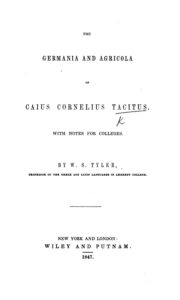
A Dialogue Concerning Oratory, originally Dialogus de Oratoribus, is a Latin prose work attributed to the Roman historian Cornelius Tacitus, who lived from approximately 56 to 120 AD. The work is one of the four surviving short works of Tacitus alongside the Agricola, the Germania, and the Annals and Histories that form the bulk of his historical writing. The Dialogus is the most stylistically distinctive of the short works, written in a polished Ciceronian Latin substantially different from the compressed and famously difficult Latin of the major historical works.
The dialogue is set in approximately 75 AD and presents a discussion among four characters who meet at the home of the poet Curiatius Maternus. The central question they discuss is why Roman oratory had declined from its great age in the late Republic to the apparently lesser performance of contemporary Roman public speaking. The four speakers offer different answers. One argues that the decline is a matter of education and rhetorical training, with the contemporary schools producing inferior students. Another argues that the cause is political, with the loss of republican liberty under the Principate removing the great causes that had previously inspired great oratory. A third defends contemporary practice. The fourth occupies a more synthesising position.
The dialogue belongs to the substantial body of late first century Roman writing that took up the question of how the great Roman cultural achievements of the late Republic could be understood and continued under the very different political conditions of the Principate. The same question runs through much of the broader Roman literature of the period including the work of Quintilian, the younger Pliny, and Tacitus himself in his historical works.
The Dialogus is the shortest of Tacitus’s works and runs only about a hundred pages in standard editions. It has been particularly studied as a primary document for understanding Roman attitudes toward the relationship between political liberty and cultural achievement, a question that has been important to political theorists from Machiavelli through the various republican traditions of the early modern and modern periods.
For readers of classical Roman literature and political thought, the Dialogus is essential reading. The standard English translations include those in the Loeb Classical Library and various individual scholarly editions. It pairs naturally with Tacitus’s other works and with Quintilian’s Institutio Oratoria.
About the Author
Download free books by Cornelius Tacitus on BDeBooks. Read Cornelius Tacitus’s works online or download as PDF/EPUB · part of our growing free eBook collection.
See all books by Cornelius Tacitus →