A Discourse On Self-Limited Diseases
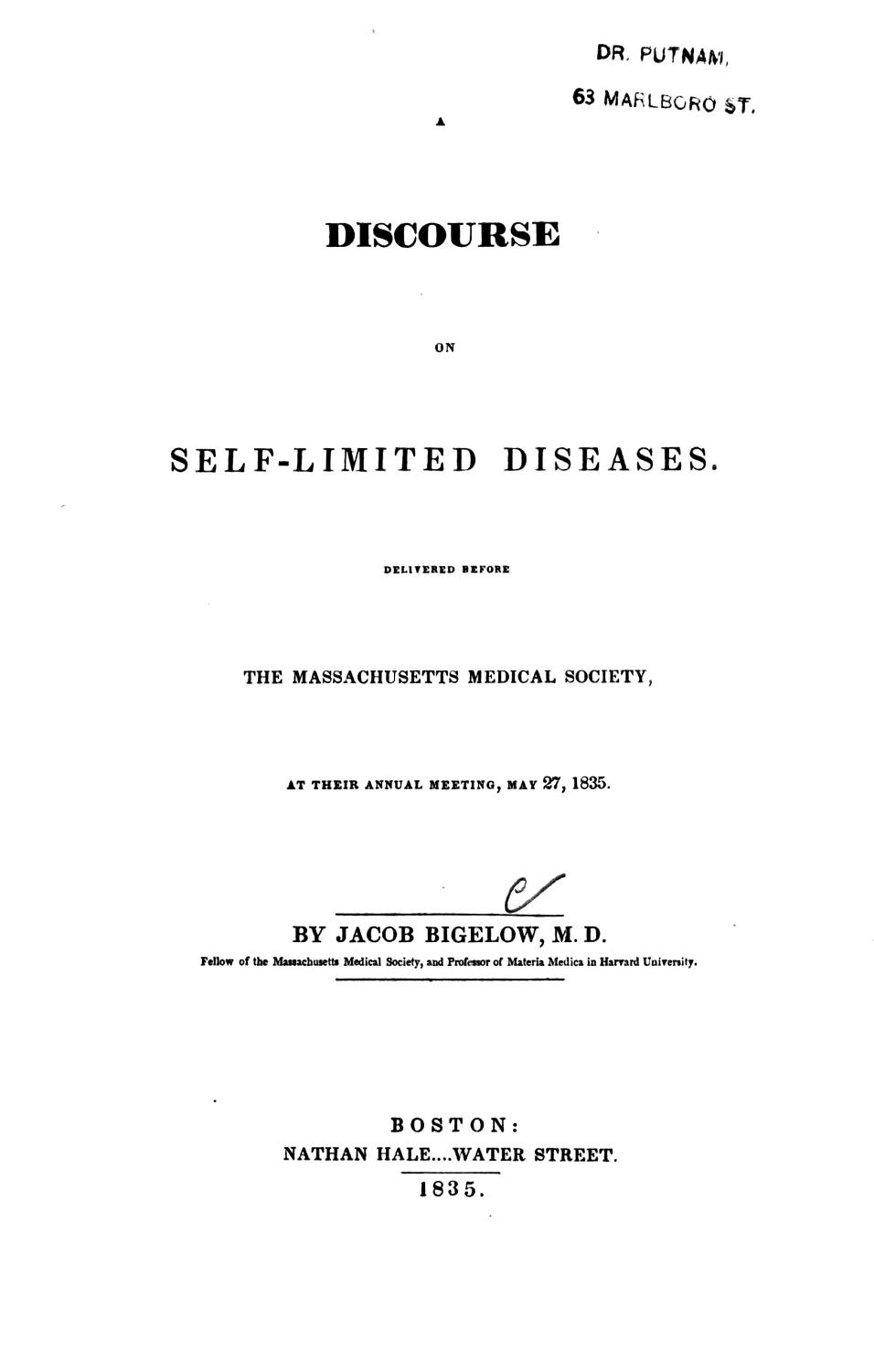
A Discourse on Self Limited Diseases is a substantial medical address by Jacob Bigelow, the American physician and Harvard medical professor who lived from 1786 to 1879 and who was one of the most influential American medical figures of the nineteenth century. The discourse was delivered in 1835 at the annual meeting of the Massachusetts Medical Society and was subsequently published and widely circulated through the American and international medical world.
Bigelow’s central argument in the discourse was substantial and was one of the most important early American contributions to what became known as therapeutic nihilism or therapeutic scepticism. He argued that substantial numbers of diseases were what he called self limited, meaning that they would run their natural course and resolve themselves whether or not the patient received any medical treatment, and that the substantial active medical interventions that contemporary medical practice favoured were therefore often either useless or actively harmful in such cases.
The argument was substantially radical for the period. American and European medical practice in the early nineteenth century was substantially based on what was called heroic medicine, the substantial use of aggressive interventions including substantial bleeding, substantial purging with calomel and other mercury compounds, blistering, and various other substantial interventions that were believed to act directly on the disease process. Bigelow’s argument that substantial numbers of conditions did not require these interventions and would resolve on their own if left alone was substantially at odds with the prevailing medical orthodoxy and contributed to the substantial mid nineteenth century shift toward less aggressive medical practice.
The discourse was substantially influential on the developing American medical profession across the middle decades of the nineteenth century. Oliver Wendell Holmes, who was Bigelow’s substantial younger contemporary at the Harvard Medical School, took up and substantially extended the therapeutic scepticism that Bigelow had developed, and the broader American medical profession across the mid nineteenth century moved substantially toward a more conservative therapeutic approach that recognised the limits of medical intervention.
Bigelow’s broader medical career was substantial. He helped establish the Massachusetts General Hospital, developed substantial work on materia medica that contributed to the standardisation of American pharmaceutical practice, and served as one of the substantial Harvard Medical School faculty across decades of substantial American medical development.
The discourse is essential reading for historians of nineteenth century American medicine and of the broader history of therapeutic theory. It pairs naturally with Holmes’s medical essays.