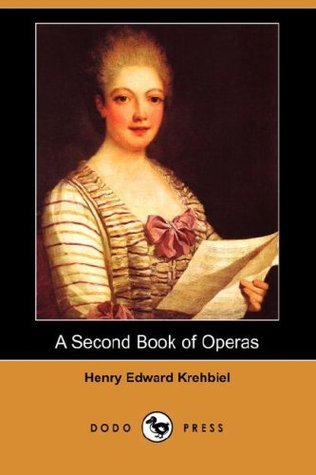
A Second Book Of Operas
A Second Book of Operas is a guide to the standard operatic repertoire by Henry Edward Krehbiel, published in 1917 as a companion volume to his earlier and similar A Book of Operas. Krehbiel, who lived from 1854 to 1923, was the chief music critic of the New York Tribune for forty three years and was the most influential American music critic of his generation. His operatic guides were widely used by American audiences who were learning to follow opera in an era when the Metropolitan Opera was establishing itself as a major international house.
The book provides essentially what the title suggests, a second selection of operas not covered in the earlier volume, presented in the same accessible format. Each opera receives a chapter of perhaps thirty pages, covering the historical background to its composition, a detailed account of the plot, descriptions of the major musical numbers with attention to particular passages a listener might want to follow, and brief biographical information about the composer and the most famous performers of the work. The operas covered in this volume include several pieces that had recently entered the standard repertoire in the years before the First World War, including works by Puccini, Strauss, and Debussy that were still relatively new for American audiences.
Krehbiel was a serious scholar of opera as well as a working critic. He had translated the standard German history of music by Ambros and had produced his own studies of African American folk music and of the Wagner operas. The opera guides reflect this scholarship. The musical descriptions are technically informed without being incomprehensible to the general reader, and the historical material is reliable. Krehbiel also brings to the books his particular taste, which was conservative in the sense that he was most enthusiastic about the German Italian tradition from Mozart through Wagner and Verdi and was generally less sympathetic to the newer Russian and French composers.
The book runs about four hundred pages and is best read by selecting individual operas as they come up in performance schedules or recordings. For readers interested in early twentieth century American music criticism and in the way opera was being presented to American audiences during the formative period of the Metropolitan Opera, this is essential material. It pairs naturally with the earlier A Book of Operas.
About the Author
Read and download 2 free books by Henry Edward Krehbiel on BDeBooks. Browse the complete collection of Henry Edward Krehbiel’s works available as free PDF and EPUB downloads. Discover novels, fiction, and other writings by Henry Edward Krehbiel in our online eBook library.
See all books by Henry Edward Krehbiel →