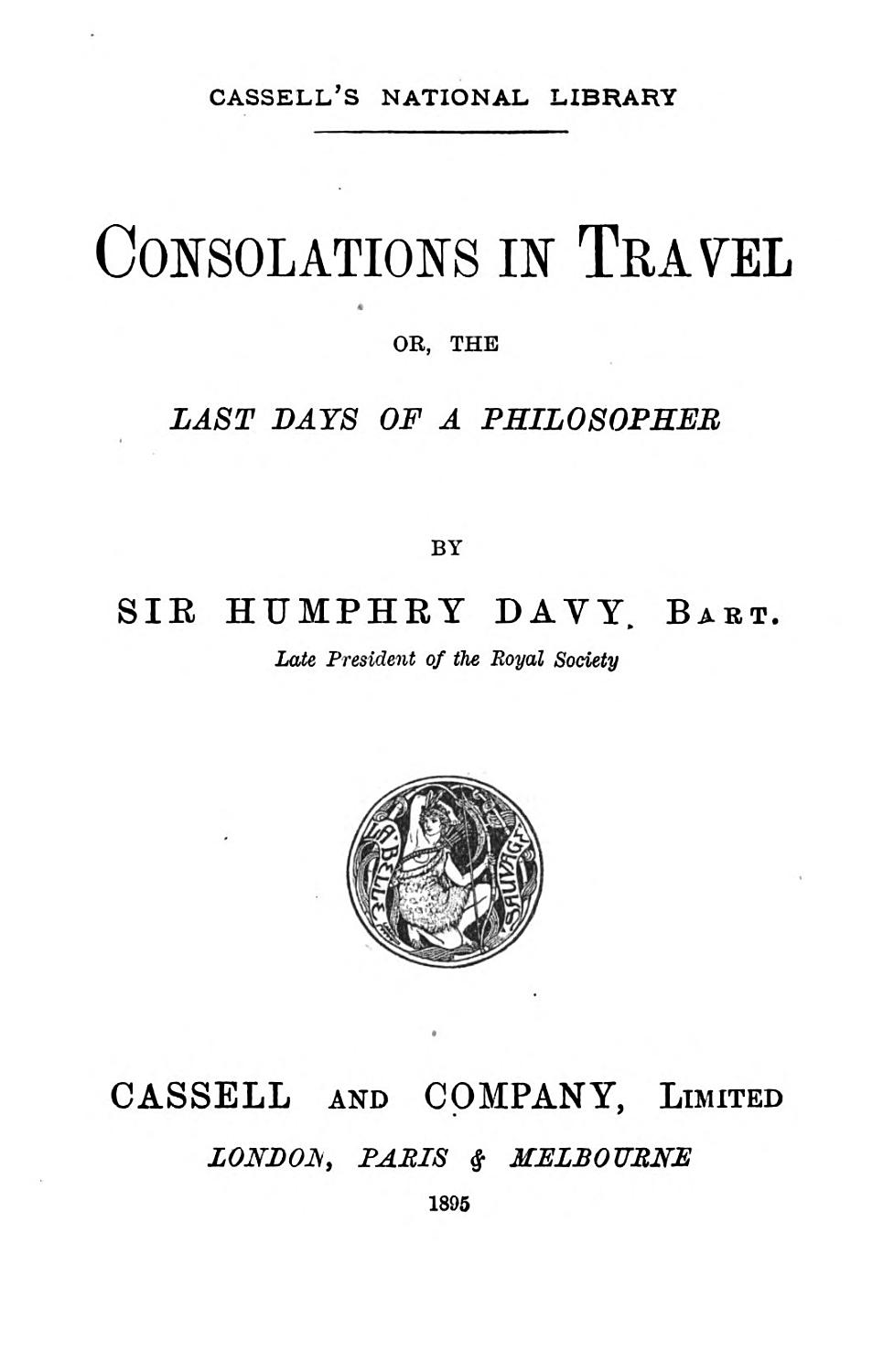
Consolations in Travel or the Last Days of a Philosopher
Consolations in Travel, or The Last Days of a Philosopher is a posthumous work by Sir Humphry Davy (1778-1829), the English chemist and inventor whose scientific career produced major contributions including the isolation of sodium, potassium, calcium, and several other elements, the invention of the miners’ safety lamp, and the foundations of electrochemistry. The book was completed shortly before his death in Geneva in May 1829 and published the same year.
The book is structured as a series of philosophical dialogues set in various European travel locations. Davy uses the dialogue form to address broader philosophical and religious questions including the nature of life, the relationship between science and religion, the immortality of the soul, and the considerable reflections on the meaning of human existence that a serious natural philosopher reaching the end of his life would naturally take up.
The book differs wide from Davy’s earlier scientific publications and represents his late-life turn toward the philosophical and religious questions that scientific work alone could not address.
About the Author
Download free books by Humphry Davy on BDeBooks. Read Humphry Davy’s works online or download as PDF/EPUB · part of our growing free eBook collection.
See all books by Humphry Davy →