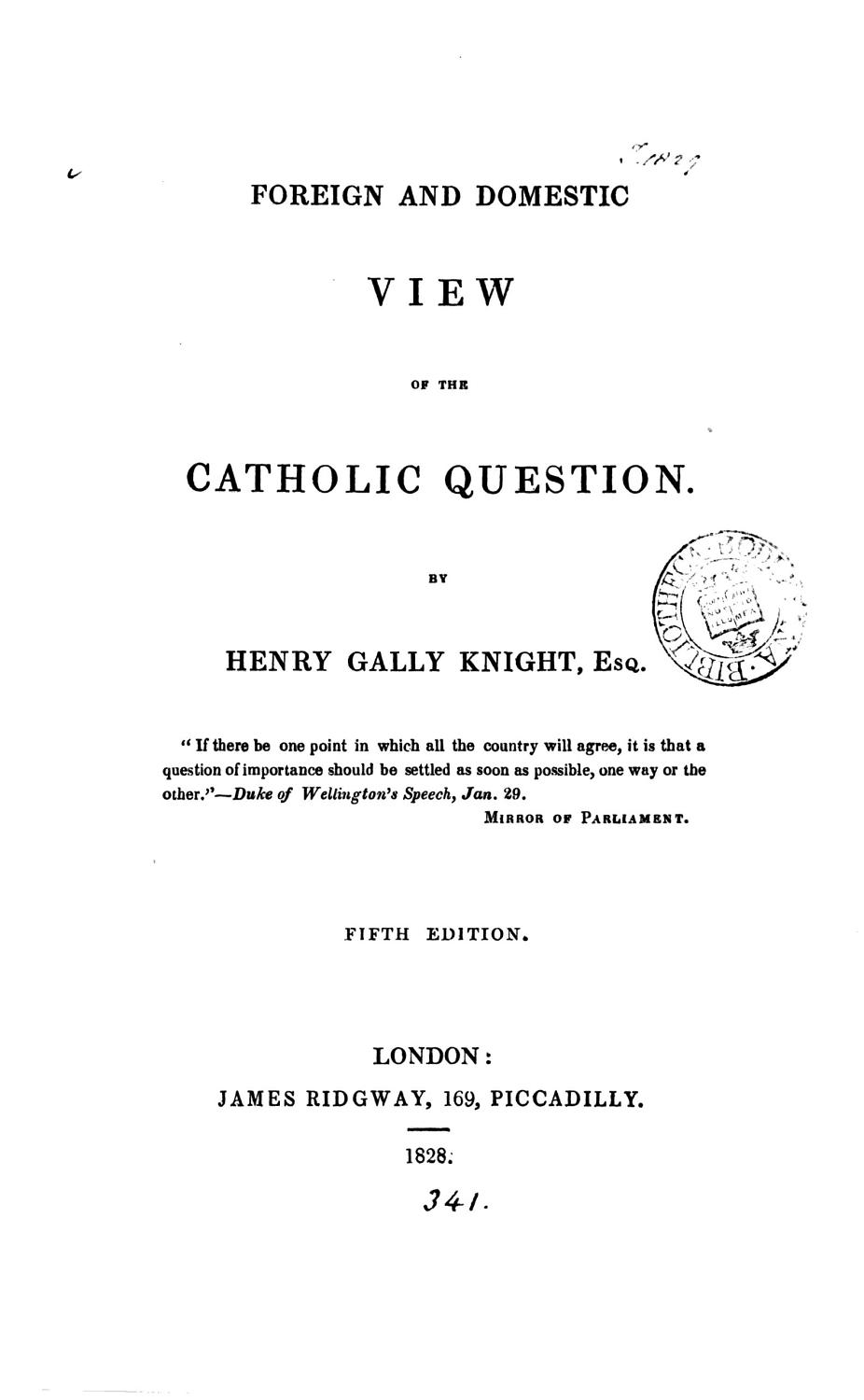
Foreign and Domestic View of the Catholic Question
Foreign and Domestic View of the Catholic Question is a political pamphlet by Henry Gally Knight, the English antiquary, architectural historian, and Member of Parliament who lived from 1786 to 1846. Knight is now better remembered for his architectural writings, particularly his work on the development of Christian and Islamic architecture in the Mediterranean countries, but he was substantially involved in British political life during the years leading up to the Catholic Emancipation Act of 1829.
The Catholic Question refers to the long British political debate about the legal disabilities that the English Penal Laws had imposed on Roman Catholics since the late seventeenth century. Catholics in England, Wales, Scotland, and Ireland were excluded from voting in parliamentary elections, from sitting in Parliament, from holding most public offices, from various forms of military service above certain ranks, and from various other rights that Protestant British subjects took for granted. The various Penal Laws had been gradually relaxed across the late eighteenth and early nineteenth centuries, with full Catholic emancipation finally arriving in 1829 under the Wellington government following substantial political pressure from Daniel O’Connell and the Irish Catholic Association.
Knight’s pamphlet contributed to the substantial pamphlet literature that the Catholic question generated during the decades when it dominated British political debate. The foreign and domestic view of the title suggests that Knight is taking up the question both in terms of the British internal political situation and in terms of the broader European context within which British Catholic policy was being conducted. The major European Catholic powers were watching British Catholic policy with substantial attention, and the international dimension of the question was one of the substantive arguments that emancipation advocates and opponents both engaged with.
Knight himself was a moderate political figure who served as a Whig and then as a Liberal MP for various constituencies across his career. His position on Catholic emancipation was broadly sympathetic, in line with the substantial majority of educated English liberal opinion that increasingly recognised the Penal Laws as anachronistic and counterproductive in the British political situation of the early nineteenth century.
The pamphlet is mostly of interest now to historians of early nineteenth century British political and religious history, particularly to those working on the long road to Catholic emancipation in 1829. It pairs naturally with the substantial broader pamphlet literature of the period.
About the Author
Read and download 5 free books by Henry Gally Knight on BDeBooks. Browse the complete collection of Henry Gally Knight’s works available as free PDF and EPUB downloads. Discover novels, fiction, and other writings by Henry Gally Knight in our online eBook library.
See all books by Henry Gally Knight →