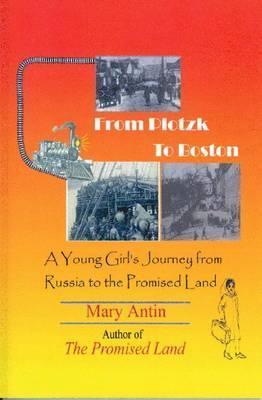
From Plotzk to Boston
From Plotzk to Boston is the first published work by Mary Antin, the Russian American writer who lived from 1881 to 1949 and who became one of the most influential American writers on the immigrant experience in the early twentieth century. The book was published in 1899 when Antin was eighteen and was based on letters she had written in Yiddish to relatives in Russia describing her family’s journey from Polotsk in present day Belarus to Boston in 1894.
Antin was born into a Jewish family in Polotsk and emigrated to the United States with her mother and siblings in 1894 to join her father who had emigrated three years earlier. The family settled in the Jewish immigrant community of Boston’s South End where Antin attended public schools and developed substantial literary and intellectual interests. She published her first poetry and prose while still in her teens and became part of the substantial Boston literary world that supported her early career.
From Plotzk to Boston records the actual journey from Russia through Germany to England and across the Atlantic to Boston, with substantial detail about the various stages of the journey including the difficulties of crossing the Russian border, the conditions of European emigrant transit through Berlin and Hamburg, the substantial difficulties of the Atlantic steamship crossing in steerage class, the arrival at Ellis Island, and the journey on to Boston where the family was finally reunited. The book is one of the most substantial first hand documents of the late nineteenth century East European Jewish migration to the United States from the perspective of a child experiencing the journey.
Antin’s much better known later work was The Promised Land of 1912, the substantial autobiographical work that became one of the standard documents of the American immigrant experience and that was widely read and assigned in American schools across the early twentieth century. The Promised Land develops the substantial themes that From Plotzk to Boston introduces and presents Antin’s mature reflection on the meaning of the American immigrant experience for a young Jewish person from the Russian Pale of Settlement.
The book is essential reading for anyone interested in the substantial late nineteenth and early twentieth century East European Jewish migration to America, in the broader history of American immigration, or in the substantial autobiographical literature of the period. It pairs naturally with The Promised Land and with the substantial broader Jewish American immigrant literature.
About the Author
Download free books by Mary Antin on BDeBooks. Read Mary Antin’s works online or download as PDF/EPUB · part of our growing free eBook collection.
See all books by Mary Antin →
Listen to From Plotzk to Boston Audiobook Free
Listen to From Plotzk to Boston by Mary Antin free online. The full audiobook (1 hr 53 min, 5 chapters, read by Sue Anderson) streams free on this page.
From Plotzk to Boston (1899) is a public domain work.
| # | Chapter | Length | |
|---|---|---|---|
| 1 | Foreword and Prefatory | 12:42 | |
| 2 | Part 1 | 29:13 | |
| 3 | Part 2 | 24:24 | |
| 4 | Part 3 | 18:21 | |
| 5 | Part 4 | 28:37 |
Prefer reading? Read From Plotzk to Boston online free or download the PDF and EPUB above.