
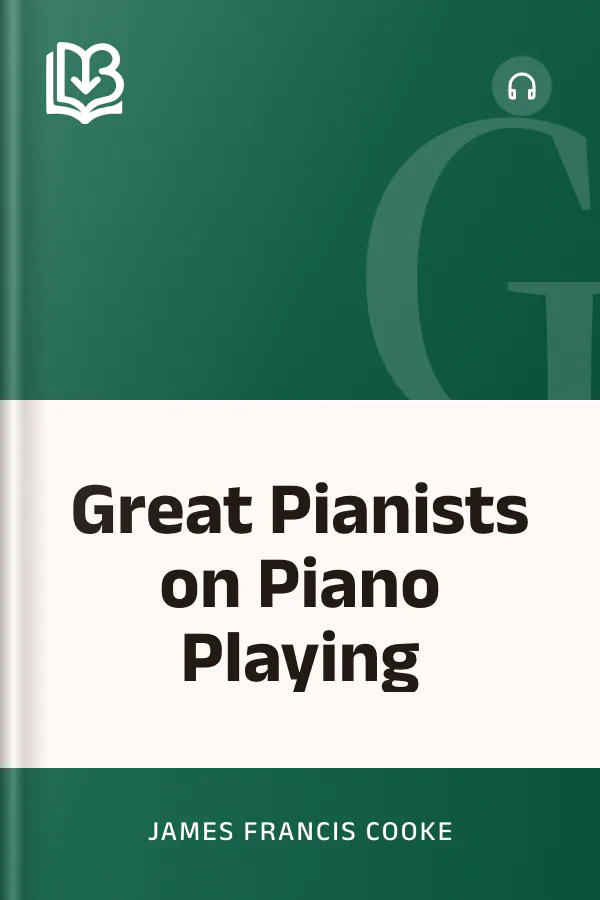
Great Pianists on Piano Playing
- Downloads
- Under 100
- Pages
- 168
Listen to Great Pianists on Piano Playing Audiobook Free
-
The Artist’s Life
32:58 -
Are Pianists Born or Made?
22:35 -
Pepito Arriola: The Story of a Wonder Child
17:50 -
Wilhelm Bachaus: The Pianist of To-Morrow
16:54 -
Harold Bauer: Artistic Aspects of Piano Study
24:33 -
Fanny Bloomfield-Zeisler: Appearing in Public
24:32 -
Ferruccio Benvenuto Busoni: Important Details in Piano Study
19:47 -
Teresa Carreño: Distinctive Piano Playing
21:00 -
Ossip Gabrilowitsch: Essentials of Touch
16:23 -
Leopold Godowsky: The Real Significance of Technic
16:24 -
Katharine Goodson: Analyzing Masterpieces
16:36 -
Josef Hofmann: Progress in Piano Study
20:44 -
Josef Lhévinne: Piano Study in Russia
21:14 -
Vladimir de Pachmann: Seeking Originality
25:24 -
Max Pauer: Modern Pianistic Problems
18:47 -
S. V. Rachmaninoff: Essentials of Artistic Playing
23:18 -
Alfred Reisenaur: Systematic Musical Training
22:17 -
Emil Sauer: The Training of the Virtuoso
25:34 -
Xaver Scharwenka: Economy in Music Study
22:46 -
Ernest Schelling: Learning a New Piece
20:12 -
Sigismund Stojowski: What Interpretation Really Is
16:04
Great Pianists on Piano Playing (1913) is a public domain work.
The audio edition streams in the page. There is no audio file to download.
About this book
Twenty-one chapters make up this 1913 volume, and most of them record a conversation between James Francis Cooke and a leading pianist of the day. Busoni talks about important details in study, Godowsky about the real meaning of technic, Rachmaninoff about the essentials of artistic playing, Josef Hofmann about progress, and Teresa Carreño about distinctive playing. Josef Lhévinne describes piano study in Russia, and Vladimir de Pachmann speaks about seeking originality.
The book opens with two chapters of Cooke's own. The first looks frankly at the virtuoso's working life, from endless hours of practice to exhausting railway tours across America; the second asks whether pianists are born or made.
The advice is practical and specific: how to study the rhythm of a piece, why a minuet is often taken too fast, how each national dance carries its own atmosphere. Piano students and teachers will still find much to use here, and anyone curious about the great performers of the early twentieth century gets a first-hand record of how they thought about their art.
Contents
About the author

More from this genre
See all- C The Century of the ChildThe Century of the Child
- Dancing, Beauty and Games
- E Educational laws of VirginiaEducational laws of Virginia
- A The Art of CourtshipThe Art of Courtship
- C The Challenge of the CountryThe Challenge of the Country
- L Letters to His Son, 1748Letters to His Son, 1748
Books like this one
Reviews and discussion
No ratings yet. Be the first reader to rate this book.
Rate this book
Pick a star, then sign in. Only readers who confirmed their email can rate.
No comments yet. Share a thought, a question or a favourite passage.
Copyright concern? Read our DMCA policy
Read or download
Public domain book This work is in the public domain and free of copyright. Anyone may read, download and share it.
- EPUB 3.4 MB
-
KINDLE Send to Kindle Send
- Download the EPUB file to this device.
- Open Amazon's Send to Kindle page, sign in, and add the file. Open Send to Kindle (opens in a new tab)
On a phone: open the downloaded EPUB and share it to the Kindle app.
You can also email the file to your Kindle address (it ends in @kindle.com) from an email address you approved in your Amazon account.
- PDF 4.4 MB
Your download is starting.
Downloads start right away. How to open EPUB on your phone
Book facts
- Author
- James Francis Cooke
- Reading time
- About 5 hours
- Pages
- 168
- Language
- English
- Genre
- Educational
- Formats
- PDF, EPUB, Read online, Audiobook
- Audio read by
- valroth, mkirkpat, docdlmartin and others