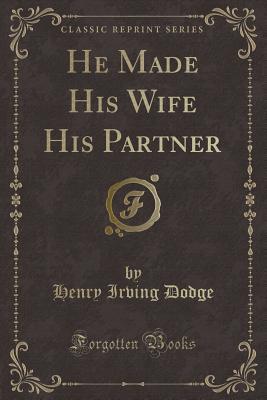
He Made His Wife His Partner
He Made His Wife His Partner is a work by Henry Irving Dodge, the American writer who lived from 1861 to 1934 and who produced fiction and popular non fiction for the American magazine and book publishing market of the early twentieth century. Dodge wrote in various commercial popular genres across his career, including business and self improvement subjects that were enormously popular in early twentieth century American publishing.
The title suggests the broad subject matter. The book addresses the question of how a businessman or professional man can incorporate his wife as a substantive partner in the various decisions and activities of his working life, rather than treating her exclusively as a home maker whose role is confined to the domestic sphere. The subject was one of substantial discussion in early twentieth century American middle class culture, with various changes in women’s education, in the broader cultural position of women, and in the practical economics of middle class households all contributing to the developing conversation about what marriage partnership actually meant in the new century.
Dodge was particularly well known for his series of books and stories featuring the character Skinner, the businessman whose various adventures and reflections appeared in popular magazines and were collected into books across the 1910s. Skinner’s Dress Suit of 1916 was the most successful of the Skinner books and was adapted into both a stage play and a film, with the various Skinner stories combining humorous treatment of contemporary American business life with substantial implicit and explicit commentary on the changing conditions of American middle class married life.
He Made His Wife His Partner belongs to Dodge’s broader writing on marriage and business questions and addresses one of the central themes that ran through much of his work. The treatment combines practical business and personal counsel with the kind of narrative interest that the commercial book market of the period required, presenting concrete examples and situations to illustrate the broader argument about partnership marriage that the book is advocating.
The book is of interest now to historians of early twentieth century American middle class culture, of the changing conditions of marriage in the period, and of the substantial commercial American self improvement and business advice literature tradition. It pairs naturally with Dodge’s Skinner stories and with the broader American business and marriage advice literature of the period.