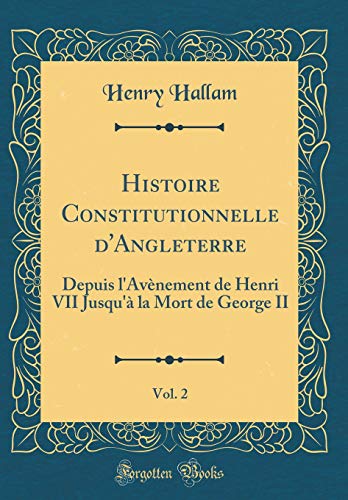
Histoire Constitutionnelle d’Angleterre, Vol. 2
Histoire Constitutionnelle d’Angleterre, Volume 2 is the French translation of the second volume of Henry Hallam’s Constitutional History of England, originally published in English in 1827. Hallam, who lived from 1777 to 1859, was one of the most important English historians of the early nineteenth century and the Constitutional History remained the standard work in its field for several generations.
The Constitutional History covers English political and constitutional development from the accession of Henry VII in 1485 to the death of George II in 1760. Hallam took as his subject the long evolution of English constitutional government across the early modern period, with substantial attention to the relations among Crown, Parliament, Church, and the various other institutions through which English political life was conducted. The book established the framework within which much subsequent English constitutional historiography was conducted, even where later historians substantially revised particular interpretations.
Hallam belonged to the broad Whig tradition of English historical writing that read English history as a long progressive development toward parliamentary government, religious toleration, and individual liberty. The reading was partisan in the sense that it favoured the parliamentary against the royalist side in the great seventeenth century constitutional conflicts and treated the Glorious Revolution of 1688 as the central positive moment in English political history. Later historians including the Tory Macaulay, who admired Hallam, and the various twentieth century revisionists have substantially modified particular interpretations, but the basic Whig framework that Hallam helped establish dominated English historical writing on the constitutional questions through much of the nineteenth century.
Volume 2 in the standard arrangement covers the seventeenth century period, including the reigns of James I and Charles I, the Civil War, the Interregnum under Cromwell, the Restoration of Charles II, and the Glorious Revolution. These were the central subjects of Whig constitutional historiography and Hallam’s treatment of them established many of the standard interpretations that the Whig tradition continued to defend.
The French translation reflects the substantial European interest in English constitutional history during the nineteenth century, when various continental political reformers were looking to the English experience for models that might be applied to their own national situations. The book is mostly of interest now to historians of English political and constitutional history and to historians of nineteenth century European political thought.
About the Author
Download free books by Henry Hallam on BDeBooks. Read Henry Hallam’s works online or download as PDF/EPUB · part of our growing free eBook collection.
See all books by Henry Hallam →