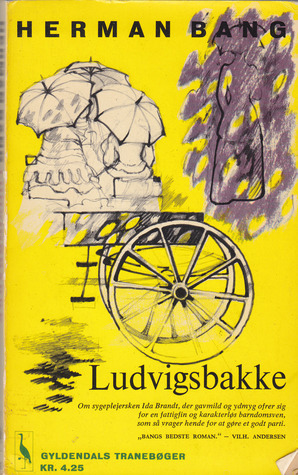
Ludvigsbakke
Ludvigsbakke is a novel by Herman Bang, the Danish writer who lived from 1857 to 1912 and who is one of the central figures of late nineteenth and early twentieth century Scandinavian literature. The novel was originally published in Danish in 1896 and is one of Bang’s major works alongside the better known novels Tine of 1889 and Mikaël of 1904.
Bang worked in the substantial late nineteenth century Scandinavian literary realist and impressionist tradition that included Henrik Ibsen, August Strindberg, and Jens Peter Jacobsen. His particular contribution was the substantial development of what came to be called the impressionist or scenic prose method, which built novels and stories out of carefully observed dramatic scenes and dialogue rather than out of the substantial authorial narrative voice that the conventional nineteenth century European novel had relied on. The technique substantially anticipated various of the developments that would characterise European literary modernism in the early twentieth century, and Bang’s particular use of the method made him substantially influential on the developing Scandinavian modernist literature.
Ludvigsbakke is set at a Danish provincial sanatorium for nervous diseases, with the various staff members and patients of the institution providing the substantial cast of characters whose interactions form the substantial content of the novel. The central character is Ida Brandt, a nurse at the sanatorium whose substantial inner life and various relationships with the other characters provide the central narrative thread that holds the various dramatic scenes together. Bang draws on substantial knowledge of contemporary Danish institutional life for the sanatorium setting and produces substantial observation of the various patterns of work, social relations, and personal relationships that characterise the institutional world.
The novel combines the substantial scenic and impressionist technique that Bang had developed with substantial psychological attention to Ida Brandt as the central conscious presence in the book. The cumulative effect is one of substantial literary modernism in advance of its time, with various of the techniques that would become characteristic of the early twentieth century European novel already developed and applied in Bang’s late nineteenth century Danish setting.
Bang’s English translations have been substantially limited compared to the translations of his major Scandinavian contemporaries, and his international reputation has accordingly been substantially smaller than his literary achievement deserves. The novel is of substantial interest to readers of Scandinavian literary modernism and of the broader European literary tradition of the period. It pairs naturally with Bang’s other novels and with the work of his Scandinavian contemporaries Strindberg and Jacobsen.