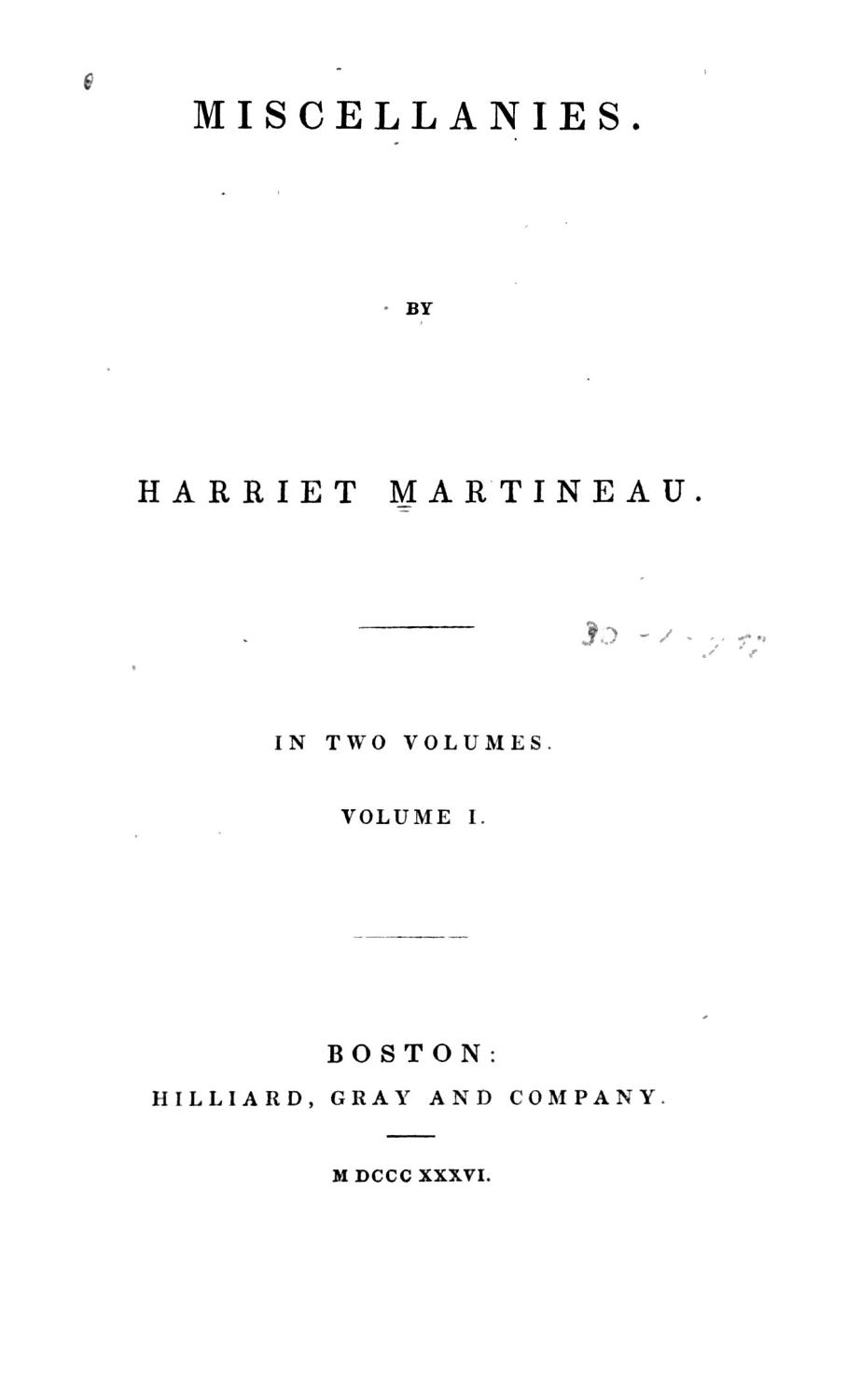
Miscellanies, Volume 1
Miscellanies, Volume 1 is the first volume of a collected edition of shorter prose works by Harriet Martineau, the English writer and social commentator who lived from 1802 to 1876 and who was one of the most influential British public intellectuals of the mid nineteenth century. Martineau produced an enormous body of work across her long career, including novels, popular educational works on political economy, history, religion, and a substantial body of magazine journalism on the political and social questions of the period.
The Miscellanies edition gathered together a selection of her shorter pieces that had originally appeared in various magazines and journals across the previous several decades. The first volume typically contains essays on a wide range of subjects, reflecting the substantial range of Martineau’s interests and her ability to write with authority on subjects from political economy through abolitionist politics to religious and philosophical questions to literary criticism and biographical sketches.
Martineau had first come to public attention with the Illustrations of Political Economy series of 1832 to 1834, a substantial sequence of fictional tales each illustrating a particular principle of the classical political economy that had been developed by Adam Smith, Malthus, and Ricardo. The Illustrations were enormously popular and made Martineau a national figure in Britain at the age of thirty. Across the following four decades she produced a steady stream of work that maintained her position as one of the leading public commentators of the period, with substantial works on America after her visit there in the 1830s, on the religious questions that occupied her during her own gradual movement away from conventional Christianity, on the political reform movements of the period, and on many other subjects.
The shorter pieces gathered in the Miscellanies show the range of her interests and the consistent quality of her prose. She wrote in a direct strong English that was unusual for a Victorian woman writer of the period and that gave her work a particular authority. The essays cover political economy, abolitionism, religious questions, biographical portraits of major figures of the period, and various other subjects.
The volume runs to several hundred pages and is best read by selection rather than straight through. For readers interested in mid nineteenth century British public intellectual life, Martineau is essential reading.
About the Author
Download free books by Harriet Martineau on BDeBooks. Read Harriet Martineau’s works online or download as PDF/EPUB · part of our growing free eBook collection.
See all books by Harriet Martineau →