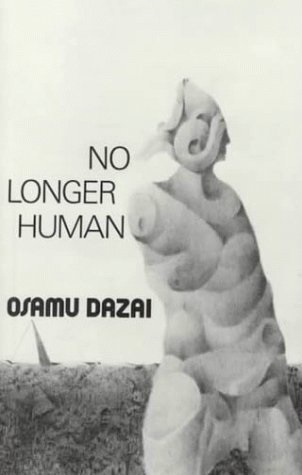
No Longer Human
Osamu Dazai

No Longer Human, originally published in Japanese as Ningen Shikkaku in 1948, is the final completed novel by Osamu Dazai, the Japanese writer who lived from 1909 to 1948. The book appeared in serial form in the magazine Tenbō from June to August 1948, and Dazai drowned himself in the Tamagawa Aqueduct in Tokyo with his lover Tomie Yamazaki on June 13, 1948, just as the second instalment was appearing in print.
The novel is presented as the notebooks of a man named Ōba Yōzō, found and edited by an unnamed narrator who occasionally provides framing commentary. Yōzō recounts his life from childhood through young manhood, with the central theme being his sense of complete alienation from the other human beings around him. He has never understood what other people seem to find natural or satisfying. He has built his entire social presentation around an elaborate clownish persona that allows him to pass as normal while actually feeling himself to be something else, something less or more or other than human. The novel works through the various episodes of his adult life, including his time as an art student in Tokyo, his various love affairs and suicide attempts, his descent into alcoholism and morphine addiction, and his eventual commitment to a mental institution.
The novel is widely understood as substantially autobiographical. The events Yōzō describes parallel events in Dazai’s own life closely enough that the book has often been read as a confession or a long suicide note. The double suicide with which Dazai ended his own life shortly after completing the book has made the reading almost impossible to avoid.
No Longer Human is one of the most widely read novels in modern Japanese literature. It has been a permanent presence on Japanese high school and university reading lists since its first publication and remains one of the most quoted Japanese novels of the twentieth century. The Donald Keene English translation has made the book accessible to international readers and the novel has acquired a substantial following outside Japan as well.
The book runs about two hundred pages in English translation. For readers approaching Japanese modernist fiction or interested in autobiographical writing on alienation and addiction, it is essential reading.