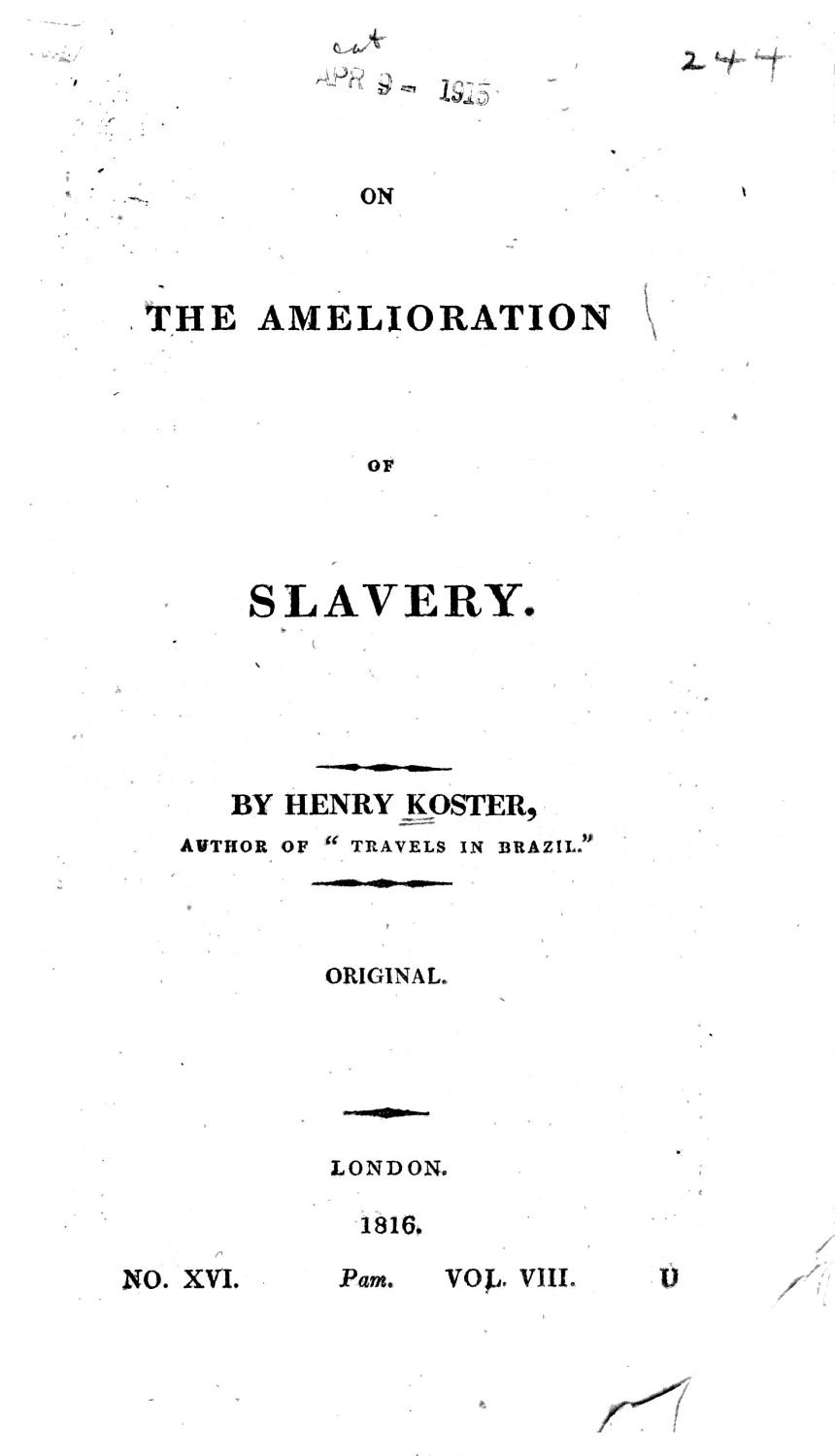
On the Amelioration of Slavery
On the Amelioration of Slavery is a work by Henry Koster, the English born resident of Portuguese Brazil who lived from 1793 to 1820 and who produced one of the most important early nineteenth century English language accounts of Brazilian social and economic life. Koster spent most of his short adult life in the Brazilian province of Pernambuco, where he managed a sugar plantation and travelled extensively through the northeast Brazilian interior.
Koster is now best known for his Travels in Brazil, published in 1816, which presented detailed observations of Brazilian society, agriculture, and culture for the substantial British and Anglophone audience interested in the South American countries that were just then beginning to break away from Portuguese and Spanish colonial control. The book was widely read and translated and became one of the principal English language sources on Brazilian society during the period of the Napoleonic wars and the immediate post Napoleonic decades.
On the Amelioration of Slavery addresses one of the major moral and political questions of the period. Slavery was a central institution of Brazilian colonial and early independent society, with the Brazilian sugar, coffee, and mining economies all built substantially on enslaved labour brought from West Africa across the Atlantic slave trade. The international British movement against the slave trade and against slavery itself was at its most active during the years when Koster was writing, with the slave trade abolition of 1807 and the various subsequent measures against slavery in the British colonies forming the central political background.
Koster’s position on Brazilian slavery was complicated. He was an opponent of slavery as a moral and economic institution but he was also a working sugar planter whose own livelihood depended on enslaved labour, and his writings reflect the tensions of that position. The amelioration of the title refers to the various measures by which the conditions of enslaved people could be improved while the institution itself continued, a position that was widely held among various nineteenth century planters and slavery defenders who wanted to forestall the more radical movement for outright abolition.
The work is mostly of interest now to historians of Brazilian slavery, of British anti slavery thought, and of early nineteenth century writing on the slavery question. It pairs naturally with Koster’s Travels in Brazil and with the broader anti slavery literature of the period.