Peace, Power, and Plent
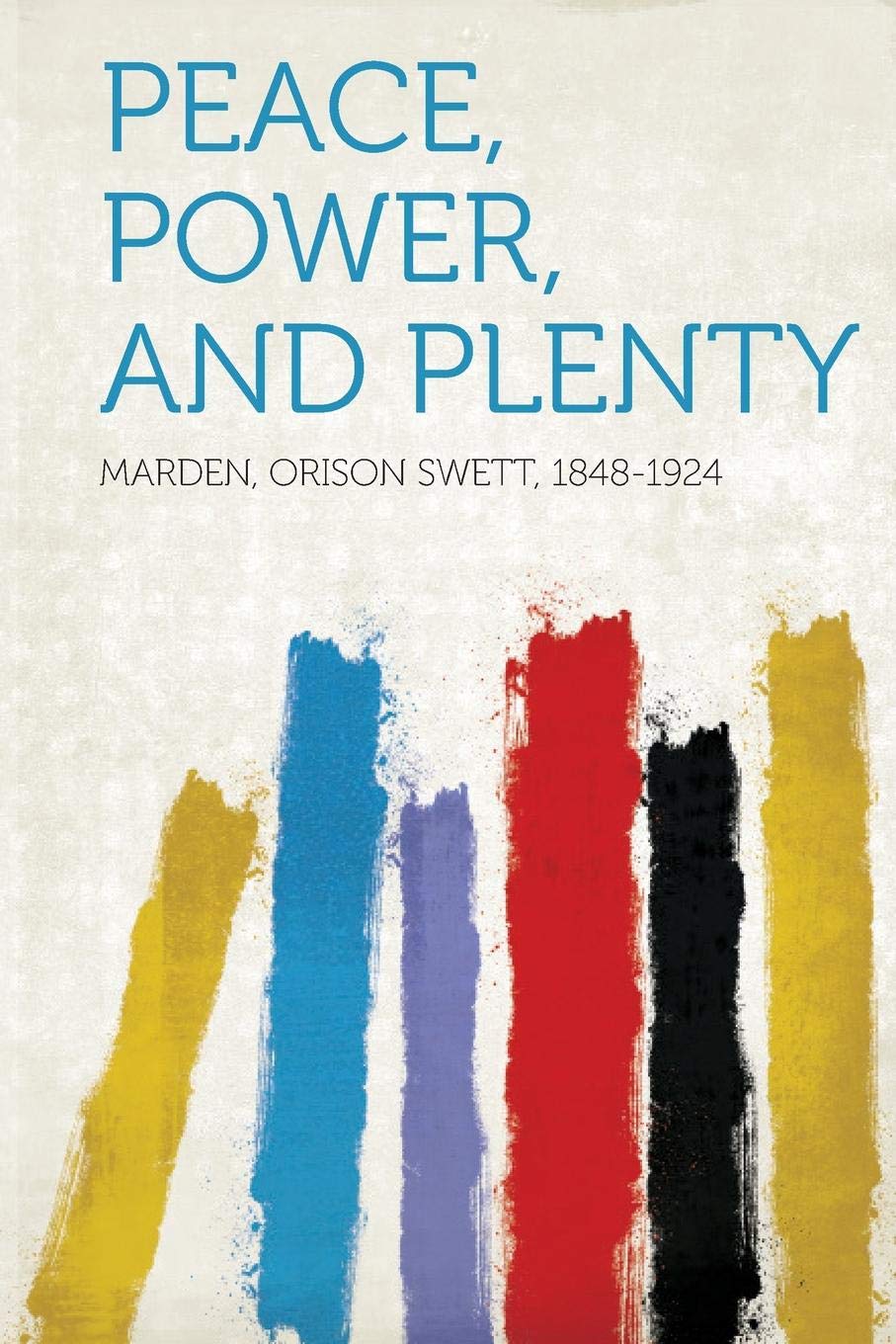
Peace, Power, and Plenty is a self-improvement book by Orison Swett Marden, published in 1909. It belongs to the substantial body of Marden books that developed his self-improvement teaching across more specifically psychological and what was then called New Thought directions in the early twentieth century.
The three nouns of the title represent what Marden considered the three central goals of a properly developed life. Peace refers to the inner mental and emotional state that allows a person to function effectively regardless of external circumstances. Power refers to the practical capacity to accomplish what one sets out to do, including both physical energy and mental focus. Plenty refers to the material prosperity that follows naturally from a life properly organized around the right principles.
The argument draws on the developing New Thought movement that was substantial in early twentieth-century American religious and self-improvement culture. New Thought combined elements of older American Transcendentalism with various forms of practical psychology and metaphysical thinking, and emphasized the role of mental attitudes in shaping the material circumstances of life. The position was that proper thinking, particularly positive and confident thinking, would tend to produce positive and successful external results.
Marden’s earlier books had emphasized the practical and disciplinary side of self-improvement, with substantial attention to hard work, persistence, careful planning, and the development of useful skills. The later books including Peace, Power, and Plenty increasingly added the New Thought psychological dimension, with more attention to mental attitudes, to the avoidance of fear and worry, and to what Marden called the cultivation of the abundant mind.
The combination became enormously influential on the developing American self-improvement and motivational literature of the twentieth century. Napoleon Hill’s later Think and Grow Rich of 1937 drew directly on the New Thought framework that Marden had helped popularize. Dale Carnegie’s How to Win Friends and Influence People of 1936 worked in a more practical mode but absorbed similar assumptions about the role of mental attitudes in producing successful outcomes.
The book runs about three hundred pages. It pairs with the other Marden books and with the broader American New Thought literature of the early twentieth century from writers including James Allen, Wallace Wattles, and Ralph Waldo Trine.
About the Author
Download free books by Orison Swett Marden on BDeBooks. Read Orison Swett Marden’s works online or download as PDF/EPUB · part of our growing free eBook collection.
See all books by Orison Swett Marden →