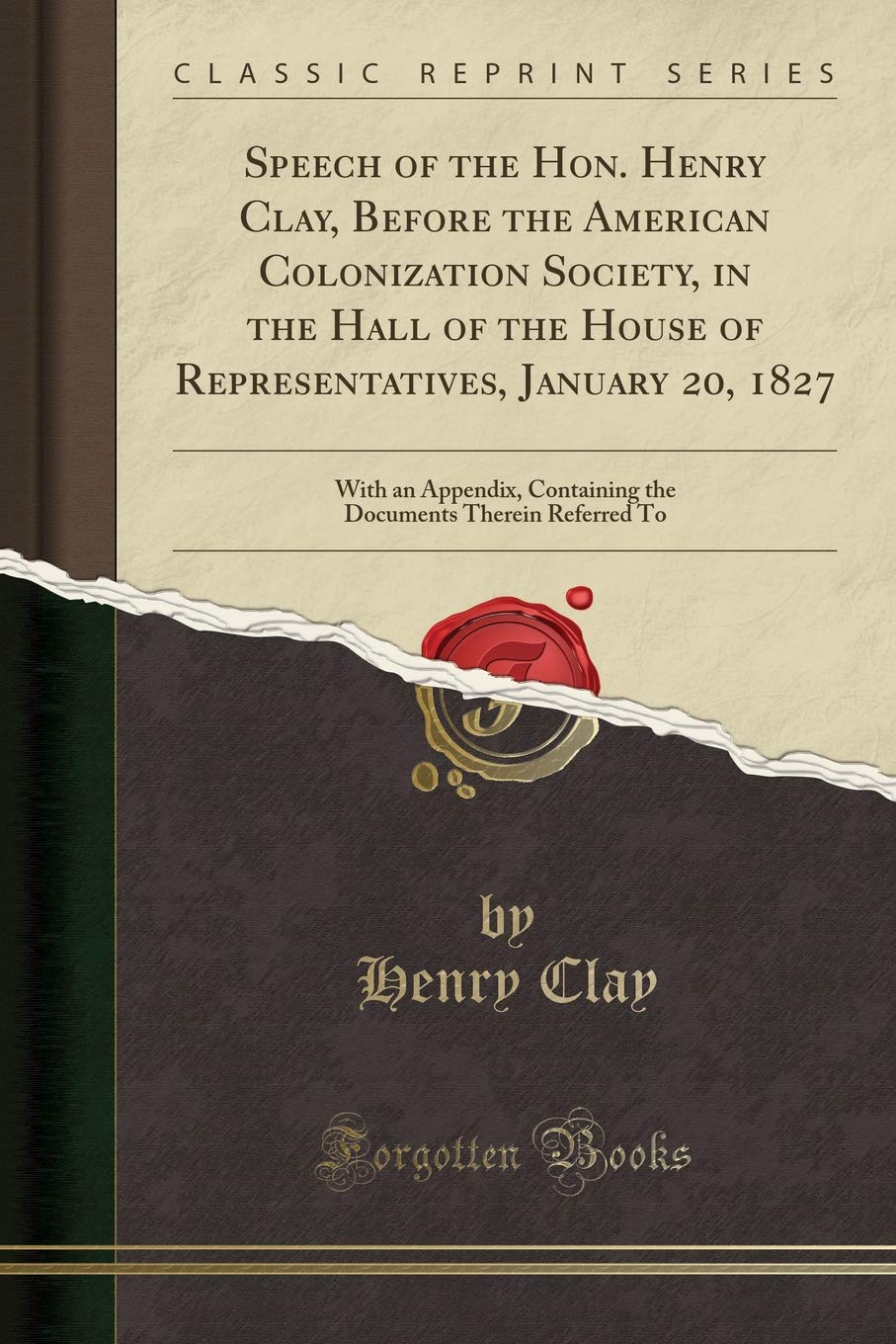
Speech of the Hon. Henry Clay, Before the American Colonization Society, in the Hall of the House of Representatives, January 20, 1827
This pamphlet collects one of Henry Clay’s many addresses to the American Colonization Society, the organization founded in 1816 to encourage the resettlement of free Black Americans in West Africa, primarily in what would become the country of Liberia. Clay was one of the society’s earliest and most prominent supporters, and he served as its president from 1836 until his death in 1852. His addresses to the society across his long career are some of the most direct articulations of his views on slavery, race, and the future of the American republic.
The colonization movement is a complicated chapter in American history that does not fit easily into modern political categories. Its supporters included slaveholders who saw colonization as a way to remove free Black people whose presence they considered destabilizing to the slave system. It also included white northerners who opposed slavery but did not believe in racial equality, and a smaller number of Black leaders who saw emigration as the only realistic path to freedom in a country that would never accept them as equals. Most Black Americans, however, rejected colonization and insisted that they were Americans by birth and would stay.
Clay’s addresses to the Colonization Society show him working through the political and moral arguments for the project in the formal nineteenth century rhetorical style. He argues for gradual emancipation followed by colonization, for the moral obligation of slaveholders to make some plan for the future, and for the practical limits of what he believed the American polity could accept on questions of race. Modern readers will find his arguments uncomfortable in many places. They are also historically important.
Clay’s prose in his major speeches is in the formal nineteenth century rhetorical style, dense by modern standards but carefully constructed for oral delivery and for subsequent print circulation. The arguments tend to be substantive, with extensive citation of historical and constitutional precedent.
For students of antebellum American politics, of the colonization movement, of the founding of Liberia, or of the long debates over slavery that preceded the Civil War, primary sources like this address are valuable. Clay’s pamphlets are short, accessible, and represent the views of one of the era’s most influential moderates on the questions that would eventually tear the country apart in civil war.
About the Author
Download free books by Henry Clay on BDeBooks. Read Henry Clay’s works online or download as PDF/EPUB — part of our growing free eBook collection.
See all books by Henry Clay → Mr. Clay’s Speech in Support of an American System for the Protection of American Industry, Delivered March 30th and 31st, 1824
 Speech of Mr. Clay, of Kentucky, on the Resolution to Expunge a Part of the Journal for the Session of 1833-1834
 Remarks of Mr. Clay, of Kentucky, On Introducing His Propositions to Compromise, On the Slavery Question
 To the People of the Congressional District
 Speech of Henry Clay, Delivered at Lexington, Kentucky, June 9, 1842
 An Address, Delivered to the Colonization Society of Kentucky