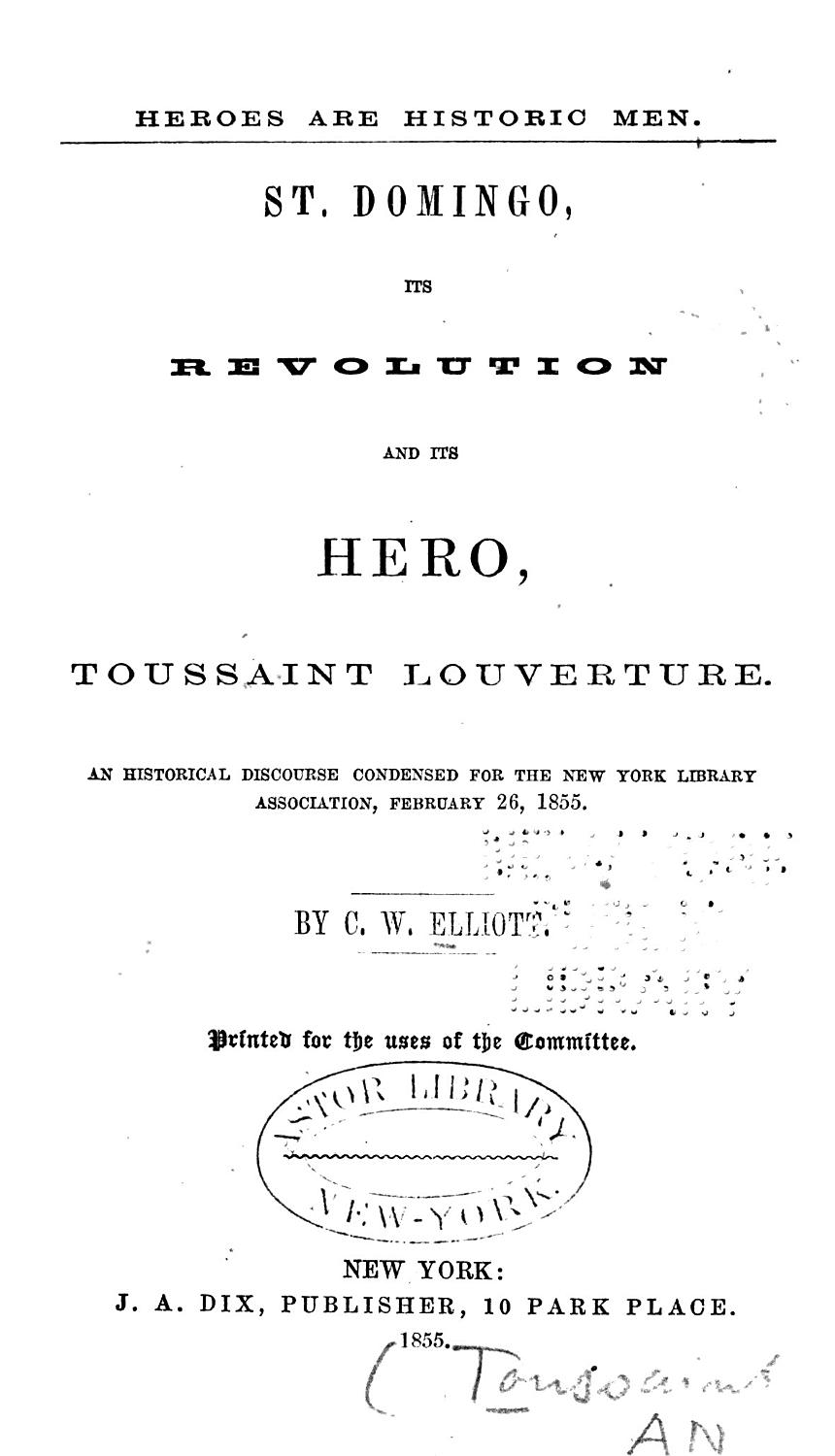
St. Domingo, Its Revolution And Its Hero, Toussaint Louverture
St Domingo, Its Revolution and Its Hero, Toussaint Louverture is a historical work by Charles Wyllys Elliott, the American writer who lived from 1817 to 1883. The book was published in 1855 and presents an English language account of the Haitian Revolution and of its principal leader Toussaint Louverture for the substantial American audience interested in slavery, abolition, and the broader question of Caribbean and Latin American political development.
The Haitian Revolution, which ran from 1791 to 1804, was the only successful slave revolution in modern world history and produced the first independent state in Latin America and the second independent republic in the Americas after the United States. The revolution overthrew French colonial rule in the western part of the island of Hispaniola, abolished slavery in the territory, defeated successive military interventions by France, Britain, and Spain, and eventually established the independent state of Haiti in 1804. Toussaint Louverture, the formerly enslaved man who emerged as the central political and military leader of the revolution from the mid 1790s until his capture by the French in 1802, was one of the most important political figures of the broader Atlantic revolutionary period.
Elliott’s book belongs to the substantial body of mid nineteenth century American anti slavery writing that took up the Haitian Revolution as one of the central case studies. The book presents Toussaint Louverture as a heroic figure whose personal qualities and political accomplishments demonstrated the falsity of the racial assumptions that defenders of American slavery used to justify the institution. The argument was a familiar one in American abolitionist literature of the period, and Elliott’s book contributed to the broader Northern intellectual case against slavery during the years leading up to the Civil War.
The book draws on the various English and French language sources that were available to a mid nineteenth century American writer. The principal source material includes the various contemporary memoirs and histories produced during and shortly after the revolution by participants and observers on various sides of the conflict. Elliott handles the material in the literary historical mode that mid nineteenth century American popular history favoured, with substantial dramatic narrative alongside the more analytical material.
The book is of interest now to historians of American anti slavery thought and to readers tracking the long English language reception of the Haitian Revolution. It pairs naturally with C L R James’s The Black Jacobins of 1938 and with the modern scholarship by Carolyn Fick and others.