State Education Self-Defeating
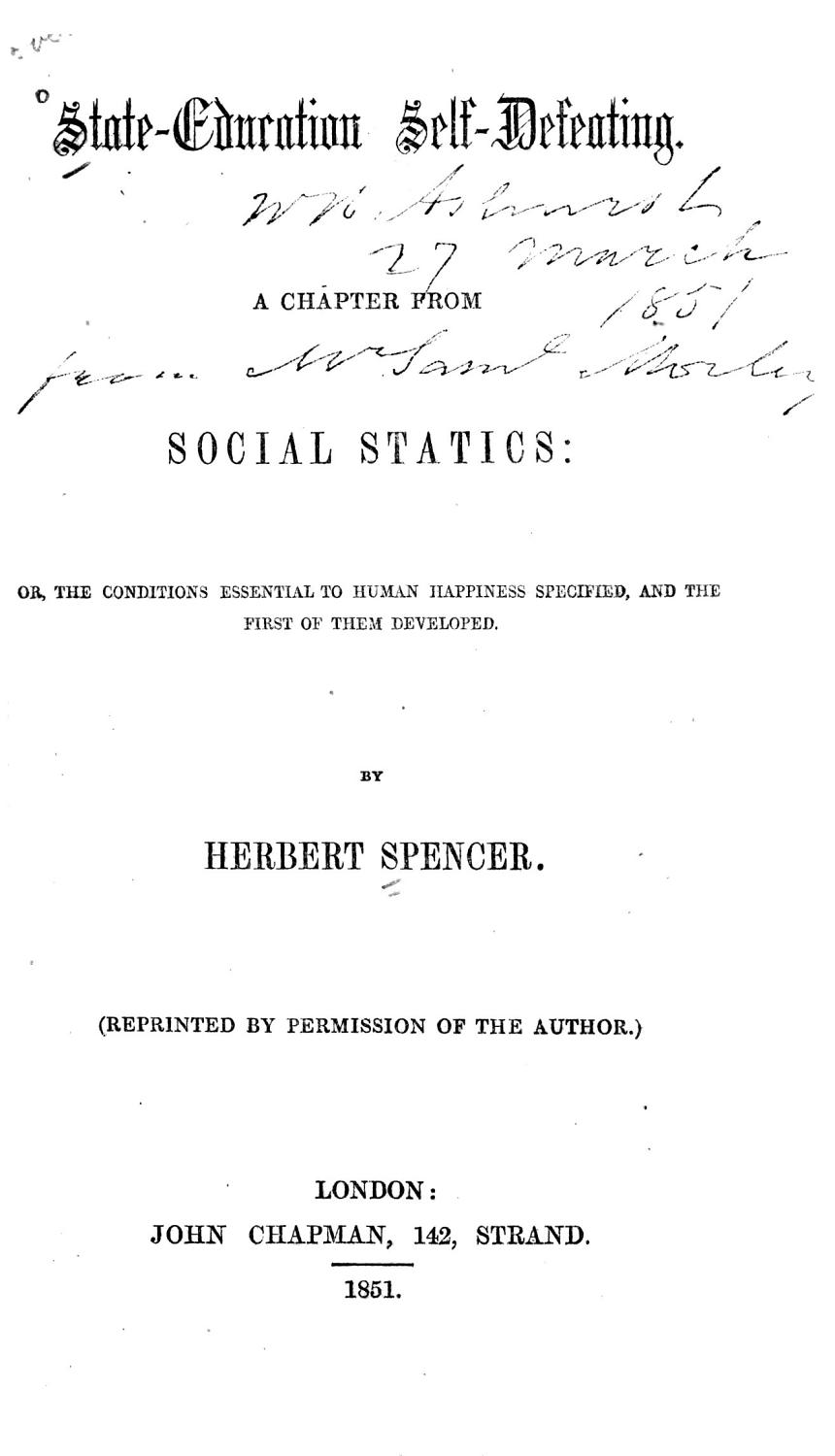
State Education Self Defeating is a chapter or essay by Herbert Spencer, the English philosopher and sociologist who lived from 1820 to 1903 and who was one of the most internationally influential English intellectual figures of the second half of the nineteenth century. The piece belongs to Spencer’s substantial body of writing on social and political questions, much of which appeared in various forms including books, magazine essays, and contributions to his larger systematic philosophical works.
Spencer was the major Victorian theorist of what he and his followers called philosophical individualism, the position that the proper sphere of legitimate government was strictly limited to the protection of individual rights and that the various forms of state action in education, social welfare, economic regulation, and other spheres represented unwarranted intrusions of state power into areas that should be left to individual and voluntary social arrangements. The state education question was one of the central battlegrounds for this position in late Victorian Britain, with the Education Act of 1870 and the subsequent expansion of state funded primary education providing the specific policy context within which Spencer and his various opponents were arguing.
The State Education Self Defeating argument presents Spencer’s case that state provision of education would produce results substantially opposite to those that the advocates of state education intended. The argument typically combines several distinct strands. Spencer argued that state education would undermine the development of educational quality that competitive voluntary provision would otherwise produce. He argued that state education would tend toward ideological uniformity that would damage the diversity of thought that a healthy society required. He argued that the costs of state education would fall disproportionately on those least able to bear them. He argued that the moral and developmental effects of state provision would be substantially worse than the alternatives the state was displacing.
The specific arguments Spencer made on the state education question were widely debated in his own time and have continued to be referenced in the long Anglo American debate about the proper role of the state in education that has run from the late nineteenth century through to the present. Modern commentators of various political positions continue to engage with Spencer’s arguments, with libertarian and conservative critics of public education drawing substantially on Spencer’s analysis and with various critics of his position offering substantial counter arguments.
The piece is of interest now to readers of Victorian political philosophy and to those interested in the historical roots of contemporary debates about education policy.