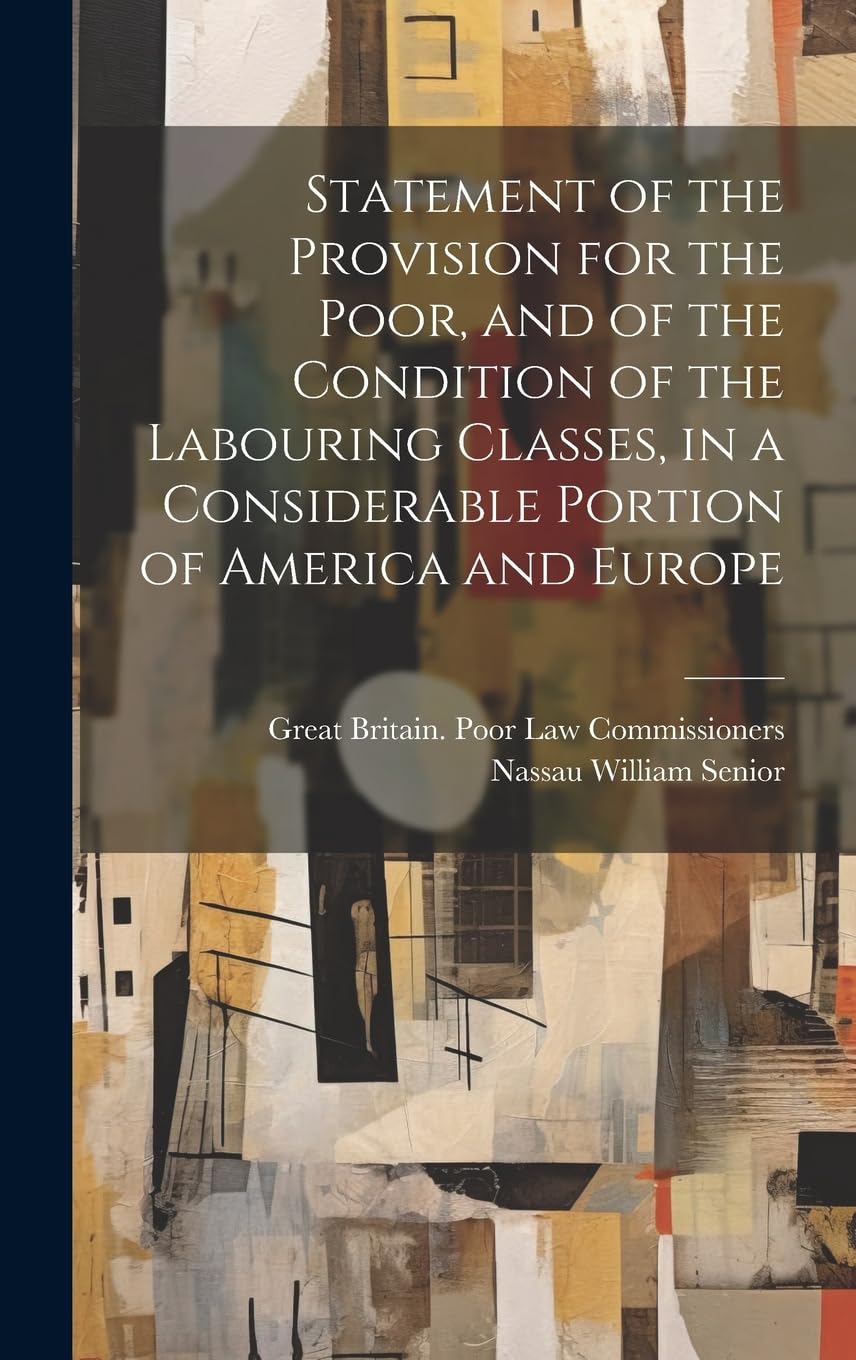
Statement of the Provision for the Poor
Statement of the Provision for the Poor by Nassau William Senior belongs to the long English argument about poor relief that ran through the early nineteenth century and that produced the Poor Law Amendment Act of 1834. Senior, who lived from 1790 to 1864, was one of the most influential English economists of his generation and the first Drummond Professor of Political Economy at Oxford. He served on the 1832 Royal Commission whose report shaped the 1834 reform.
The pamphlet sets out the case for restricting outdoor relief and for confining able bodied paupers to workhouses under conditions deliberately less attractive than the worst paid free labour. The principle, which Senior helped articulate and which became known as less eligibility, dominated English social policy for the rest of the century and shaped the design of the workhouses that Dickens attacked in Oliver Twist a few years later.
Senior wrote from the position of classical political economy. He believed the old Speenhamland system of supplementing wages from the rates had created a permanent class of dependent paupers, had depressed wages, and had broken the connection between work and reward that the labour market depended on. His analysis was rigorous within its own framework. The framework itself, in retrospect, omitted a great deal about how an industrial economy actually worked and about what the people in question could realistically do.
The pamphlet is short and direct in the manner of early nineteenth century English economic and political writing. For readers of Victorian social policy, of the history of welfare provision, or of the long English debate about poverty and its remedies, it is one of the central primary documents of the 1834 settlement. It pairs naturally with the full Royal Commission report of 1834 and with the various responses produced by Tory and Chartist critics in the years that followed.
About the Author
Download free books by Nassau William Senior on BDeBooks. Read Nassau William Senior’s works online or download as PDF/EPUB · part of our growing free eBook collection.
See all books by Nassau William Senior →