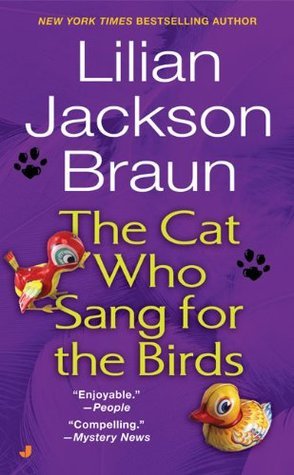
The Cat Who Sang for the Birds
The Cat Who Sang for the Birds is the twentieth Cat Who mystery from Lilian Jackson Braun, published in 1998. By this point in the long running series the formula was firmly established and was most of the appeal. James Qwilleran, the heavily mustached former crime reporter who has settled in Pickax in Moose County, somewhere four hundred miles north of everywhere, gets pulled into another local mystery alongside his two Siamese cats Koko and Yum Yum. Koko, in particular, has the unexplained gift of noticing things that turn out to be clues, and Qwill has long since stopped pretending he does not pay attention.
In this entry the case involves the death of a respected Pickax bird carver whose carefully crafted wooden bird sculptures had been displayed throughout the Moose County area. The bird carver’s death appears at first to be a natural cause, but Qwill begins to suspect that something darker is happening when various small inconsistencies in the situation start to accumulate. The bird theme that gives the novel its title runs through the case in various ways, with the carver’s sculptures, the actual birds of the Moose County woods, and Koko’s distinctive vocalizations all playing roles in the slow unfolding of what actually occurred.
Braun’s plotting is gentle by mystery standards. Violence happens off the page. Suspects are usually pleasant people with reasons to be uncomfortable rather than dangerous criminals with motives to kill. The pleasure of a Cat Who book is the slow accumulation of detail, the warm sense of place, and the quiet humor of Qwill’s observations on whatever situation he has been pulled into. By book twenty, the regular cast of Pickax characters had become as much a draw for longtime readers as the cats themselves.
The late 1990s entries in the Cat Who series are some of the strongest in the long sequence. Braun was at the height of her powers as a cozy mystery writer, the Pickax world had been built out enough to feel fully realized, and the Koko mythology had been established without the formula yet feeling repetitive. The bird carving subject matter gives this particular entry its distinctive flavor, with the regional folk art tradition of Moose County providing additional texture beyond just the central mystery.
For longtime fans, The Cat Who Sang for the Birds is a comfortable entry that delivers the series pleasures. For new readers, starting with The Cat Who Could Read Backwards is the better entry point, but the books work in any order with some loss of continuity context.
About the Author
Lilian Jackson Braun was an American author best known for The Cat Who… series, light-hearted cozy mysteries featuring journalist Jim Qwilleran and his clever Siamese cats.
See all books by Lilian Jackson Braun →