The Dharma
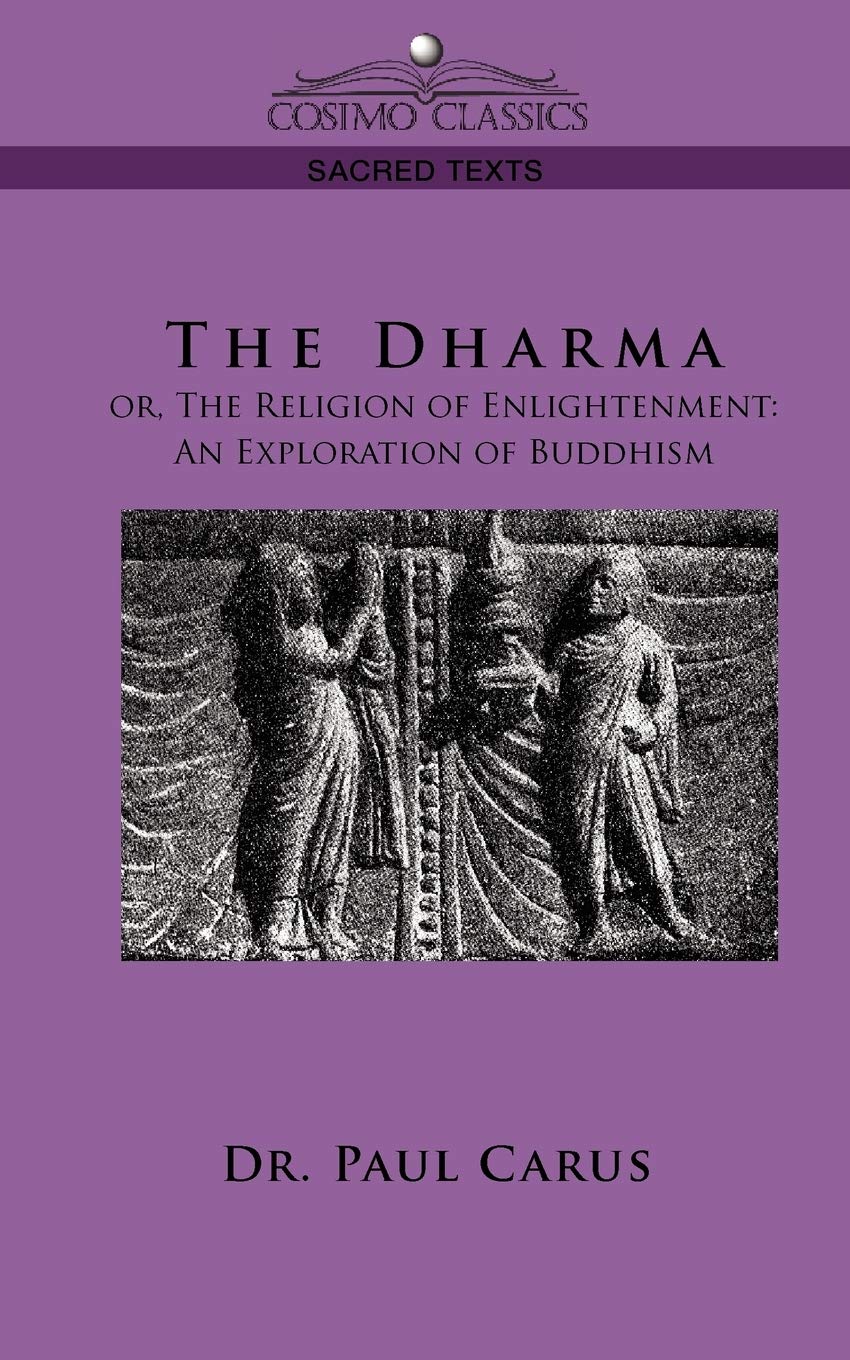
The Dharma is one of Paul Carus’s many short books on Buddhist concepts, written for a general American readership in the late nineteenth and early twentieth centuries. Carus was a German born American philosopher and prolific author, best remembered as the long time editor of the Open Court Publishing Company and of the journals The Open Court and The Monist. He was one of the most important early American interpreters of Asian religion and philosophy for Western readers, and his many books on Buddhism, Taoism, and comparative religion played a significant role in shaping how educated Americans first encountered these traditions.
The dharma is one of the central concepts in Buddhist thought, with the Sanskrit term carrying multiple connected meanings depending on the context. As the teaching of the Buddha, the dharma refers to the body of doctrine and practice that the Buddha taught his followers and that his subsequent tradition has preserved across millennia. As a more general concept, the dharma refers to the fundamental law or pattern of reality that the Buddhist teaching identifies and that human practice can come into right relation with. Carus’s treatment of the dharma in this short volume works through these various meanings and tries to present the concept in a way that Western readers without prior background can engage with.
What distinguishes Carus’s approach from a lot of contemporary writing on Buddhism is the seriousness of his philosophical engagement. He was not himself a Buddhist but he had a serious philosophical interest in the religion and corresponded with leading Buddhist figures of his era, including Soyen Shaku and D.T. Suzuki. His books were aimed at presenting Buddhism to Western readers on its own intellectual terms rather than dismissing it as primitive or as fundamentally inferior to Christianity, which was the more common Western treatment of Asian religion in the period.
Carus’s books on Asian religion are now historical artifacts more than living introductions to Buddhism. Modern Buddhist studies has moved well past the framings he was working with and many of his interpretations have been substantially revised. But for readers interested in the history of how Western Buddhism developed, in the prehistory of the modern engagement with Asian thought, or in the wider intellectual culture of late nineteenth and early twentieth century America, Carus’s work remains worth knowing.
The book is short and accessible, written in the slightly formal nineteenth century philosophical style that Carus tended toward.
About the Author
Download free books by Paul Carus on BDeBooks. Read Paul Carus’s works online or download as PDF/EPUB · part of our growing free eBook collection.
See all books by Paul Carus →