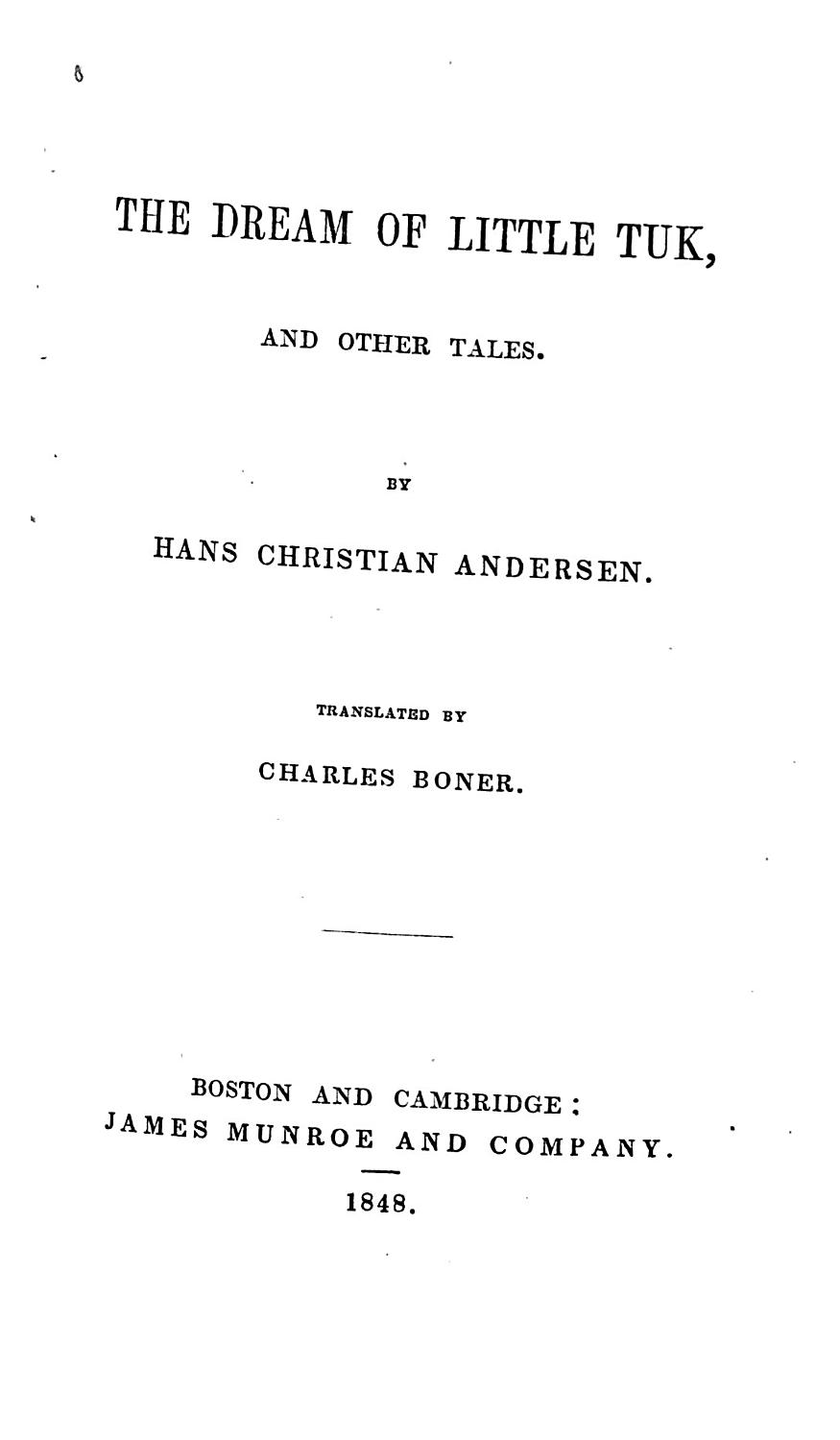
The Dream of Little Tuk, and Other Tales
The Dream of Little Tuk, and Other Tales collects fairy tales by Hans Christian Andersen, the Danish writer who lived from 1805 to 1875 and who is generally considered the greatest fairy tale writer of the modern European tradition. Andersen produced more than one hundred and fifty fairy tales across his long career, beginning with the first collection Eventyr, fortalte for Børn published in Copenhagen in 1835 and continuing through the various collections that appeared until shortly before his death.
The title story The Dream of Little Tuk was originally published in Danish as Lille Tuk in 1847 and belongs to the middle period of Andersen’s fairy tale work. The story follows a young schoolboy named Tuk who falls asleep while studying his geography lesson and dreams a long sequence of fantastic visions in which the various Danish cities and historical figures he was supposed to be learning about visit him and present themselves in various dramatic forms. The story combines Andersen’s characteristic warmth toward children with the substantial historical and geographical material that the dream visions present.
The other stories in the collection typically include various of Andersen’s other famous tales. The Little Mermaid, The Ugly Duckling, The Emperor’s New Clothes, The Steadfast Tin Soldier, The Snow Queen, Thumbelina, and various others appear in various English language selections of Andersen’s work. The specific selection in any particular volume of The Dream of Little Tuk and Other Tales depends on the editorial choices of the particular publisher, but Andersen’s substantial body of fairy tale work means that any selection will include substantial material of lasting literary value.
Andersen wrote in the developing nineteenth century European fairy tale tradition that included the Brothers Grimm, Charles Perrault from the earlier French tradition, and various other writers. His particular contribution was the combination of folk fairy tale elements with substantial original literary invention. Many of his most famous stories including The Little Mermaid and The Ugly Duckling are entirely his own creations rather than retellings of folk material, although they have been so widely absorbed into international culture that they now function as if they had always been part of the broader fairy tale tradition.
The collection runs to several hundred pages depending on the selection. For readers approaching Andersen, this kind of mixed selection is the natural starting point. It pairs naturally with the various other Andersen collections and with the Brothers Grimm and the broader European fairy tale tradition.
About the Author
Read and download 10 free books by Hans Christian Andersen on BDeBooks. Browse the complete collection of Hans Christian Andersen’s works available as free PDF and EPUB downloads. Discover novels, fiction, and other writings by Hans Christian Andersen in our online eBook library.
See all books by Hans Christian Andersen →