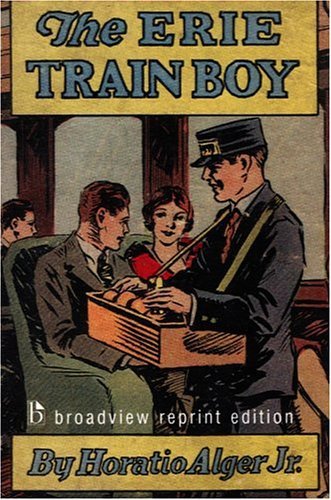
The Erie Train Boy
The Erie Train Boy is one of Horatio Alger Jr.’s many novels for boys, fitting squarely into the rags to respectability formula that earned him his lasting place in American popular literature. The train boy of the title refers to the young men employed by railroads in the nineteenth century to sell newspapers, candy, fruit, and small goods to passengers as the trains moved between stations. The position was an entry level job that gave young men access to a wider geography than most local employment would offer, and Alger uses the train boy setup as the starting point for his protagonist’s adventures along the Erie Railroad route.
The protagonist is a young train boy whose family has fallen on hard times and who is supporting himself and his mother through the small wages of the railroad position. The novel follows the standard Alger plot beats. The temptation of the wrong sort of company among the passengers and other railroad workers. The discovery of a sympathetic older patron who recognizes the protagonist’s worth. The appearance of villains who would prefer to keep him in his original lowly station. The slow accumulation of small successes that build toward the moral resolution Alger’s readers expected.
What makes the novel interesting beyond the standard Alger formula is the specific occupational and geographical detail. The Erie Railroad was one of the major American rail lines of the period, running from New York City through the upstate New York countryside to the western Great Lakes region, and the train boy job and the wider world of nineteenth century American railroading are rendered with the kind of street level accuracy that gives Alger’s novels their particular historical value. Modern readers interested in the actual social and economic conditions of late nineteenth century American railroad work can find in Alger’s novels a sentimentalized but genuinely observed portrait of the life that his young readers were actually growing up in.
For scholars of nineteenth century American children’s literature, of the cultural construction of the self made man, or of the wider print culture that shaped American boyhood in the post Civil War decades, Alger’s catalogue remains essential. The Erie Train Boy is a representative entry and a fair sample of his style. Many of his books are now in the public domain.
About the Author
Horatio Alger Jr. was a 19th-century American author famous for his rags-to-riches juvenile novels, in which poor boys rise through hard work, honesty, and a little luck. His name became shorthand for the American self-made success story.
See all books by Horatio Alger →