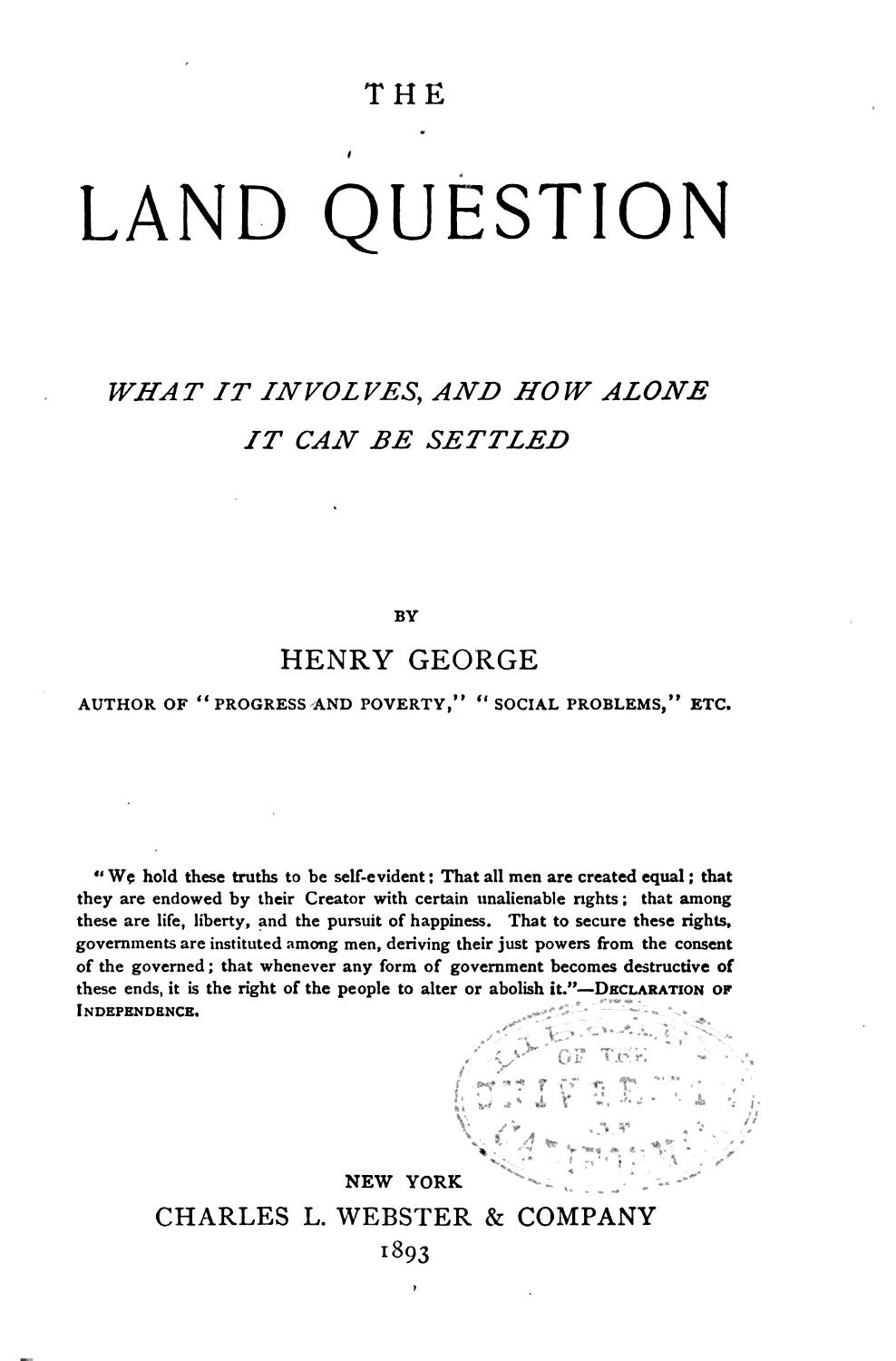
The Land Question
The Land Question is a substantial work by Henry George, the American political economist and social reformer who lived from 1839 to 1897 and who is best known as the author of Progress and Poverty of 1879. The Land Question, originally published in 1881, presents George’s central economic and political argument in a more focused form, with particular attention to the Irish land question that was a major political issue in Britain and Ireland during the years when the book was written.
The Irish land system in the late nineteenth century had become one of the most controversial political questions facing the British government. Generations of absentee English and Anglo Irish landlords had extracted rents from Irish tenant farmers in conditions that produced repeated agrarian crises, including the catastrophic famine of the 1840s and the continuing rural poverty that gave rise to the Land League movement of the late 1870s and 1880s. The Gladstone government had responded with various Land Acts attempting to provide tenant rights and to address the worst abuses of the landlord system, but more radical reformers were arguing for fundamental changes in the system of land tenure itself.
George enters the Irish land debate with his characteristic single tax argument. He holds that the Irish land problem is a particularly clear example of the general problem of land monopoly that he had analyzed in Progress and Poverty, and that the appropriate solution is not the various tenant rights legislation that the British government was passing but the more fundamental reform of capturing the rental value of land for the community through the single tax. The book develops this argument through a detailed examination of the Irish situation and through extended comparison with the land questions facing the United States and other industrializing economies.
The book had substantial influence on Irish and British radical thought during the 1880s and 1890s, with George himself making several speaking tours of Britain and Ireland during the period. The single tax movement that grew out of his work became one of the major reform movements of the late nineteenth and early twentieth centuries.
The book runs about three hundred pages and is essential reading for anyone interested in late Victorian land reform movements. It pairs naturally with Progress and Poverty and with The Crime of Poverty.
About the Author
Download free books by Henry George on BDeBooks. Read Henry George’s works online or download as PDF/EPUB · part of our growing free eBook collection.
See all books by Henry George →