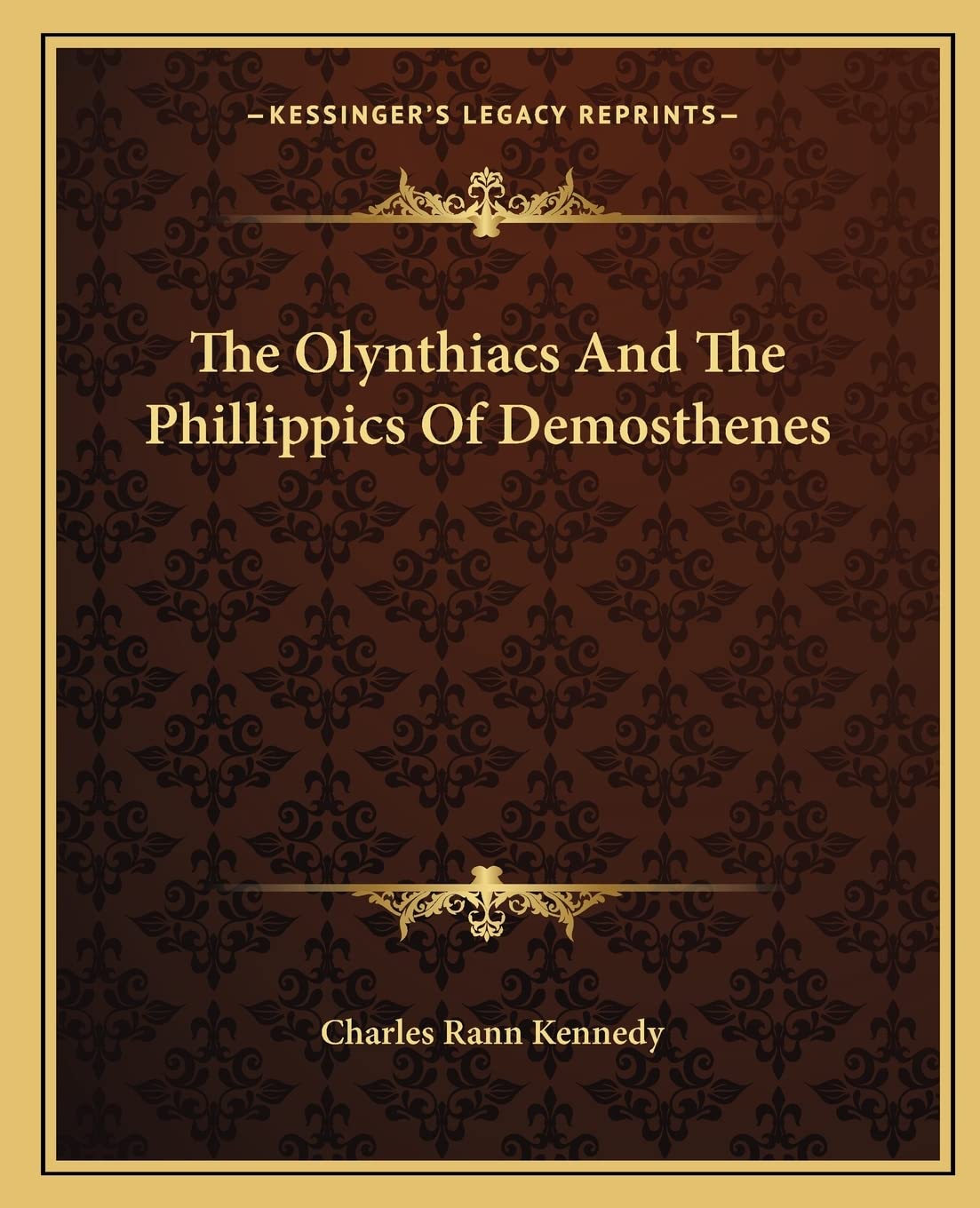
The Olynthiacs And The Phillippics Of Demosthenes
The Olynthiacs and the Philippics of Demosthenes is an English translation by Charles Rann Kennedy, the English classical scholar who lived from 1808 to 1867 and who produced widely used English versions of the major Greek orators for the substantial Victorian academic and educated reading public.
Demosthenes, who lived from 384 to 322 BC, is generally considered the greatest of the ancient Athenian orators and one of the principal opponents of the rising power of Philip II of Macedon during the years when Macedonia was establishing the dominance over the Greek city states that Alexander the Great would extend across the broader Mediterranean and Near Eastern world. The Olynthiacs and the Philippics are the two great speech sequences in which Demosthenes argued for Athenian resistance to Philip’s expansion.
The three Olynthiacs were delivered in 349 BC to argue that Athens should send substantial military aid to the city of Olynthus, which was under threat from Philip’s forces. Despite Demosthenes’s arguments the Athenian aid that was actually sent was inadequate, and Olynthus fell to Philip in 348 BC with the city destroyed and the population enslaved. The four Philippics, delivered between 351 and 341 BC, attacked Philip more directly and argued for sustained Athenian military preparation against him. The first Philippic of 351 BC is generally considered the greatest of the four and one of the supreme achievements of ancient Greek oratory.
Demosthenes’s particular contribution to Greek oratory was the combination of careful logical argument with sustained moral and political seriousness about the actual political situation he was addressing. The speeches are not displays of rhetorical virtuosity for their own sake but are practical political arguments aimed at persuading actual Athenian voters to take specific political and military action. The cumulative failure of Demosthenes’s arguments to move Athenian policy decisively against Philip, and the subsequent Macedonian conquest that Demosthenes had been warning against, gave the speeches their tragic dimension when read in retrospect.
Kennedy’s translation reads well in nineteenth century English and was the standard version used in English academic and amateur classical reading for several generations. The translation pairs naturally with the various scholarly editions of Demosthenes and with the broader Greek oratory tradition including Lysias, Isocrates, and Aeschines.
About the Author
Download free books by Charles Rann Kennedy on BDeBooks. Read Charles Rann Kennedy’s works online or download as PDF/EPUB · part of our growing free eBook collection.
See all books by Charles Rann Kennedy →