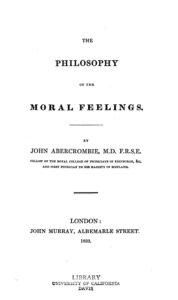
The Philosophy of the Moral Fee
The Philosophy of the Moral Feelings is a work by John Abercrombie, the Scottish physician and philosopher who lived from 1780 to 1844 and who was one of the most distinguished medical and philosophical writers in early nineteenth century Edinburgh. The book was first published in 1833 and was widely read in the substantial Scottish and English philosophical and educated reading audience of the period.
Abercrombie was one of the leading Edinburgh physicians of his generation, with substantial medical practice and substantial original contributions to neurology and the pathology of brain diseases. His Pathological and Practical Researches on Diseases of the Brain and Spinal Cord of 1828 was one of the major nineteenth century medical works on neurological pathology and established Abercrombie’s substantial international medical reputation. Alongside the medical work he produced substantial philosophical writing in the broader Scottish Common Sense philosophical tradition that Thomas Reid and Dugald Stewart had developed across the late eighteenth and early nineteenth centuries.
The Philosophy of the Moral Feelings addresses the moral and ethical questions from the perspective of the Scottish Common Sense tradition. Abercrombie’s earlier Inquiries Concerning the Intellectual Powers of 1830 had addressed the corresponding questions about intellectual or cognitive psychology, and the Moral Feelings book continued the project by taking up the parallel questions about the various feelings, motives, and ethical responses that constitute moral life. The book is essentially a Scottish Common Sense psychology of moral life, with substantial attention to the various particular moral feelings including conscience, benevolence, justice, gratitude, and the various other feelings that the tradition understood as fundamental components of moral character.
Abercrombie’s approach combined the careful empirical observation that the Common Sense tradition favoured with the broader Christian moral framework that nineteenth century Scottish Presbyterian culture took for granted. The book was widely used in nineteenth century Scottish and English moral education and was reprinted across many editions through the middle decades of the nineteenth century. It pairs naturally with the corresponding Inquiries Concerning the Intellectual Powers and with the broader Scottish Common Sense philosophical literature of Thomas Reid, Dugald Stewart, and the various other figures in the tradition.
The book is of interest now to historians of nineteenth century Scottish philosophy and to readers interested in the long influence of the Common Sense tradition on British and American moral and educational thought.
About the Author
Download free books by John Abercrombie on BDeBooks. Read John Abercrombie’s works online or download as PDF/EPUB · part of our growing free eBook collection.
See all books by John Abercrombie →