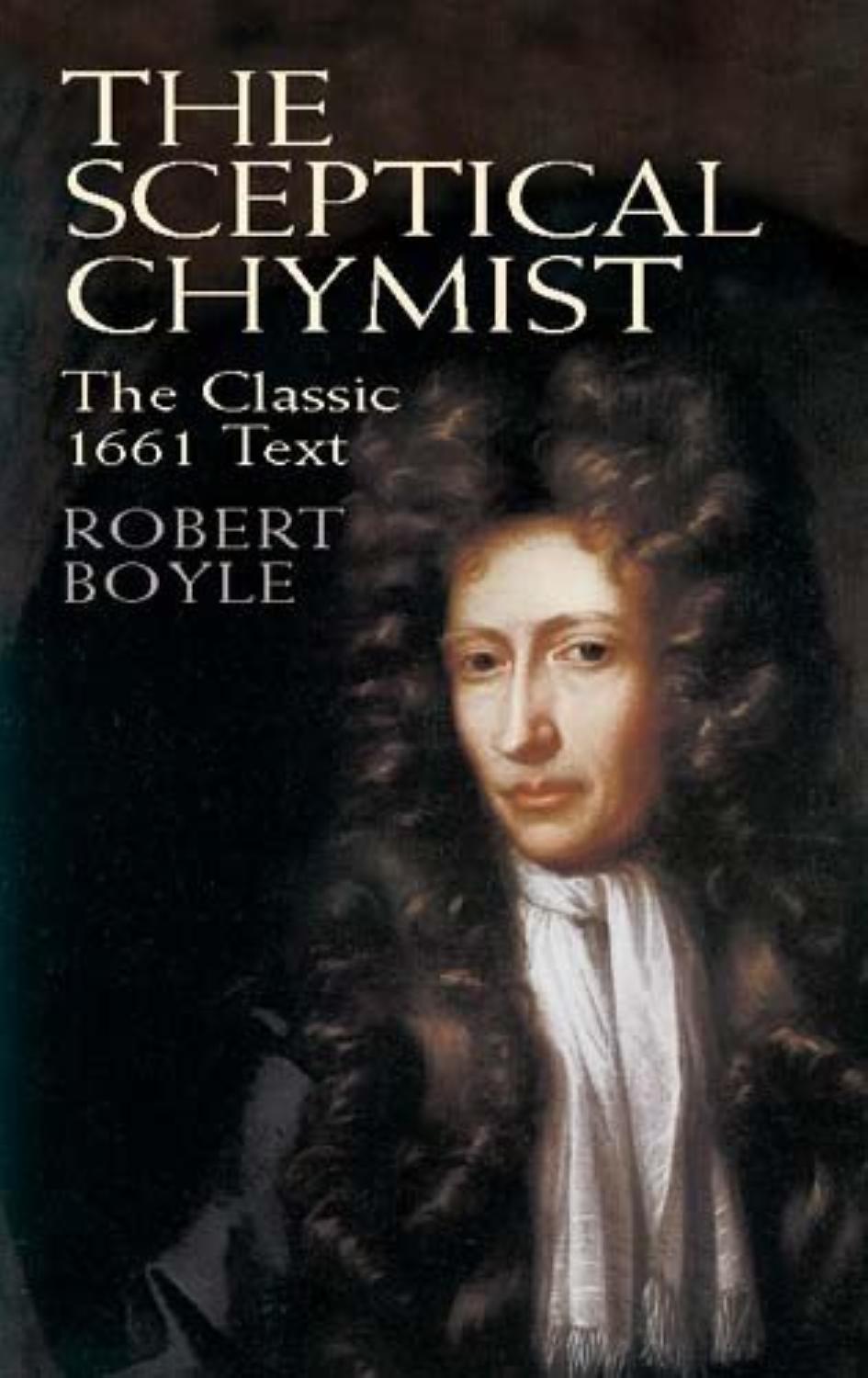
The Sceptical Chymist
Published in 1661, this treatise takes the form of a dialogue among several natural philosophers who gather in a garden and argue over what matter is actually made of. Robert Boyle uses the conversation to attack two long-accepted schemes: the Aristotelian four elements (earth, air, fire, water) and the Paracelsian three principles (salt, sulphur, mercury). In their place he presses a corpuscular view, holding that substances are built from tiny particles in motion, and he insists that a true element must be a body that cannot be resolved into anything simpler. Boyle grounds his doubts in experiment rather than inherited authority. The work helped pull chemistry away from alchemy and toward a rigorous, evidence-based science, which is one reason Boyle is often counted among the founders of modern chemistry.