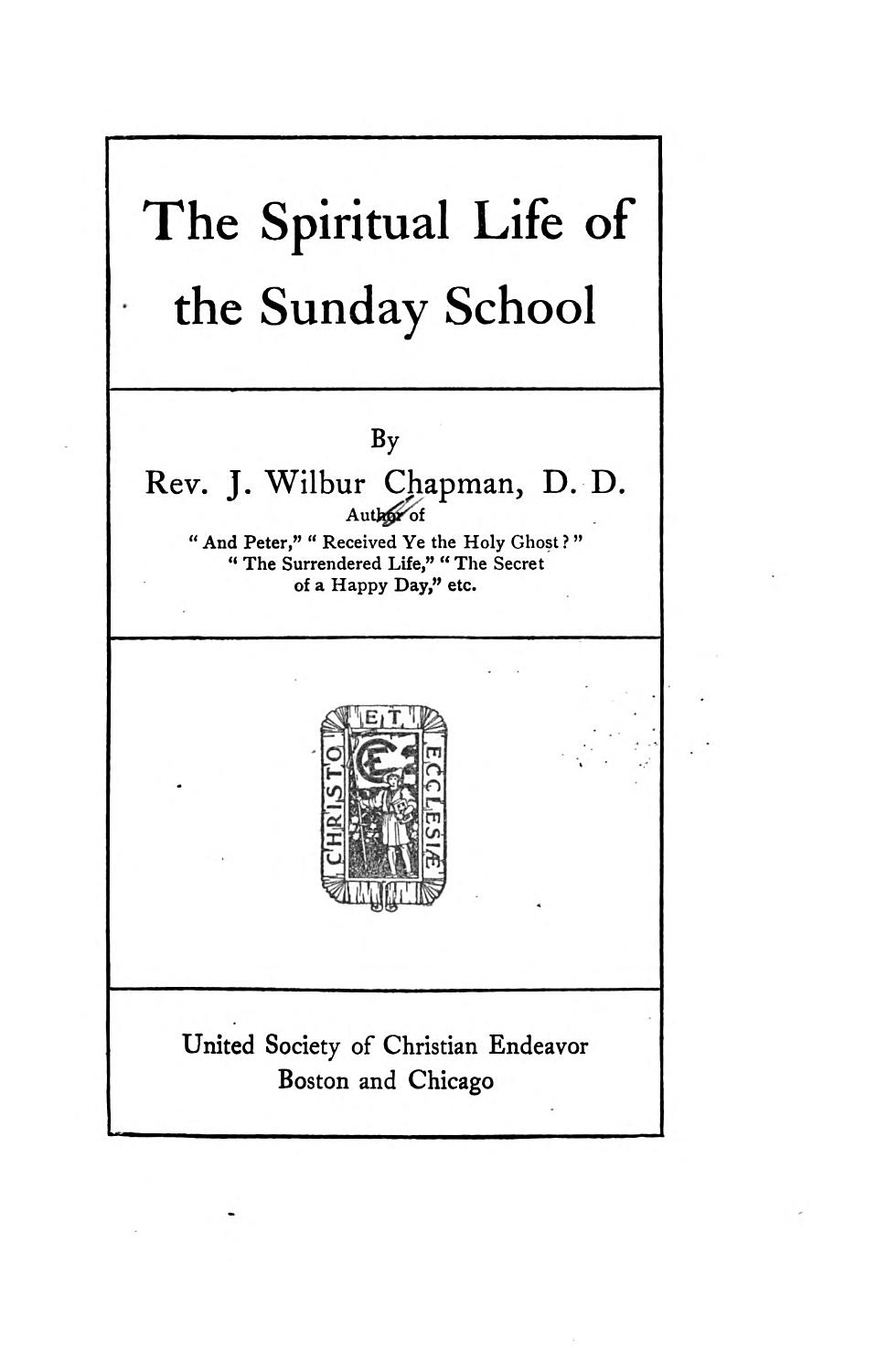
The Spiritual Life of the Sunday School
The Spiritual Life of the Sunday School is a religious educational work by John Wilbur Chapman, the American Presbyterian minister and evangelist who lived from 1859 to 1918 and who was one of the most prominent American Protestant evangelists of the generation between Dwight L Moody and Billy Sunday.
Chapman conducted large scale evangelistic campaigns across the United States and in Australia, Britain, and various other parts of the English speaking world during the late nineteenth and early twentieth centuries. He developed the simultaneous evangelistic campaign method in which a coordinated evangelistic effort would be conducted across all the Protestant churches of a city or region simultaneously, with central rallies in the large halls supported by smaller meetings at the individual congregations. The method became one of the standard approaches to large scale American evangelistic work in the early twentieth century and influenced the later campaign methods of Billy Sunday and eventually Billy Graham.
Alongside his evangelistic work Chapman produced a substantial body of writing on various aspects of practical Christian ministry and religious education. The Spiritual Life of the Sunday School belongs to this strand of his work. The Sunday school was one of the major institutions of late nineteenth and early twentieth century American Protestantism, providing weekly religious education for children and substantial numbers of adults across the various Protestant denominations. The quality and content of Sunday school instruction was a subject of substantial denominational and inter denominational attention, with various organisations producing curriculum materials, teacher training programs, and supporting literature for the Sunday school workers who staffed the programs.
Chapman’s book addresses the spiritual rather than the technical or curricular aspects of Sunday school work. He is interested in the question of how Sunday school teachers and superintendents can themselves cultivate the personal religious life that the work requires, and how the Sunday school as an institution can be shaped to support the genuine spiritual development of the children and young people who attend it. The book belongs to the substantial body of devotional and practical literature that the American Protestant Sunday school movement produced during its peak period.
The book is mostly of interest now to historians of American Protestant religious education and to readers of early twentieth century evangelical devotional literature.