Wakondah, the Master of Life
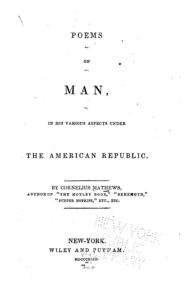
Wakondah, the Master of Life is a long poem by Cornelius Mathews, the American writer who lived from 1817 to 1889 and who was one of the central figures of the Young America literary movement of the 1840s. Mathews produced poetry, fiction, and journalism in support of the movement’s goal of developing a distinctively American literature drawing on American historical, geographical, and cultural material rather than on the European traditions that had dominated earlier American writing.
The poem takes its central material from Native American religious tradition. Wakondah is one of the names for the supreme being or great spirit in the religious vocabulary of various Plains Indian peoples, particularly the Sioux and related groups. Mathews uses the figure as the central subject of a long narrative poem that attempts to render Native American religious and mythological material in English verse, drawing on the popular ethnographic and travel literature about Native American peoples that was available to American readers in the 1830s and 1840s.
The attempt to use Native American material as the basis of serious American literature was part of the broader Young America program. The movement believed that American writers needed to find subjects that were distinctively American rather than imitative of European literary traditions, and Native American myth, history, and religious tradition seemed to many of the Young America writers to provide such material. The various long poems and novels that came out of this impulse, including Mathews’s Wakondah and Longfellow’s much more famous Hiawatha of 1855, attempted with varying degrees of success to translate Native American cultural material into the forms of nineteenth century European literature.
The poem was not a major popular success and Mathews’s literary reputation has not survived in the way that Longfellow’s has. The treatment of the Native American material is shaped by the assumptions of the period and would be considered uncomfortable in various ways by modern readers, although Mathews’s intent was generally respectful within the limits of his understanding. The poem is mostly of interest now as a document of the Young America literary movement and of nineteenth century American literary engagement with Native American subjects.
The book is short and reads as a single sitting. For readers interested in early American literary nationalism, this is a representative example.
About the Author
Download free books by Cornelius Mathews on BDeBooks. Read Cornelius Mathews’s works online or download as PDF/EPUB · part of our growing free eBook collection.
See all books by Cornelius Mathews →