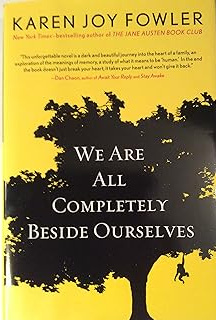
We Are All Completely Beside Ourselves
Karen Joy Fowler had already written several well received novels, including The Jane Austen Book Club, when she published We Are All Completely Beside Ourselves in 2013. The book ended up on the Booker Prize shortlist, won the PEN Faulkner Award, and surprised a lot of readers who thought they knew what kind of novelist Fowler was.
The narrator, Rosemary Cooke, is a college student in the late 1990s who tells you early on that she is going to start her story in the middle. She has reasons. Rosemary grew up in a family that was the subject of an unusual scientific experiment, and the central premise of the novel is something most reviewers refused to spoil at the time. The result was that thousands of readers came to the book knowing only that something strange had happened in Rosemary’s childhood and that she has spent her adult life avoiding the truth of it.
The revelation, when it comes, reframes everything. Fowler then spends the rest of the book exploring what that childhood meant for Rosemary, her sister Fern, her brother Lowell, and her parents, and the questions the novel asks about animal consciousness, scientific ethics, and family memory linger long after the final page. The prose is funny in a dry, slightly melancholy way that fits the narrator perfectly.
Readers who like character driven fiction with a strong moral undercurrent should give this book a try. It is not a long novel and Fowler’s pacing is excellent. She is one of those writers who can be very serious and very playful at the same time, and We Are All Completely Beside Ourselves is the book where she pulled that combination off most fully.
About the Author
Karen Joy Fowler is an American writer renowned for her wide range of literary works. Her 1991 debut book, “Sarah Canary,” was well-received by critics. It is set in nineteenth-century America and centers on the theme of alienation, with characters including a Chinese American, a…
See all books by Karen Joy Fowler →