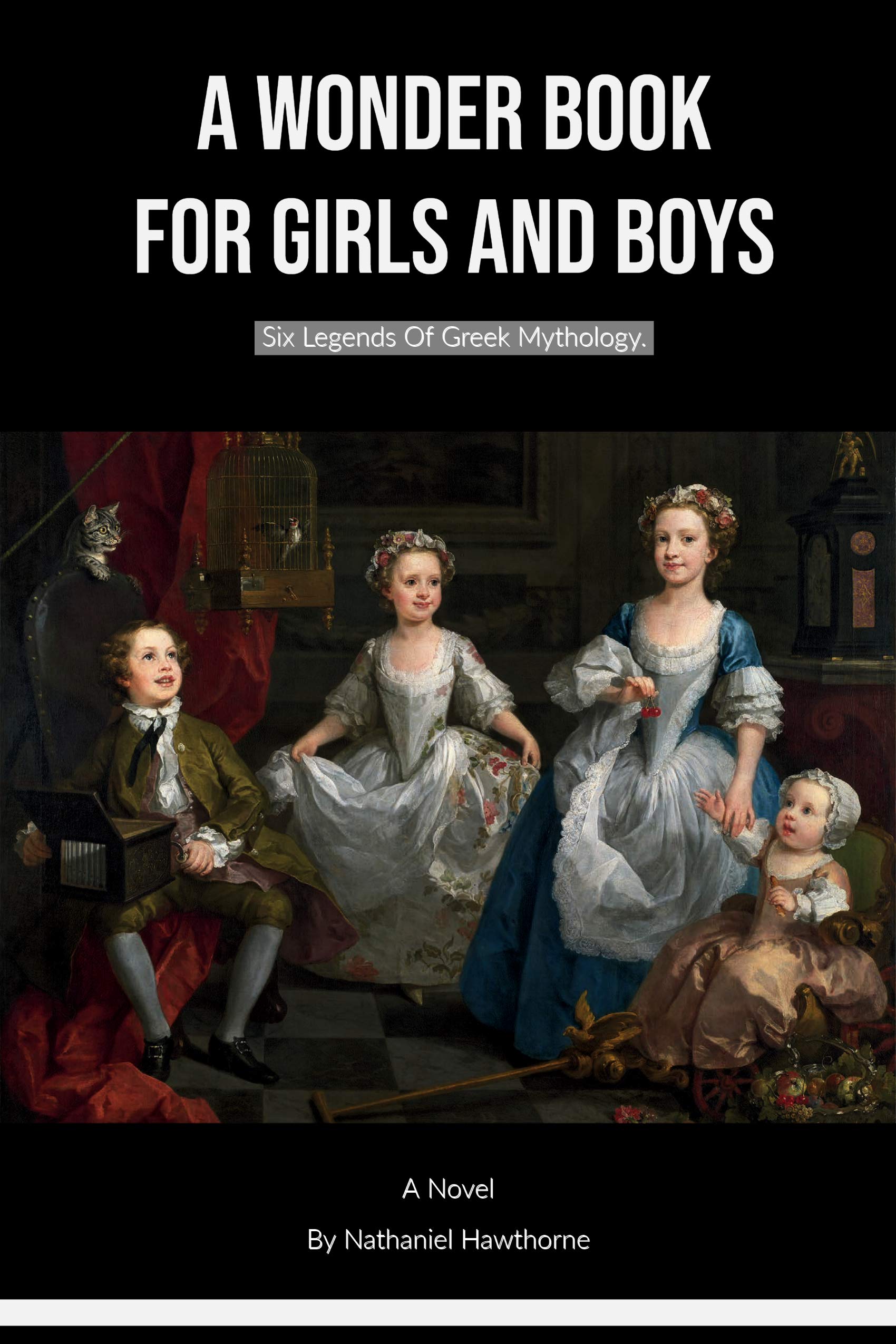
A Wonder Book for Girls and Boys
A Wonder Book for Girls and Boys is Nathaniel Hawthorne’s 1851 collection of retold Greek myths for young readers, one of his most beloved books for children and one of the texts that helped shape American family reading for generations. Hawthorne wrote the book at a moment when classical mythology was a standard part of American school curricula but the available retellings for children were often dry or moralizing in ways that made the stories difficult for young readers to actually engage with. His own retellings were aimed at making the myths come alive for children in ways that the more academic versions could not.
The collection contains six major Greek myths, retold in Hawthorne’s own prose and framed with a connecting story about a young storyteller named Eustace Bright who is entertaining a group of children at the Tanglewood estate in the Berkshires. The myths include the Gorgon’s Head about Perseus and Medusa, the Golden Touch about King Midas, the Paradise of Children about Pandora’s box, the Three Golden Apples about Hercules, the Miraculous Pitcher about Baucis and Philemon, and the Chimaera about Bellerophon and the winged horse Pegasus. Hawthorne renders each story in the kind of warm, accessible prose that respects his young audience without talking down to them.
Hawthorne would follow A Wonder Book with a sequel called Tanglewood Tales in 1853, continuing the framing device with Eustace Bright and adding six more retold Greek myths. Together the two books became standard family reading in nineteenth and early twentieth century America, with generations of children encountering the myths first through Hawthorne’s versions before going on to read the more direct translations of the original Greek and Roman sources.
Hawthorne’s prose in the Wonder Book is more accessible than the heavier moral allegories of his major novels. The voice is that of a storyteller working to entertain children rather than a moralist working through the deeper themes that animate The Scarlet Letter and The House of the Seven Gables. The result is a book that reads as warmly today as it did in 1851, with the central pleasure of the stories themselves still very much intact even after more than a century and a half of subsequent retellings have appeared.
For families with young children who are encountering Greek mythology for the first time, A Wonder Book for Girls and Boys remains essential.
About the Author
Nathaniel Hawthorne was a 19th-century American novelist and short-story writer central to the Dark Romantic movement. He is best known for The Scarlet Letter and The House of the Seven Gables, with their themes of sin, guilt, and Puritan New England.
See all books by Nathaniel Hawthorne →
Listen to A Wonder Book for Girls and Boys Audiobook Free
Listen to A Wonder Book for Girls and Boys by Nathaniel Hawthorne free online. The full audiobook (5 hr 9 min, 14 chapters, read by Clive Catterall) streams free on this page.
A Wonder Book for Girls and Boys (1851) is a public domain work.
| # | Chapter | Length | |
|---|---|---|---|
| 1 | Preface | 2:52 | |
| 2 | Chapter 1 Part 1 - The Gorgon's Head | 23:26 | |
| 3 | Chapter 1 Part 2 - The Gorgon's Head | 20:42 | |
| 4 | Chapter 1 Part 3 - The Gorgon's Head | 16:47 | |
| 5 | Chapter 2 Part 1 - The Golden Touch | 20:53 | |
| 6 | Chapter 2 Part 2 - The Golden Touch | 23:49 | |
| 7 | Chapter 3 Part 1 - The Paradise of Children | 23:17 | |
| 8 | Chapter 3 Part 2 - The Paradise of Children | 16:57 | |
| 9 | Chapter 4 Part 1 - The Three Golden Apples | 25:37 | |
| 10 | Chapter 4 Part 2 - The Three Golden Apples | 28:21 | |
| 11 | Chapter 5 Part 1 - The Miraculous Pitcher | 23:33 | |
| 12 | Chapter 5 Part 2 - The Miraculous Pitcher | 23:45 | |
| 13 | Chapter 6 Part 1 - The Chimaera | 28:55 | |
| 14 | Chapter 6 Part 2 - The Chimaera | 29:47 |
Prefer reading? Read A Wonder Book for Girls and Boys online free or download the PDF and EPUB above.