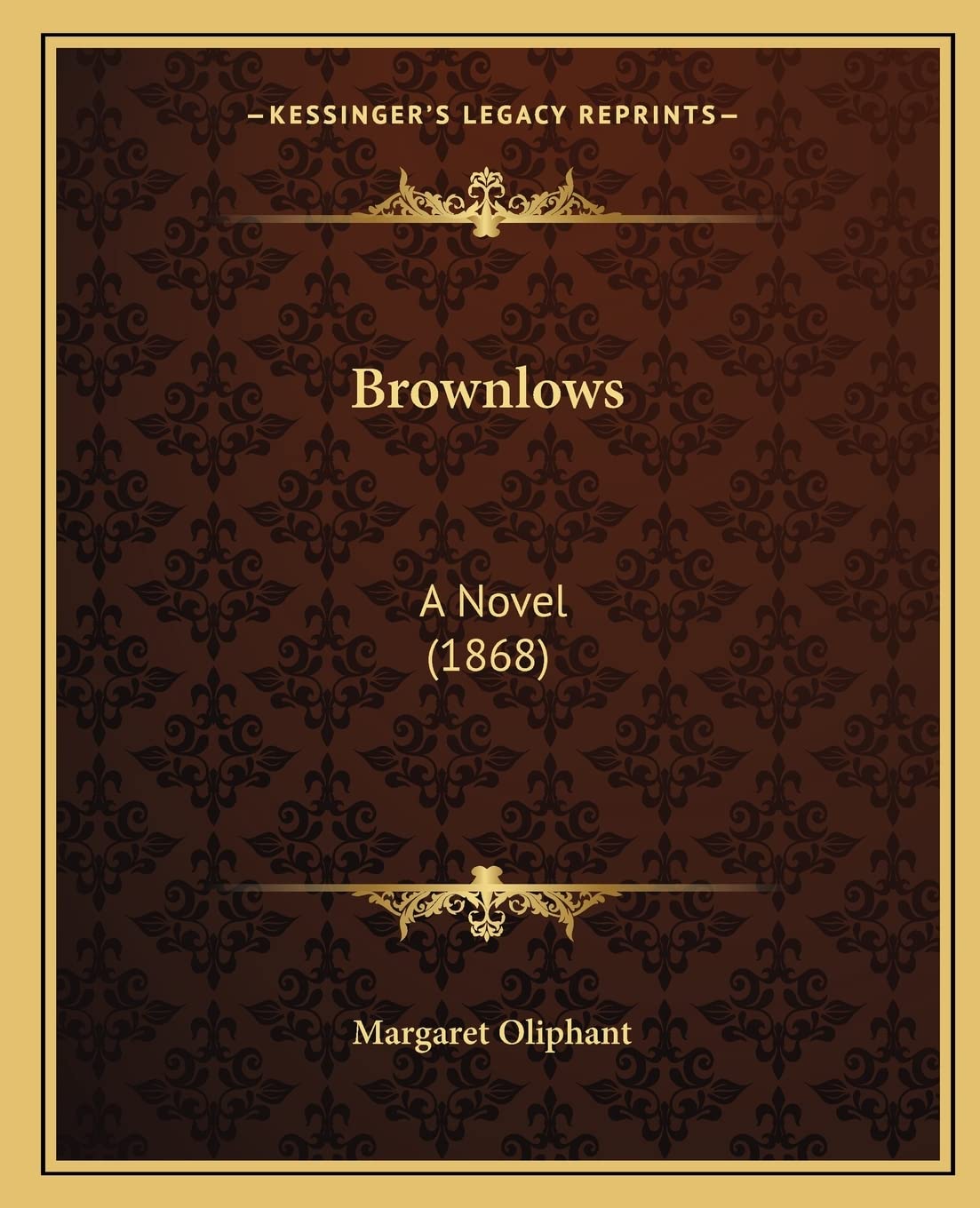
Brownlows
Brownlows is one of Margaret Oliphant’s many Victorian novels, possibly part of her Carlingford Chronicles or one of her other connected series of English provincial fiction. Oliphant was one of the most prolific and respected writers of the Victorian era, with a working career that produced more than ninety novels and hundreds of articles, all written under the financial pressure of supporting her own children and several extended family members after her husband’s early death.
The Brownlows of the title likely refers to a particular family whose various members and their interlocking relationships drive the central plot of the novel. Oliphant’s novels often built around the slow developing relationships within and between specific Victorian middle class families, with the rigid social codes and economic constraints of the period providing both the structural framework and the source of the various complications that her plots worked through. The Brownlow family novel would fit comfortably into her wider catalogue of careful psychological observation of middle class Victorian English life.
What distinguishes Oliphant from many of her contemporaries is her unsparing eye for the limitations of the social world she was depicting. Her novels are sometimes funny, often moving, and almost always more morally complicated than their domestic settings would suggest. She was not a sentimental writer despite the sometimes sentimental subject matter she worked with, and her best novels reward the patient reader with insights into Victorian middle class life that drier social histories cannot match. The Brownlow family novel would give her room to develop the kind of careful character work that her best fiction shows.
Oliphant’s prose is unhurried in the way Victorian novels often are, with long passages of psychological observation, careful descriptions of social setting, and dialogue that captures the formal rhythms of polite middle class speech in the period. The pacing is slower than modern novels and the prose is in the formal late Victorian style, but readers who settle into the rhythm find a strong, character driven novel that takes its time with its themes.
For readers interested in Victorian fiction, in the wider catalogue of Margaret Oliphant beyond her famous Carlingford novels and her ghost stories, or in the women writers of the era who have been overshadowed by their male contemporaries, Brownlows is worth knowing. The novel sits in the wider body of work that Oliphant produced across her remarkable career, and the family novel format gives readers a sample of the kind of careful Victorian fiction that her best work shows.
About the Author
Download free books by Margaret Oliphant on BDeBooks. Read Margaret Oliphant’s works online or download as PDF/EPUB · part of our growing free eBook collection.
See all books by Margaret Oliphant →