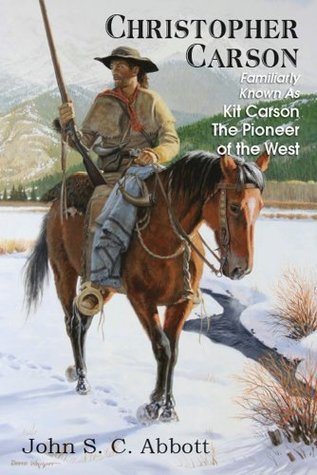
Christopher Carson
Christopher Carson, Familiarly Known as Kit Carson, the Pioneer of the West is a popular biography by John Stevens Cabot Abbott. The book appeared in 1873, five years after Carson’s death in 1868.
Kit Carson (1809-1868) was among the most famous figures of the nineteenth-century American frontier. His career as trapper, scout, guide, military officer, and Indian agent took him across the American West from the 1820s onward. He participated in many of the major events of frontier expansion, including the various Western explorations of John C. Fremont, the Mexican-American War, several Indian campaigns, and the broader American conquest of the territories acquired from Mexico in 1848.
Abbott belongs to the strain of nineteenth-century American writers who produced popular frontier biographies for the substantial post-Civil War market. Readers wanted accessible accounts of the recently closed frontier, and writers like Abbott, Edward Ellis, and various others met the demand. The biographies typically combined available primary sources, including the subjects’ own narratives where they existed, with the kind of dramatic reconstruction that the popular form encouraged.
Abbott handles Carson in the heroic biographical mode the period favored. Carson appears as a model of frontier virtues: physical courage, practical competence, honesty in dealings with both settlers and indigenous peoples, and loyalty to the broader American national project. The treatment of indigenous peoples reflects nineteenth-century American assumptions and is uncomfortable for modern readers in various ways, though Abbott is more measured than many of his contemporaries and treats individual Native characters with more respect than the sweeping generalizations often allowed.
The book runs about three hundred pages. For readers interested in nineteenth-century American popular frontier biography, Abbott’s Carson is a standard example. It pairs with his David Crockett, with Edward Ellis’s various frontier books, and with the actual Carson autobiography that the historian DeWitt Peters had recorded in the 1850s.
About the Author
Download free books by John Stevens Cabot Abbott on BDeBooks. Read John Stevens Cabot Abbott’s works online or download as PDF/EPUB · part of our growing free eBook collection.
See all books by John Stevens Cabot Abbott →