Dolly Reforming Herself
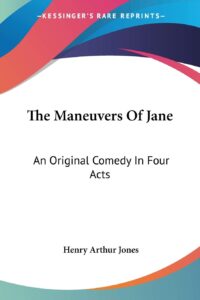
Dolly Reforming Herself is a comedy in four acts by Henry Arthur Jones, first performed at the Haymarket Theatre, London, in November 1908. Jones, who lived from 1851 to 1929, was one of the most prolific and commercially successful English playwrights of the late Victorian and Edwardian periods, producing more than sixty plays across a long working career.
The play is a comedy of manners in the Edwardian drawing room mode, set at the country house of Dolly and Harry Telfer on New Year’s Day. The thirty year old Dolly has resolved, in the spirit of New Year’s resolutions, to reform certain habits that have been causing friction in her marriage and in her social life. The play follows her various efforts at self improvement across a single day of country house life, with the inevitable complications that arise when other characters with their own agendas interact with her resolutions.
Jones was working within the well established convention of Edwardian domestic comedy that took the well-to-do English country house as its setting and the small social and romantic dramas of its inhabitants as its material. The play has the polished surface that the genre required, with witty dialogue, carefully drawn minor characters, and the kind of plot complications that allowed actors substantial scenes of comic performance. Jones had been writing in this mode for decades and was extremely good at it.
The play was successful in its original production and remained in the West End repertoire for several seasons. It belongs to the substantial body of late Victorian and Edwardian comedy that has not stayed in the active theatrical canon but that gives a useful picture of how serious commercial theatre actually worked during the period before the First World War transformed the British theatrical world.
Jones occupied a particular position in the late Victorian and Edwardian theatre. He was admired by Bernard Shaw and other serious dramatic critics as one of the writers who had helped raise the artistic standards of the English commercial theatre, while also remaining a commercial success in a way that Shaw himself struggled to achieve until late in his career. The play runs about a hundred pages in standard published form. For readers interested in Edwardian English theatrical comedy, this is a representative example.
About the Author
Read and download 4 free books by Henry Arthur Jones on BDeBooks. Browse the complete collection of Henry Arthur Jones’s works available as free PDF and EPUB downloads. Discover novels, fiction, and other writings by Henry Arthur Jones in our online eBook library.
See all books by Henry Arthur Jones →