Florien
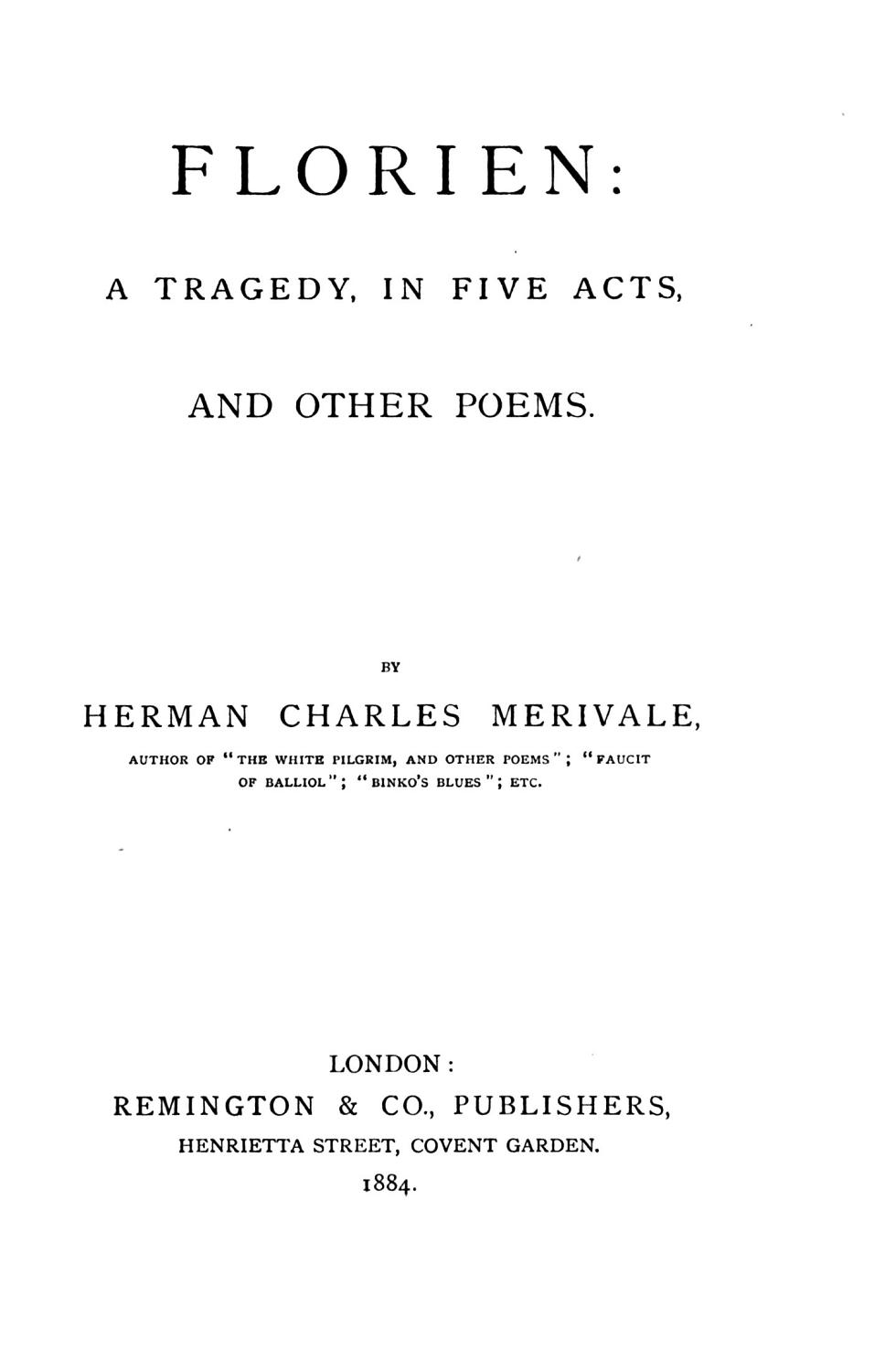
Florien is a work by Herman Charles Merivale, the English playwright, novelist, and journalist who lived from 1839 to 1906. Merivale produced a substantial body of dramatic and literary work across the late Victorian period and was a substantial figure in the London theatrical and literary world of the second half of the nineteenth century.
Merivale was the son of John Lewis Mallet and the nephew of Charles Merivale, the historian of Rome, and was raised within the substantial London literary and intellectual world of the mid Victorian period. He was educated at Harrow and Oxford and was called to the bar before turning to literature as his main occupation. His various plays for the London commercial stage included substantial successes during the 1870s and 1880s, with works produced at the major West End theatres of the period.
Florien belongs to Merivale’s literary output and may be either a play, a novel, or a verse work depending on the particular treatment Merivale chose for the material. The name Florien suggests a romantic or historical subject, possibly with classical or medieval European setting, in the manner that Victorian romantic literature characteristically favoured. Various of Merivale’s other works took up similar romantic historical subjects and presented them in the elevated literary mode that the period’s serious popular literature required.
Merivale also produced substantial work for the newer journalistic forms that the late Victorian period was developing. He contributed to various London magazines and newspapers and was for a time the dramatic critic for the Athenaeum. His various theatrical reviews and his broader writings on the contemporary London theatrical scene give substantial documentary material for historians of late Victorian English theatre.
Merivale’s later years were affected by mental illness, with substantial periods of hospitalisation that limited his literary output during the 1890s and early 1900s before his death in 1906. His various plays and other works continued to be performed and read in his own time but have not generally survived in the active canon of late Victorian English literature.
The book is of interest now to readers of late Victorian English drama and popular literature, particularly to those interested in the substantial commercial London theatrical world of the period. It pairs naturally with Merivale’s other plays and with the broader Victorian theatrical literature.