
Humorous Verses
Humorous verses
This chapter is long, so it is split into 3 parts.
Lawson, Henry, 1867-1922
This book was produced in EPUB format by the Internet Archive.
The book pages were scanned and converted to EPUB
format automatically. This process relies on optical character recognition, and is somewhat susceptible to errors. The book may not offer the correct reading sequence, and there may be weird characters, non-words, and incorrect guesses at structure. Some page numbers and headers or footers may remain from the scanned page. The process which identifies images might have found stray marks on the page which are not actually images from the book. The hidden page numbering which may be available to your ereader corresponds to the numbered pages in the print edition, but is not an exact match; page numbers will increment at the same rate as the corresponding print edition, but we may have started numbering before the print book's visible page numbers. The Internet Archive is working to improve the scanning process and resulting books, but in the meantime, we hope that this book will be useful to you.
The Internet Archive was founded in 1996 to build an Internet library and to promote universal access to all knowledge. The Archive's purposes include offering permanent access for researchers, historians, scholars, people with disabilities, and the general public to historical collections that exist in digital format. The
Internet Archive includes texts, audio, moving images, and software as well as archived web pages, and provides specialized services for information access for the blind and other persons with disabilities.
Created with abbyy2epub (v.1.7.6)
9599
CORNELL
UNIVERSITY
LIBRARY
BOUGHT WITH THE INCOME OF THE SAGE ENDOWMENT
FUND GIVEN IN 1891 BY
HENRY WILLIAMS SAGE
Cornell University Library PR 9599.L42H9
Humorous verses.
3 1924 013 249 564
The original of tliis book is in tlie Cornell University Library.
There are no known copyright restrictions in the United States on the use of the text.
http://www.archive.org/details/cu31924013249564
Silver Star
RICE
STARCH
Jhe ^esf in the World.
^ WONT STICK TO THE IRON.
-Requires No Boilin]
TAKE CC
CREAMOL"
B-OH
CONSUMPTION, COUGHS &. COLDS, - - - CHRONIC ASTHMA OR BRONCHITIS,
AND OTHEB COMPIAINTS OF THE
CHEST, THROAT AND LUNGS.
Unequalled for restoring the system after an attack of INFLUENZA
(Sreamol" Conquers 7>ebiliig -
if
. . Ain> . .
( Wasting Jfiseases of all /(I'tjds.
\ A.XTX3 <
1 j
\ A.XTX3 <
■) I
FAT, STRONG & HEALTHY.
Sweet and Pleasant to Take.
Reoommended and prescribed by Physicians, from whom we hold testimonials, copies of which we will post on application.
ORBAMOL" IS OBTAINABLE EVBBYWHBRB.
Proprietors: The Australian Drugr Co., Ltd., Sjinef.
IS THE
CHEAPEST
AND
^,„„,„.,^ BEST HOUSE
Pianos, Organs, Musical Instruments
OF EVERY DESCRIPTION.
Save Money by Purchasing
a Reliable and Perfect Piano, ench as the following, which are constructed of the Best* seasoned Materials, and have the Most Improved Actions,and, furthermore, contain MODERN IMFBOTEMENTS
IN OONSTBUOTION.
STEINWAY, BRINSMEAD,
I IDD /The genuine B.\ ^ l^ltrtry LippfcSohn I at Penrlcb, Carl Bcke, Qor* and Kallmon, The Victor and " Belling."
W, H. PALING & CO., LTD.
Established 1S68.
Paling fir Co., Ltd., are able to give the Best Value owins ^ to the unmenae, Dumber they seU. Their present enormouB trade is owing to wonderful value, also to the fact that the Pianw give unusual satisfacti<Dn, even in most tryiiitf^parts of Queensland. PianoBmay be nought for Cash, th are supplied to apy part of the Oolony on Easy lime-Payment from 20S. monthly.
Paling & Oo.'s nsaally immense stock has lately been-', augmented by the ariivsl' of severid large shipments, and is now ex< ceptional^
complete.
338 QEORQE STREET, SYDNEY.
HUMOROUS VERSES
I desire to thank the editor and proprietors of the Sydney Bulletin for the privilege of reprinting the verses in this volume.
H. L. Sydney, March 17th, 1900.
HUMOROUS VERSES
HENRY LAWSON
Author of " When the World was Wide and Other Vkrbhb,' "While the Billt Boils," "On the Track and Over THE SLIPRAILS," AND " POPDLAR VERSES "
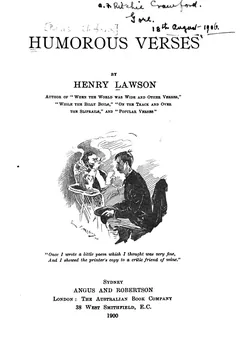
" Once 1 vyfote a little poem which I thought was very Jiiie, Atid I showed the printer's copy to a critic friend of unine.*
Sydkey
ANGUS AND ROBBETSON
London : The Australian Book Company
38 West Smithweld, E.G.
1900
Sydsey :
Websbalb, Shoosmith and Co., Printers,
117 Clarbncb Strbbt.
CONTENTS.
PASE
MY LITERARY FRIEND
Once I wrote a little poem which I
thought was very fine, . . . 125
MARY CALLED HIM 'MISTER'
They'd parted but a year before—she
never thought he'd come, . . . 127
REJECTED
She says she's very sorry, as she sees you to the gate; . . . . . 130
O'HARA, J. P.
James Patrick O'Hara, the Justice of
Peace, 134.
BILL AND JIM FALL OUT
Bill and Jim are mates no longer—they would scorn the name of mate— . 138
THE PAROO
It was a week from Christmas-time, . 142
vi. CONTENTS
THE GREEN-HAND ROUSEABOUT
Call this hot 1 I beg your pardon. Hot! —you don't know what it means.
THE MAN FROM WATERLOO
It was the Man from Waterloo,
SAINT PETER
Now, I (jhink there is a likeness
THE STRANGER'S FRIEND
The strangest things, and the maddest things, that a man can do or say,
THE GOD-FORGOTTEN ELECTION
Pat M'Durmer brought the tidings to the town of God-Forgotten : . . .
THE BOSS'S BOOTS
The shearers squint along the pens, they squint along the ' shoots ;'
THE CAPTAIN OF THE PUSH
As the night was falling slowly down on city, town and bush,
BILLY'S 'SQUARE AFFAIR'
Long Bill, the captain of the push, was tired of his estate, ....
CONTENTS vii.
PAGE
A DERRY ON A COVE
'Twas in the felon's dock he stood, his
eyes were black and blue; . .185
RISE YE! RISE YE!
Rise ye ! rise ye! noble toilers ! claim
your rights with fire and steel! . 187
THE BALLAD OF MABEL CLARE
Ye children of the Land of Gold, . 190
CONSTABLE M'CARTHY'S INVESTIGATIONS
Most unpleasantly adjacent to the haunts
of lower orders . . . .196
AT THE TUG-OF-WAR
'Twas in a tug-of-war where I—the
guvnor's hope and pride— . . 205
HERE'S LUCK!
Old Time is tramping close to-day—you
hear his bluchers fall, . . . 208
THE MEN WHO COME BEHIND
There's a class of men (and women) who
are always on their guard— . . 211
viii. CONTENTS
THE DAYS WHEN WE WENT SWIMMING The breezes waved the silver grass,
the"OLD BARK SCHOOL
It was built of bark and poles, and the floor was full of holes TROUBLE ON THE SELECTION
You lazy boy, you're here at last,
THE PROFESSIONAL WANDERER
When you've knocked about the country —been away from home for years;
A LITTLE MISTAKE
'Tis a yarn I heard of a new-chum • trap '
A STUDY IN THE "NOOD"
He was bare—we don't want to be rude—
A WORD TO TEXAS JACK
Texas Jack, you are amusin'. By Lord Harry, how I laughed
THE GROG-AN'-GRUMBLE STEEPLECHASE 'Twixt the coastline and the border lay the town of Grog-an'-Grumble BUT WHAT'S THE USE
But what's the use of writing ' bush'—
Once I wrote a little poem which'I thought was very fine, And I showed the printer's copy to a critic friend of mine, First lie. praised the thing a little, then he found a little fault; ' The ideas are good,' he muttered, ' but the rhythm seems to halt.'
So I straighten'd up the rhythm where he marked it with his pen, And I copied it and showed it to my clever friend again. ' You've improved the metre greatly, but the rhymes are bad,' he said. As he read it slowly, scratching surplus wisdom from
his head.
126
r..,"r I
126 MY LITERARY FRIEND
So I worked as he suggested (I believe in taking time), , And, I burnt the ' midnight taper' while I
straightened up the rhyme. ' It is better now,' he muttered, ' you go on and
you'll succeed, ' It has got a ring about it—the ideas are what you need.'
So I worked for hours upon it (I go on when I commence). And I kept in view the rhythm and the jingle and the sense, And I copied it and took it to my solemn friend once more— It reminded him of something he had somewhere read before.
Now the people say I'd never put such horrors into print If I wasn't too conceited to accept a friendly hint, And my dsarest friends are certain that I'd profit in the end If I'd always show my copy to a literary friend.
They'd parted but a year before—she never thought he'd come, She stammer'd, blushed, held out her hand, and called him ' Mister Gum.' How could he know that all the while she longed to
murmur ' John.' He called her ' Miss le Brook,' and asked how she was
getting on.
They'd parted but a year before; they'd loved each other well, But he'd been to the city, and he came back such a
swell. They longed to meet in fond embrace, they hungered for a kiss— But Mary called him ' Mister,' and the idiot called her ' Miss.'
He stood and lean'd against the door—a stupid chap was he— And, when she asked if he'd come in and have a cup of tea, He looked to left, he looked to right, and then he glanced behind, And slowly doflfed his cabbage-tree, and said he
' didn't mind.'
She made a shy apology because the meat was tough. And then she asked if he was sure his tea was sweet enough; He stirred the tea and sipped it twice, and answer'd
' plenty, quite ;' And cut the smallest piece of beef and said that it was ' right.'
She glanced at him at times and cough'd an awkward little cough; He stared at anything but her and said, ' T must be off.' That evening he went riding north—a sad and lonely rideShe locked herself inside her room, and there sat down and cried.
MARY CALLED HIM • MISTER ' 129
They'd parted but a year before, they loved each
other wellBut she was such a country girl and he was such a swell ; They longed to meet in fond embrace, they hungered for a kiss— But Mary called him ' Mister ' and the idiot called her ' Miss.'
REJECTED
She says she's very sorry, as she sees you to the gate; You calmly say ' Good-bye' to her while standing off a yard, Then you lift your hat and leave her, walking mighty stiff and straight— But you're hit, old man—hit hard.
In your brain the words are burning of the answer that she gave, As you turn the nearest corner and you stagger just a bit; But you pull yourself together, for a man's strong heart is brave When it's hit, old man—hard hit.
130
REJECTED 1.31
You might try to drown the sorrow, but the drink has no effect; You cannot stand the barmaid with her coarse and vulgar wit; And so you seek the street again, and start for home direct. When you're hit, old man—hard hit.
You see the face of her you lost, the pity in her smile— Ah ! she is to the barmaid as is snow to chimney grit; You're a better man and nobler in your sorrow, for. a while. When you're hit, old man—hard hit.
And, arriving at your lodgings, with a face of deepest gloom. You shun the other boarders and your manly brow you knit; You take a light and go upstairs directly to your roomBut the whole house knows you're hit.
132 REJECTED
You clutch the scarf and collar, and you tear them from your throat, You rip your waistcoat open like a fellow in a fit; And you fling them in a corner with the made-toorder coat, When you're hit, old man —
hard hit.
You throw yourself, despairing, on your narrow little bed. Or pace the room till someone starts with ' Skit! cat!—skit!' And then lie blindly staring at the plaster overhead— You are hit, old man—hard hit.
It's doubtful whether vanity or love has sufiered worst. So neatly in our nature are those feelings interknit. Your heart keeps swelling up so bad, you wish that it would burst. When you're hit, old man—hard hit.
You thinlc and think, and think, and think, till you go mad almost; Across your sight the spectres of the bygone seem to flit; REJECTED 133
The very girl herself seems dead, and comes back as a ghost, When you're hit, like this—hard hit.
You know that it's all over—you're an older man by years, In the future not a twinkle, in your black sky not a split. Ah! you'll think it well that women have the privilege of tears. When you're hit, old man
—hard hit.
You long and hope for nothing but the rest that sleep can bring. And you find that in the morning things have brightened up a bit; But you're dull for many evenings, with a cracked heart in a sling. When you're hit, old man—hard hit.
James Patrick O'Hara, the Justice of Peace, He bossed the P.M. and he bossed the police ; A parent, a deacon, a landlord was he— A townsman of weight was O'Hara, J.P.
ft He gave out the prizes, foundation-stones laid, He shone when the Governor's visit was paid ; And twice re-elected as Mayor was he—
The flies couldn't roost on O'Hara, J.P,
Now Sandy M'Ply, of the Axe-and-the-Saw, Was charged with a breach of the licensing lawHe sold after hours whilst talking too free On matters concerning O'Hara, J.P.
134
And each contradicted the next witness flat, Concerning back parlours, side-doors, and all that; 'Twas very conflicting, as all must agree— ' Ye'd betther take care !' said O'Hara, J.P.
But ' Baby,' the barmaid, her evidence gave— A poor, timid darling who.tried to be brave— ' Now, don't be afraid—if it's frightened ye be
— ' Speak out, my good girl,' said O'Hara, J.P.
Her hair was so golden, her eyes were so blue. Her face was so fair and her words seemed so true— So green in the ways of sweet wcmen was he That she jolted the heart of O'Hara, J, P.
He turned to the other grave Justice of Peace, And whispered, ' You can't always trust the police ; ' I'll visit the premises during the day, '
And see/or myself,' said O'Hara, Jay Pay.
(Case postponed.)
'Twas early next morning, or late the same night— ' 'Twas early next morning' we think would be right— And sounds that betokened a breach of the law Escaped through the cracks of the Axe-and-the-Saw.
And Constable Dogherty, out in the street, Met Constable Clancy a bit off his beat; He took him with finger and thumb by the ear, And led him around to a lane in the rear.
He pointed a blind where strange shadows were seen— Wild pantomime hinting of revels within— ' We'll drop on M'Ply, if you'll listen to me, ' And prove we are right to O'Hara, J. P.'
But Clancy was up to the lay of the land,
He cautiously shaded his mouth with his hand—
' Wisht, man ! Howld yer whisht! or it's ruined we'll be, ' It's the justice himself—it's O'Hara, J.P '
They hish'd and they whishted, and turned themselves round, . And got themselves off like two cats on wet ground ; Agreeing to be, on their honour as men, A deaf-dumb-and-blind institution just then.
Inside on a sofa, two barmaids between, With one on his knee was a gentleman seen; And any chance eye at the keyhole could see In less than a wink 'twas O'Hara, J.P.
O'HARA, J. P. 137
The first in the chorus of songs that were sung, The loudest that laughed at the jokes that were sprung, The guest of the evening, the soul of the spree— The daddy of all was O'Hara, J.P.
And hard-cases chuckled, and hard-cases said That Baby and Alice conveyed him to bed— In subsequent storms it was painful to see Those hard-cases side with the sinful J.P.
Next day, in the court, when the case came in sight, O'Hara declared he was satisfied quite; The case was dismissed—it was destined to be The final ukase of O'Hara, J.P.
The law and religion came down on him first— The Christian was hard but his wife was the worst! Half ruined and half driven crazy was he— It made an old man of O'Hara, J.P.
Now, young men who come from the bush, do you hear? Who know not the power of barmaids and beer — Don't see for yourself! from temptation steer free. Remember the fall of O'Hara, J.P.
Bill and Jim are mates no longer—they would scorn the name of mate—
Those two bushmen hate each other with a soul-consuming hate; Yet erstwhile they were as brothers should be (tho' they never will) : Ne'er were mates to one another half so true as Jim and Bill.
Bill was one of those who have to argue every day or die— Though, of course, he swore 'twas Jim who always itched to argufy. They would, on most abstract subjects, contradict each other flat And at- times in lurid language—they were mates in spite of that.
138
Bill believed the Bible story re the origin of him— He was sober, he was steady, he was orthodox ; while
Jim, Who, we grieve to state, was always getting into drunken scrapes, Held that man degenerated from degenerated apes.
Bill was British to the backbone, he was loyal through and through; Jim declared that Blucher's Prussians won the fight
at Waterloo, And he hoped the coloured races would in time wipe out the white— And it rather strained their mateship, but it didn't burst it quite.
They battled round in Maoriland—they saw it through iind through— And argued on the rata, what it was and how it
grew ; Bill believed the vine grew downward, Jim declared that it grew up— Yet they always shared their fortunes to the final bite and sup.
Night after night they argued how the kangaroo was born, And each one held the other's stupid theories in scorn, Bill believed it was ' born inside,' Jim declared it was born out— Each as to his own opinions never had the slightest doubt.
They left the earth to argue and they went among the stars, Be conditions atmospheric, Bill believed ' the hair of Mars ' Was too thin for human bein's to exist in mortal states.' Jim declared it was too thict, if anything—yet they
were mates
Bill for Freetrade—Jim, Protection—argued as to which was best For the welfare of the workers—and their mateship stood the test! They argued over what they meant and didn't mean at all. And what they said and didn't—and were mates in spite of all.
BILL AND JIM FALL OUT 141
Till one night the two together tried to light a fire in camp, When they had a leaky billy and the wood was scarce and damp. And . . . No matter : let the moral be distinctly understood : One alone should tend the fire, while the other brings the wood.
It was a week from Christmas-time,
As near as I remember, And half a year since in the rear We'd left the Darling Timber. The track was hot and more than drear; The long day seemed for ever ; But now we knew that we were near Our camp—the Paroo River.
With blighted eyes and blistered feet,
With stomachs out of order, Half mad with flies and dust and heat We'd crossed the Queensland Border. I longed to hear a stream go by
And see the circles quiver ; T longed to lay me down and die That night on Paroo River.
142
THE PAROO 143
'Tis said the land out West is grand—
I do not care who says it— It isn't even decent scrub, Nor yet an honest desert; It's plagued with flies, and broiling hot, A curse is on it ever ; I really think that God forgot The country round that river.
My mate—a native of the land—
In fiery speech and vulgar, Condemned the flies and cursed the sand,
And doubly damned the mulga. He peered ahead, he peered about
—
A bushman he, and clever— ' Now mind you keep a sharp look-out;
' We must be near the river.'
The ' nose-bags ' heavy on each chest
(God bless one kindly squatter !) With grateful weight our hearts they pressed—
We only wanted water. The sun was setting (in the west) In colour like a liver— ■V^e'd fondly hoped to camp and rest
That night on Paroo River.
144 THE PAROO
A cloud was on my mate's broad brow,
And once I heard him mutter : ' I'd like to see the Darling now,
' God bless the Grand Old Gutter !' And now and then he stopped and said
In tones that made me shiver— ' It cannot well be on ahead,
' I think we've crossed the river'
But soon we saw a strip of ground
That crossed the track we followed— No barer than the surface round.
But just a Uttle hollowed. His brows assumed a thoughtful frown—
This speech he did deliver : ' I wonder if we'd best go down
' Or up the blessed river "i'
' But where,' said I, ' 's the blooming stream f And he replied, ' We're at it!' I stood awhile, as in a dream,
' Great Scott!' I cried, ' is that it ? ' Why, that is some old bridle-track !'
He chuckled, ' Well, I never ! ' It's nearly time you came out-back—
' This is the Paroo River !'
THE PAROO 145
No place to camp—no spot of damp—
No moisture to be seen there; If e'er there was it left no sign That it had ever been there. But ere the morn, with heart and soul We'd cause to thank the Giver— We found a muddy water-hole Some ten miles down the river.
Call thjs hot ? I beg your pardon. Hot!—you don't know what it means. (What's that, waiter? lamb or mutton!
Thank you—
mine is beef and greens. Bread and butter while I'm waiting. Milk?
Oh,
yes—a bucketful.) I'm just in from west the Darling, ' pieking-up ' and
*rolKng wool.'
Mutton stewed or chops for breakfast, dry and tasteless, boiled in fat; Bread or brownie, tea or coffee—two hours' graft in front of that; Legs of mutton boiled for dinner—mutton greasywarm for tea—■
Mutton curried (gave my order, beef and plenty greens for me.) U6
THE GREEN-HAND RODSEABOUX 147
Breakfast, curried rice and mutton till your innards sacrifice, And you sicken at the colour and the smell of curried rice. All day long with living mutton—bits and belly-wool and fleece; Blinded by the yoke of wool, and shirt and trousers
stiff trith grease. Till you long for sigh't of verdure, cabbage-plots and water clear, And you crave for beef and butter as a boozer craves for beer.
Dusty patch in baking mulga—glaring iron hut and shed— Peel and smell of rain forgotten—water scarce and feed-grass dead. Hot and suffocating sunrise—all-pervading sheep-yard
smell— Stiff and aching green-hand stretches—' Slushy' rings the bullock-bell— Pint of tea and hunk of brownie—sinners string towards the shed— Great, black, greasy crows round carcass—
screen
behind of dust-cloud red.
148 THE GREEN-HAND ROUSEABOUT
Engine whistles. ' Go it, tigers!' and the agony begins, Picking up for seven devils out of Hades—for my sins; Picking up for seven devils, seven demons out of Hell! Sell their souls to get the bell-sheep—half a-dozen Christs they'd sell! Day grows hot as where they come from—too danmed
hot for men or brutes; 'Roof of corrugated iron, six-foot-six above the shoots !
Whiz and rattle and vibration, like an endless chain
of trams; Blasphemy of five-and-forty — prickly heat — and stink of rams ! ' Barooo' leaves his pen-door open and the sheep come bucking out; When the rouser goes to pen them, ' Barooo'
blasts
the rouseabout. Injury with insult added—trial of our cursing powers— Cursed and cursing back enough to damn a dozen worlds like ours.
' Take my combs down to the grinder, will yer 1'
' Seen my cattle-pup ?' 'There's a sheep fell down in my shoot—just jump
down and pick it up.' ' Give the oiE.ce when the boss comes.' ' Catch that
gory sheep, old man.' ' Count the sheep in my pen, will yer ? ' ' Fetch my
combs back when yer can.' ' When yer get a chance, old feller, will yer pop down
to the hut ? ' Fetch my pipe—the cook '11 show yer—and I'll let yer have a cut.'
Shearer yells for tar and needle. Ringer's roaring like a bull: ' Wool away, you (son of angels). Where the hell's the (foundling) Wool !!'
Pound a week and station prices—mustn't kick
against the pricks— Seven weeks of lurid mateship—ruined soul and four
pounds six.
ISO THE GREEN-HAND ROUSEABOUT
What's that 1 waiter 1 met stuffed mutton ! Look here, waiter, to be brief,
I said beef ! you blood-stained villain! Beef—moocow—Roast Bullock—BEEF!
THE MAN FROM "WATERLOO (With kind regards to "Banjo.") It was the Man from Waterloo,
When work in town was slack, Who took the track as bushmen do, And humped his swag out back. He tramped for months without a bob,
For most the sheds were full, Until at last he got a job At picking up the wool. He found the work was rather rough, But swore to see it through, For he was made of sterling stuff—
The Man from Waterloo.
The first remark was like a stab
That fell his ear upon, 'Twas—' There's another something scab
' The boss has taken on !'
152 THE MAN I'ROM WATERLOO
They couldn't let the towny be—
They sneered like anything; They'd mock him when he'd sound the '
g'
In words that end in ' ing.'
There came a man from Ironbark,
And at the shed he shore; He scoffed his victuals like a shark, And like a fiend he swore. He'd shorn his flowing beard that day—•
He found it hard to reap— Because 'twas hot and in the way While he was shearing sheep. His loaded fork in grimy holt Was poised, his jaws moved fast, Impatient till his throat could bolt The mouthful taken last. He couldn't stand a something toff.
Much less a jackaroo; And swore to take the trimmings off The Man from Waterloo.
The towny saw he must be up
Or else be underneath. And so one day, before them all, He dared to clean his teeth.
The men came running from the shed,
And shouted, ' Here's a lark !' ' It's gone to clean its tooties !' said The man from Ironbark. His feeble joke was much enjoyed ; He sneered as bullies do. And with a scrubbing-brush he guyed The Man from Waterloo.
The Jackaroo made no remark
But peeled and waded in, And soon the Man from Ironbark Had three teeth less to grin ! And when they knew that he could fight They swore to see him through. Because they saw that he was right
—
The Man from Waterloo.
Now in a shop in Sydney, near
The Bottle on the Shelf, The tale is told—with trimmings—by The Jackaroo himself. ' They made my life a hell,' he said;
' They wouldn't let me be; ' They set the bully of the shed
' To take it out of me.
154 THE MAN FROM WATERLOO
' The dirt was on him like a sheath,
' He seldom washed his phiz; ' He sneered because I cleaned my teeth
' I guess I dusted his ! ' I treated them as they deserved—
' I signed on one or two ! ' They won't forget me soon,' observed The Man from Waterloo.
Now, I think there is a likeness
'Twixt St. Peter's life and mine, For he did a lot of trampin'
Long ago in Palestine. He was ' union ' when the workers First began to organise. And—I'm glad that old St. Peter
Keeps the gate of Paradise.
When the ancient agitator
And his brothers carried swags, I've no doubt he very often Tramped with empty tucker-bags ; And I'm glad he's Heaven's picket,
For I hate explainin' things, And he'll think a urtion ticket Just as good as Whitely King's.
155
156 SAINT PETER
He denied the Saviour's union,
Which was weak of him, no doubt; But perhaps his feet was blistered And his boots had given out. And the bitter storm was rushin'
On the bark and on the slabs, And a cheerful fire was blazin'.
And the hut was full of 'scabs.'
When I reach the great head-station—
Which is somewhere ' off the track 'I won't want to talk with angels Who have never been out back ; They might bother me with offers Of a banjo—meanin' well— And a pair of wings to fly with, When I only want a spell.
I'll just ask for old St. Peter,
And I think, when he appears, I will only have to tell him
That I carried swag for years. ' I've been on the track,' I'll teU him,
' An' I done the best I could,' And he'll understand me better Than the other angels would.
SAINT PETER 157
He won't try to get a chorus
Out of lungs that's worn to rags, Or to graft the wings on shoulders That is stiff with humpin' swags. But I'll rest about the station Where the work-bell never rings, Till they blow the final trumpet And the Great Judge sees to things.
THE STRANGER'S FRIEND
The strangest things, and the maddest things, that a man can do or say, To the chaps and fellers and coves Out Back are matters of every day ; Maybe on account of the lives they lead, or the life
that their hearts discard— But never a fool can be too mad or a '
hard case'
be too hard.
I met him in Bourke in the Union days—with which we have nought to do (Their creed was narrow, their methods crude, but
they stuck to ' the cause' like glue). He came into town from the Lost Soul Run for his
grim half-yearly.' bend,' And because of a curious hobby he had, he was
known as ' The Stranger's Friend.'
X6S
THE STRANGERIS FRIEND 159
It is true to the region of adjectives when I say that the spree was ' grim,' For to go on the spree was a sacred rite, or a heathen
rite, to him. To shout for the travellers passing through to the land where the lost soul bakes— Till they all seemed devils of different breeds, and his
pockets were filled with snakes.
In the joyful mood, in the solemn mood—in his cynical stages too— In the maudlin stage, in the fighting stage, in the stage when all was blue— From the joyful hour when his spree commenced,
right through to the awful end. He never lost grip of his ' fixed idee '
that he was the
Stranger's Friend.
' The feller as knows, he can battle around for his bloomin' self,' he'd say— ' I don't give a curse for the " blanks " I knoW-send
the hard-up bloke this way; 'Sead the stranger round, and I'll see him through,'
and, e'en as the bushman spoke, \
The chaps and fellers would tip the wink to a casual,
' hard-up bloke.'
And it wasn't only a bushman's ' bluff' to the fame of the Friend they scored, For he'd shout the stranger a suit of clothes, and he'd
pay for the stranger's board— The worst of it was that he'd skite all night on the
edge of the stranger's bunk. And never got helplessly drunk himself till he'd got
the stranger drunk.
And the chaps and the fellers would speculate—by way of a ghastly joke— As to who'd be caught by the 'jim-jams' first
—the
Friend or the hard-up bloke ? And the ' Joker' would say that there wasn't a doubt
as to who'd be damned in the end, When the Devil got hold of a hard-up bloke in the
shape of the Stranger's Friend.
It mattered not to the Stranger's Friend what the rest might say or think, He always held that the hard-up state was due to the
curse of drink, To the evils of cards, and of company : ' But a young cove's built that way, 'And I was a bloomin' fool meself when I started out,'
he'd say.
THE STRANGER'S FRIEND 161
At the end of the spree, in clean white 'moles,' cleanshaven, and cool as ice,
He'd give the stranger a ' bob' or two, and some straight Out Back advice ;
Then he'd tramp away for the Lost Soul Run, where the hot dust rose like smoke,
Having done his duty to all mankind, for he'd ' stuck to a hard-up bloke.'
They'll say 'tis a 'song of a sot,' perhaps, but the Song of a Sot is true. I have ' battled' myself, and you know, you chaps,
what a man in the bush goes through ; Let us hope when the last of his sprees is past, and
his cheques and his strength are done. That, amongst the sober and thrifty mates, the
Stranger's Friend has one.
Pat M'Durmer brought the tidings to the town of God-Forgotten :
'There are lively days before ye—commin Parlymint's dissolved !'
And the boys were all excited, for the State, of course, was ' rotten,'
And, in subsequent elections, God-Forgotten was involved. There was little there to live for save in drinking beer and eating; But we
rose on this occasion ere the news appeared in print, For the boys of God-Forgotten, at a wild, uproarious meeting, Nominated Billy Blazes for the commin Parlymint.
162
Other towns had other favourites, but the day before the battle Bushmen flocked to God-Forgotten, and the distant sheds were still; Sheep were left to go to glory, and neglected mobs of cattle Went a-straying down the river at their sweet bucolic will. William Spouter stood for Freetrade (and his votes were split by Nottin), He had influence behind him and he also had the tin. But across the lonely flatlands came the cry of GodForgotten, ' Vote for Blazes and Protection, and the land you're living in !'
Pat M'Durmer said, ' Ye schaymers, please to shut yer ugly faces, '
Lend yer dirty ears a momint while I give ye all a hint: ' Keep ye sober till to-morrow and record yer vote for Blazes ' If ye want to send a ringer to the commin Parlymint.
' As a young and growin' township God-Forgotten's been neglected, '
And, if we'd be ripresinted, now's the moment to begin— ' Have the local towns encouraged, local industries purtecfced : 'Vote for Blazes, and Protection, and the land ye're livin' in.
' I don't say that William Blazes is a perfect out-an' outer, ' I don't say he have the larnin', for he never had the luck ; ' I don't say he have the logic, or the gift of gab, like Spouter, ' I don't say he have the practice—but I sat he
HAVE THE PLUCK !
' Now the country's gone to ruin, and the Governments are rotten, '
But he'll save the public credit and purtect the public tin; ' To the iverlastin' glory of the name of God-Forgotten ' Vote for Blazes and Protection, and the land ye're livin' in !'
Pat M'D. went on the war-path, and he worked like salts and senna, For he organised committees full of energy and push; And those wild committees riding through the whiskyfed Gehenna Routed out astonished voters from their humpies in the bush. Everything on wheels was ' rinted,' and half-sobered drunks were shot in ; Said M'Durmer to the driver, ' If ye want to save yer skin, ' Never stop to wet yer whistles—drive like hell to God-Porgotten, ' Make the villains plump for Blazes, and the land they're livin' in.'
Half the local long-departed (for the purpose resurrected) Plumped for Blazes and Protection, and the country where they died; So he topped the poll by sixty, and when Blazes was elected There was victory and triumph on the God-Forgotten side.
Then the boys got up a banquet, and our chairman, Pat M'Durmer, Was next day discovered sleeping in the local baker's bin— All the dough had risen round him, but we heard a smothered murmur, '
Vote for Blazes—and Protection—and the land ye're livin' in.'
Now the great Sir William Blazes lives in London, 'cross the waters.
And they say his city mansion is the swellest in West End, But I very often wonder if his toney sons and daughters Ever heard of Billy Blazes who was once the ' people's friend.' Does his biassed memory linger round that wild electioneering When the men of GodForgotten stuck to him through thick and thin ? Does he ever, in his dreaming, hear the cry above the cheering: 'Vote for Blazes and Protection, and the land you're livin' in ?'
THE GOD-FORGOTTEN ELECTION 167
Ah, the bush was grand in those days, and the Western boys were daisies, And their scheming and their dodging would outdo the wildest print; Still my recollection lingers round the time when Billy Blazes Was returned by God-Forgotten to the ' Commin Parlymint': Still I keep a sign of canvas—'twas a mate of mine that made it—
And its paint is cracked and powdered, and its threads are bare and thin, Yet upon its grimy surface you can read in letters faded : •Vote for Blazes and Protection, and the Land you're livin' in.'
The shearers squint along the pens, they squint along the ' shoots;' The shearers squint along the board to catch the Boss's boots ; They have no time to straighten up, they have no time to stare, But when the Boss is looking on, they like to be aware.
The ' rouser' has no soul to save. Condemn the rouseabout !
And sling 'em in, and rip 'em through, and get the bellsheep out ; And skim it by the tips at times, or take it ■with the roots—
But 'pink' 'em, nice and pretty wJien you see the Boss's boots.
168
The shearing super sprained his foot, as bosses sometimes do—
And wore, until the shed cut out, one ' side-spring' and one shoe; And though he changed his pants at times—some worn-out and some neat—
No ' tiger' there could possibly mistake the Boss's feet.
The Boss affected larger boots than many Western men. And Jim the Ringer swore the shoe wsis half as big again ; And tigers might have Jieard the boss ere any harm was done— For when he passed it was a sort of dot and carry one.
But now there comes a picker-up who sprained his ankle, too, And limping round the shed he found the Boss's
cast-off shoe. He went to work, all legs and arms, as green-hand rousers will. And never dreamed of Boss's boots—much less of Bogan Bill.
Ye sons of sin that tramp and shear in hot and dusty scrubs, Just keep away from ' Jieadin' 'em,' and keep away from pubs, And keep away from handicaps—for so your sugar scoots— And you may own a station yet and wear the Boss's boots.
And Bogan by his mate was heard to mutter through his hair ;
' The Boss has got a rat to-day : he's buckin' everywhere—
' He's trainin" for a bike, I think, the way he comes an' scoots,
' He's like a bloomin' cat on mud the way he shifts his boots.'
Now Bogan Bill was shearing rough and chanced to cut a teat; He stuck his leg in front at once, and slewed the ewe a bit; He hurried up to get her through, when, close beside his shoot. He saw a large and ancient shoe, in mateship with a boot.
He thought that he'd be fined all right—he couldn't turn the ' yoe ;' The more he wished the boss away, the more he wouldn't go; And Began swore amenfuUy—-beneath his breath he
swore— And he was never known to ' pink' so prettily before.
And Began through his bristling scalp in his mind's eye could trace, The cold, sarcastic smile that lurked about the Boss's
face ; He cursed him with a silent curse in language known to few, He cursed him from his boot right up, and then down to his shoe.
But while he shore so mighty clean, and while he screened the teat, He fancied there was something wrong about the Boss's feet: The boot grew unfamiliar, and the odd shoe seemed awry. And slowly up the trouser went the tail of Bogan's eye.
Then swiftly to the features from a plaited green-hide beltYou'd have to ring a shed or two to feel as Bogan felt— For 'twas his green-hand picker-up (who wore a vacant look), And Bogan saw the Boss outside consulting with his cook.
And Bogan Bill was hurt and mad to see that rouseabout ; And Bogan laid his ' Wolseley' down and knocked that rouser out; lie knocked him right across the board, he tumbled through the shoot
—
' I'll learn the fool,' said Bogan Bill, ' to flash the Boss's boot!'
The rouser squints along the pens, he squints along the shoots.
And gives his men the office when they miss the Boss's boots.
They have no time to straighten up, they're too wellbred to stare, But when the Boss is looking on they like to be aware.
THE BOSS'S BOOTS 173
The rouser has no soul to lose—it^s blarst the rouseabout!
And rip 'em through and yell for * tar ' and get the bellsheep outf And take it with the scum at tim^s or take it with the roots,—
But ^pink* ^em nice and pretty when you see the Bosses boots.
•Bouseabout* and *picker-up' are interchangeable terms in above rhjones, as also 'boss' and ' super'; the shed-name for the latter is '
Bossover-the-board.' The shearer is paid by the hundred, the rouser by the week. ' Pink 'em pretty': to shear clean to the skin. * Bellsheep': shearers are not supposed to take another sheep out of pen when ' Smoke-ho,' breakfast or dinner bell goes, but some time themselves to get so many sheep out, and oiie as the bell goes^
which makes more work for the rouser and entrenches on his *
smoke-ho,' as he must leave his ' board' clean. Shearers are seldom or never fined now.
As the night was falliug slowly down on city, town and bush, From a slum in Jones' Alley sloped the Captain of the Push; And he scowled towards the North, and he scowled towards the South, As he hooked his little finger in the corners of his
mouth. Then his whistle, loud and shrill, woke the echoes of the ' Rocks,' And a dozen ghouls came sloping round the corners of the blocks.
There was nought to rouse their anger ; yet the oath that each one swore Seemed less fit for publication than the one that went