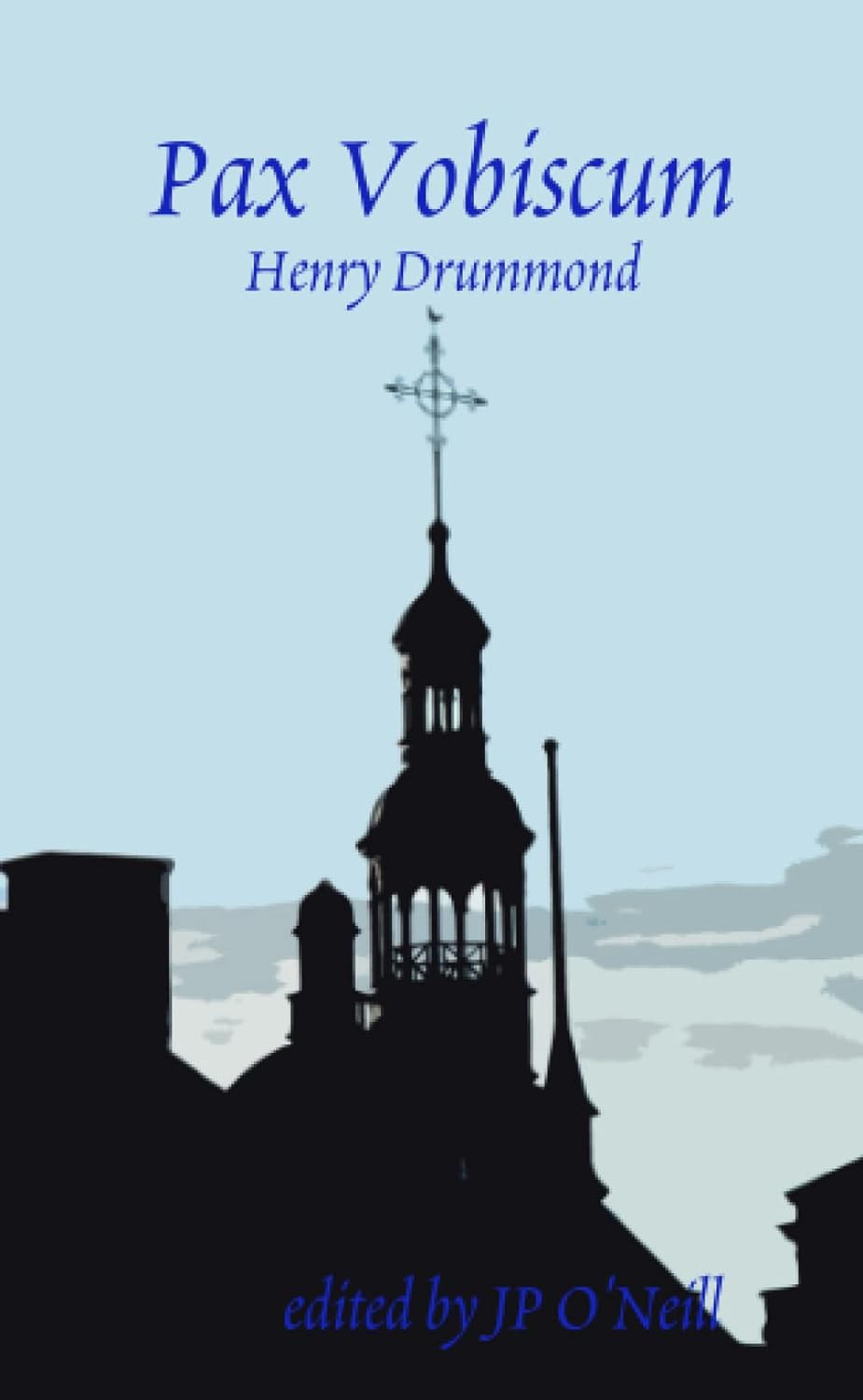
Pax Vobiscum
Pax Vobiscum is a short devotional address by Henry Drummond, first delivered as a sermon and then published as a small book in 1890. Along with The Greatest Thing in the World, it is one of the two short Drummond works that has stayed continuously in print since its first publication, and it is one of the most quietly influential pieces of late Victorian devotional writing.
The Latin title means peace be with you, and the address is essentially a meditation on the question of how a person can find inner peace in the conditions of ordinary modern life. Drummond’s answer is characteristic of his method. He takes the question seriously as a practical problem rather than as a theological abstraction. He distinguishes between the kind of peace that comes from external circumstances, which is fragile because circumstances change, and the kind of peace that comes from a settled inner orientation, which is more durable. He then walks through how the second kind is actually acquired, using examples drawn from ordinary life and from his reading in natural science.
The argument is gentle but it is also surprisingly direct. Drummond does not pretend the spiritual life is easy or that the methods he proposes will produce immediate results. He uses the analogy of the slow growth of plants and the slow building of habit to make the point that inner peace is grown rather than acquired, and that the conditions for its growth need to be deliberately maintained. The writing is plain and conversational throughout, with very little theological vocabulary, in a way that allowed the book to find readers far outside the conventional churchgoing audience.
The book is very short, often printed in editions of fifty or sixty pages. It can be read in an hour. For readers who want a single introduction to Drummond, Pax Vobiscum is probably the best place to start, because it shows his method in its most concentrated form. It pairs naturally with The Greatest Thing in the World, his short address on First Corinthians thirteen, and with The Ideal Life, the slightly longer collection of devotional addresses published after his death.
About the Author
Henry Drummond was a 19th-century Scottish evangelist, writer, and lecturer. He is best remembered for his essay The Greatest Thing in the World, a meditation on love.
See all books by Henry Drummond → Reasons Wherefore a Clergyman of the Church of England Should Not Become a Roman Catholic
 Substance of Lectures Delivered in the Churches
 Abstract Principles of Revealed Religion
 Social Duties On Christian Principles
 On Government by the Queen, and Attempted Government from the People
 A Life for a Life and Other Addresses