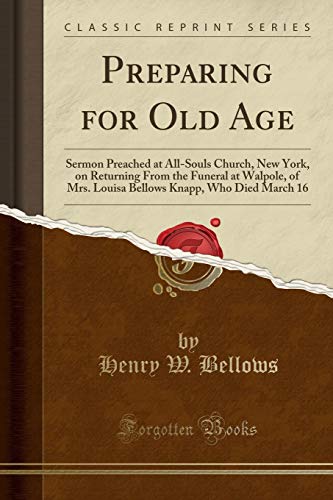
Preparing for Old Age
Preparing for Old Age is a work by Henry Whitney Bellows, the American Unitarian minister who lived from 1814 to 1882 and who was one of the most influential American Unitarian clergymen of his generation. Bellows served as pastor of All Souls Unitarian Church in New York City from 1838 until his death, and was a substantial figure in the broader American liberal Protestant world during the middle decades of the nineteenth century.
Bellows is now best remembered as the founder and first president of the United States Sanitary Commission, the major American civilian organisation that supported the Union Army medical services during the Civil War. The Sanitary Commission was modelled partly on the British Sanitary Commission that had been organised during the Crimean War a decade earlier and was substantially responsible for the improved conditions in Union Army camps and hospitals that helped reduce the disease mortality that had devastated armies in earlier wars. Bellows’s organisational work on the Sanitary Commission essentially established the model for the later American Red Cross and various other civilian medical relief organisations.
Alongside his pastoral and organisational work Bellows produced a substantial body of writing on religious, social, and ethical subjects. He worked in the broadly Unitarian theological tradition that combined careful philosophical engagement with the major religious questions with substantial practical attention to the social and ethical dimensions of contemporary American life. His various sermons, lectures, and books were widely read in the substantial American Unitarian and broader liberal Protestant audience of the period.
Preparing for Old Age addresses the questions that older Americans face as they approach and enter the final phase of their lives. The subject was one of substantial interest in American Protestant pastoral and devotional writing throughout the nineteenth century, with various ministers producing books that combined practical counsel about the physical and social changes that aging brings with the spiritual reflection that the approach to death was understood to require. Bellows brings to the subject the kind of practical wisdom that decades of pastoral work in a large urban congregation had given him.
The book is of interest now to readers of nineteenth century American Unitarian pastoral writing and of the broader American Protestant tradition on aging and death.
About the Author
Read and download 3 free books by Henry Whitney Bellows on BDeBooks. Browse the complete collection of Henry Whitney Bellows’s works available as free PDF and EPUB downloads. Discover novels, fiction, and other writings by Henry Whitney Bellows in our online eBook library.
See all books by Henry Whitney Bellows →