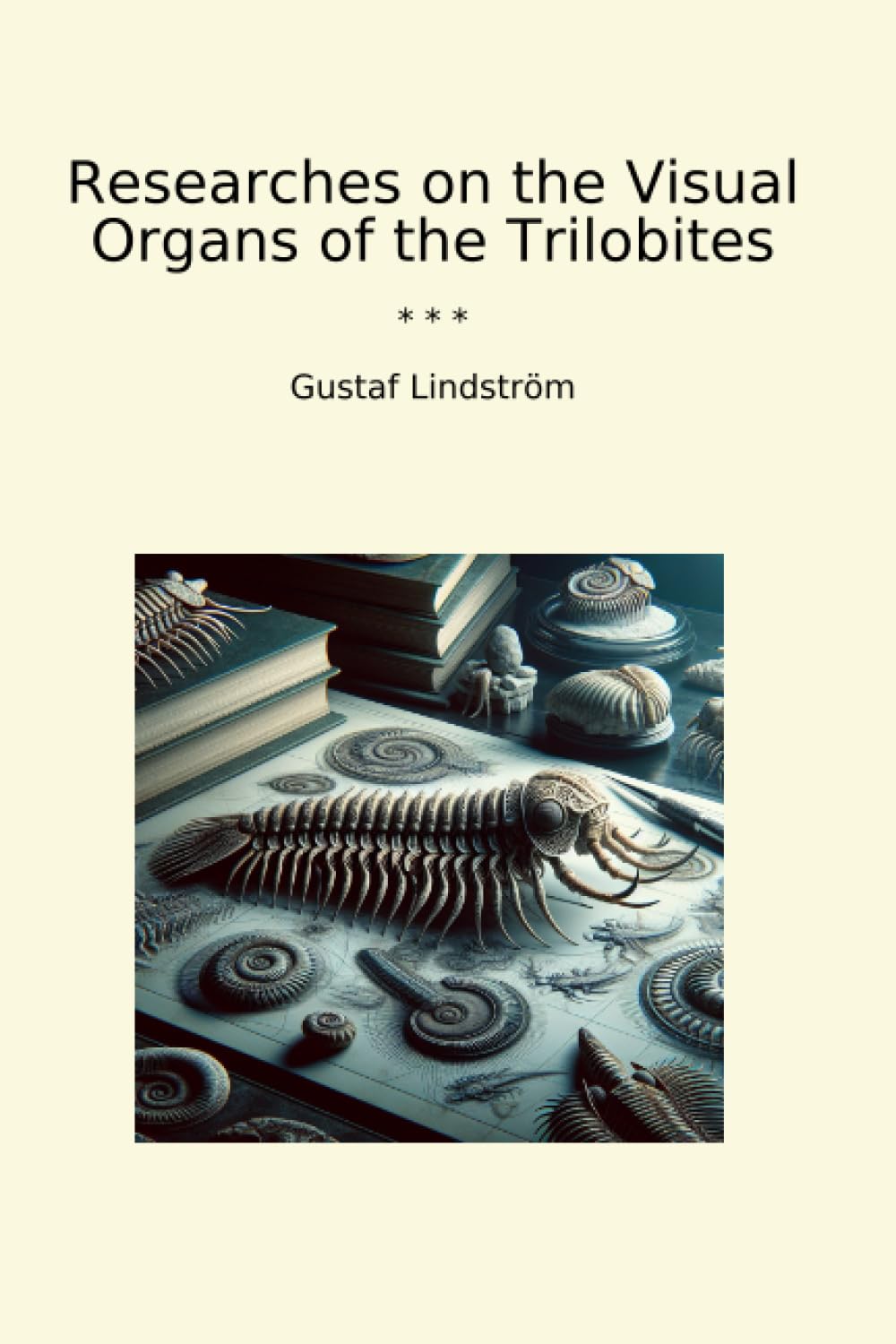
Researches on the Visual Organs of the Trilobites
Researches on the Visual Organs of the Trilobites is a scientific paper by Gustaf Lindström, the Swedish paleontologist who lived from 1829 to 1901 and who served as curator at the Swedish Museum of Natural History from 1857 until his retirement in 1901. Lindström was one of the leading European paleontologists of his generation and produced substantial research on the Paleozoic invertebrate fossils of Scandinavia, particularly on the trilobites that are abundant in the Cambrian and Ordovician rocks of the Baltic region.
Trilobites are an extinct group of marine arthropods that lived from the Cambrian period beginning approximately 540 million years ago until the end of the Permian period approximately 250 million years ago. They are among the most familiar of all fossil organisms and have been studied intensively since the early nineteenth century when serious paleontological work began. The trilobite eye is of particular interest because trilobites had the earliest sophisticated visual organs known in the fossil record. The compound eyes of trilobites consisted of arrays of individual lenses made of calcite, the same mineral that formed the rest of the trilobite exoskeleton, and the geometric and optical properties of these eyes have attracted substantial attention from researchers interested in the early evolution of vision.
Lindström’s paper presents detailed anatomical descriptions and microscopic studies of trilobite eye structures from specimens in the Swedish collections. The paper would have included plates with photographic or drawn illustrations of the eye structures, detailed measurements of the individual lenses, and analytical discussion of the optical properties that the various eye arrangements implied. Lindström was working in the rigorous descriptive tradition that European paleontology had developed across the nineteenth century, with substantial attention to the detailed comparative anatomy that the field required.
The paper is one of the early systematic studies of trilobite eye morphology and contributed to the developing scientific understanding of how vision had evolved in the early animal world. Subsequent paleontological work on trilobite eyes by Euan Clarkson, Riccardo Levi Setti, and various twentieth century researchers has substantially extended the analysis, but Lindström’s careful descriptive work remains part of the foundational literature in the field.
The paper is mostly of interest now to specialists in trilobite paleontology and in the historical development of paleontological science. It pairs naturally with the other Scandinavian paleontological literature of the period.