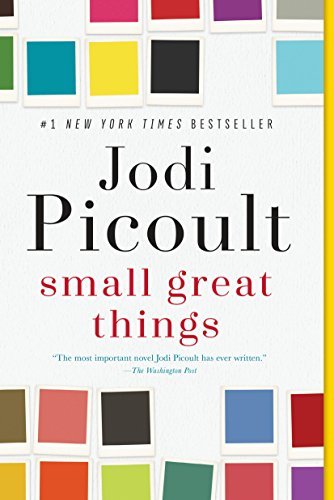
Small Great Things
Small Great Things is Jodi Picoult’s 2016 novel, one of her most ambitious and one of the books that put her squarely in the middle of contemporary American conversations about race, racism, and the criminal justice system. The novel centers on Ruth Jefferson, a Black labor and delivery nurse with more than twenty years of experience at a Connecticut hospital. When the white supremacist parents of a newborn baby Ruth has been caring for demand that no Black staff be allowed to touch their child, the hospital quietly complies. When the baby suffers a medical crisis while Ruth is the only nurse available, the consequences of the hospital’s accommodation of the parents’ racism land squarely on Ruth, who finds herself charged with murder.
Picoult uses her standard rotating perspectives technique, with chapters narrated by Ruth, by the white public defender Kennedy McQuarrie who reluctantly takes her case, and by Turk Bauer, the white supremacist father whose grief and rage drive the prosecution. The decision to give one of the narrative voices to a white supremacist character was one of the most controversial elements of the book, with Picoult arguing in her author’s note that she wanted to put white readers including herself in the position of having to spend time inside the head of the kind of person whose existence many liberal white Americans prefer not to think about.
The novel was the result of years of research into American racial history and contemporary criminal justice. Picoult worked closely with Black women who reviewed the manuscript, with civil rights attorneys, and with various scholars whose work shaped the legal and historical material in the book. The result is a novel that some Black readers and reviewers have found powerful and others have found problematic in specific ways. Both responses are worth taking seriously. The conversations the book provoked, especially among white book club readers, were exactly the conversations Picoult was hoping to start.
For longtime Picoult fans, Small Great Things is one of her most consequential novels. For new readers, the book is a difficult but important contemporary novel that takes the moral seriousness of its subject as seriously as the material requires. Whether or not the reader agrees with all of Picoult’s choices, the engagement with the material is unmistakable.
About the Author
Read and download 5 free books by Jodi Picoult on BDeBooks. Browse the complete collection of Jodi Picoult’s works available as free PDF and EPUB downloads. Discover novels, fiction, and other writings by Jodi Picoult in our online eBook library.
See all books by Jodi Picoult →