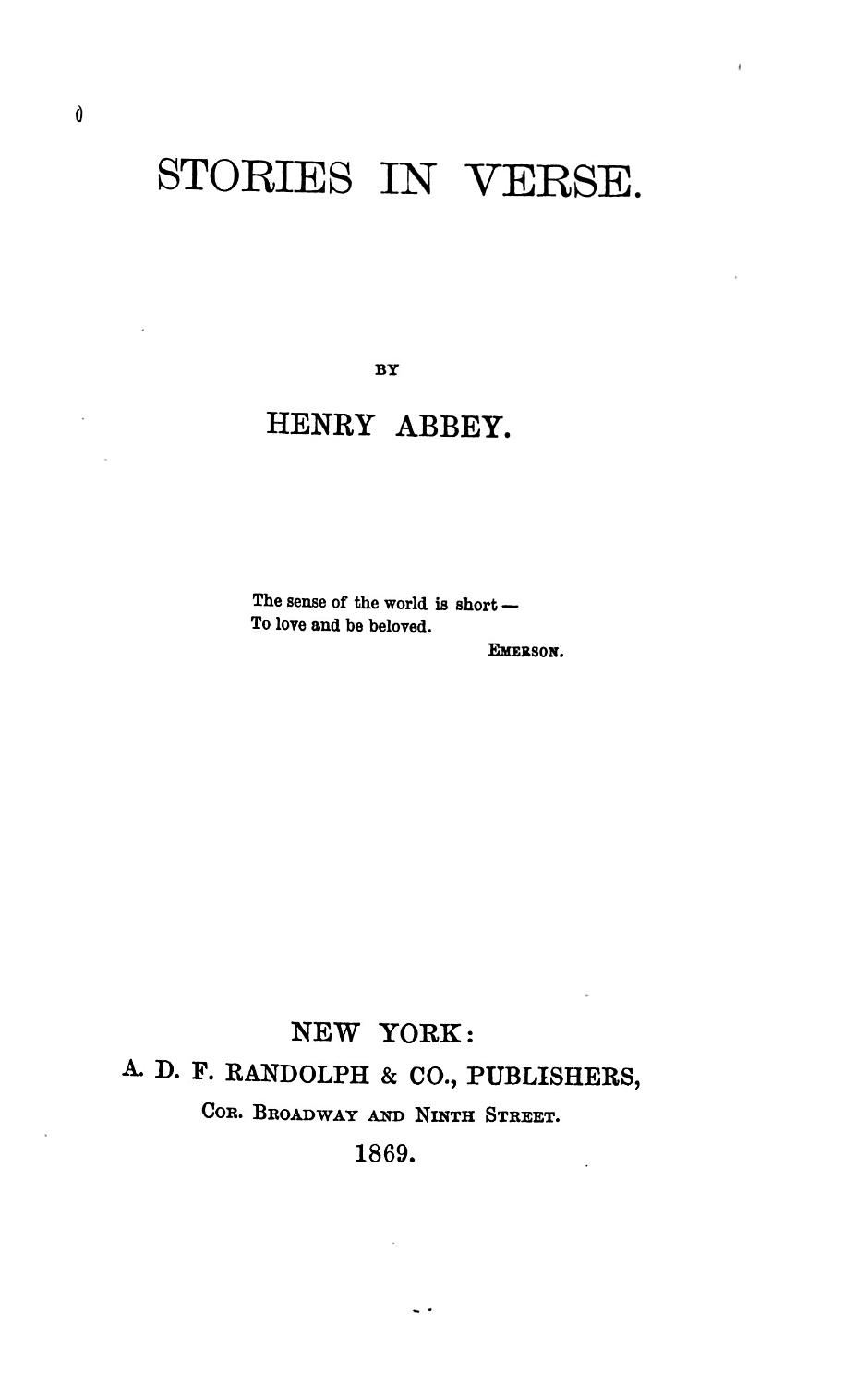
Stories in Verse
Stories in Verse is a poetry collection by Henry Abbey, the American poet who lived from 1842 to 1911 and who produced a substantial body of verse across the late nineteenth and early twentieth centuries. Abbey was a Hudson Valley New York poet whose work appeared in various American magazines and in several collected volumes during his lifetime, and his particular position in late nineteenth century American verse was as a competent regional poet whose work was widely read in his own time without ever achieving the national reputation that the major New England poets of his period commanded.
The Stories in Verse collection presents narrative poetry, the verse form that combined the storytelling of fiction with the formal structures of poetry that had been popular in nineteenth century American verse since Longfellow and various others had established the genre as one of the major forms of American poetic writing. The narrative poem allowed substantial latitude for plot, character development, and various other novelistic elements while preserving the metrical and rhyming structures that gave verse its particular formal interest.
Abbey was working in the late stage of the American narrative poetry tradition. By the late nineteenth century the form was already beginning to feel slightly out of date, with the major American poetic energy moving toward the lyric tradition that would culminate in the work of Emily Dickinson and toward the various experimental developments that would produce twentieth century American modernist poetry. Narrative poetry continued to be produced and read in substantial quantities, but it was no longer the central American poetic form that it had been in the middle decades of the century.
The individual poems in the collection cover various subjects in the conventional narrative mode. There are historical narratives drawing on American and European historical material. There are domestic narratives based on observed or imagined family situations. There are pieces in the regional Hudson Valley mode that draw on Abbey’s particular New York background. There are religious and reflective narratives in the broadly Christian mode that the late nineteenth century American narrative poetry tradition favoured.
The book is of interest now mostly to specialists in late nineteenth century American poetry and to readers interested in the regional poetic traditions of the Hudson Valley and the broader New York state literary scene. It pairs naturally with the work of other late nineteenth century American narrative poets including Edmund Clarence Stedman and Bayard Taylor.