
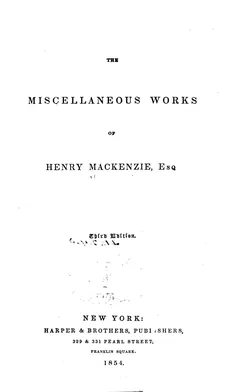
The Miscellaneous Works of Henry Mackenzie
The miscellaneous works of Henry Mackenzie
This chapter is long, so it is split into 5 parts.
Henry Mackenzie
This book was produced in EPUB format by the Internet Archive.
The book pages were scanned and converted to EPUB
format automatically. This process relies on optical character recognition, and is somewhat susceptible to errors. The book may not offer the correct reading sequence, and there may be weird characters, non-words, and incorrect guesses at structure. Some page numbers and headers or footers may remain from the scanned page. The process which identifies images might have found stray marks on the page which are not actually images from the book. The hidden page numbering which may be available to your ereader corresponds to the numbered pages in the print edition, but is not an exact match; page numbers will increment at the same rate as the corresponding print edition, but we may have started numbering before the print book's visible page numbers. The Internet Archive is working to improve the scanning process and resulting books, but in the meantime, we hope that this book will be useful to you.
The Internet Archive was founded in 1996 to build an Internet library and to promote universal access to all knowledge. The Archive's purposes include offering permanent access for researchers, historians, scholars,
people with disabilities, and the general public to historical collections that exist in digital format. The Internet Archive includes texts, audio, moving images, and software as well as archived web pages, and provides specialized services for information access for the blind and other persons with disabilities.
Created with abbyy2epub (v.1.7.6)
This is a digital copy of a book that was preserved for generations on library shelves before it was carefully scanned by Google as part of a project to make the world's books discoverable online.
It has survived long enough for the copyright to expire and the book to enter the public domain. A public domain book is one that was never subject to copyright or whose legal copyright term has expired.
Whether a book is in the public domain may vary country to country.
Public domain books are our gateways to the past, representing a wealth of history, culture and knowledge that's often difficult to discover.
Marks, notations and other marginalia present in the original volume will appear in this file - a reminder of this book's long journey from the publisher to a library and finally to you.
Usage guidelines
Google is proud to partner with libraries to digitize public domain materials and make them widely accessible. Public domain books belong to the public and we are merely their custodians.
Nevertheless, this work is expensive, so in order to keep providing this resource, we have taken steps to prevent abuse by commercial parties, including placing technical restrictions on automated querying.
We also ask that you:
+ Make non-commercial use of the files We designed Google Book Search for use by individuals, and we request that you use these files for personal, non-commercial purposes.
+ Refrain from automated querying Do not send automated queries of any sort to Google's system: If you are conducting research on machine translation, optical character recognition or other areas where access to a large amount of text is helpful, please contact us.
We encourage the use of public domain materials for these purposes and may be able to help.
+ Maintain attribution The Google "watermark" you see on each file is essential for informing people about this project and helping them find additional materials through Google Book Search. Please do not remove it.
+ Keep it legal Whatever your use, remember that you are responsible for ensuring that what you are doing is legal. Do not assume that just because we believe a book is in the public domain for users in the United States, that the work is also in the public domain for users in other countries. Whether a book is still in copyright varies from country to country, and we can't offer guidance on whether any specific use of any specific book is allowed. Please do not assume that a book's appearance in Google Book Search means it can be used in any manner anywhere in the world.
Copyright infringement liability can be quite severe.
About Google Book Search
Google's mission is to organize the world's information and to make it universally accessible and useful. Google Book Search helps readers discover the world's books while helping authors and publishers reach new audiences. You can search through the full text of this book on the web
atjhttp : //books . qooqle . com/
»
'i*
4f:
TAYLOR INSTITUTION.
BEQUEATHED TO THE UNIVERSITY
BY
ROBERT FINCH, M. A.
OF BALL101 COLLEGE,
(*m^&ftj--.:*i$$l&
ig >edby< >Ogk
Digitized by CjOOQIC
•. f
Digitized by CjOOQlC
TIES
MISCELLANEOUS WORKS
OF
HENRY MACKENZIE, Esq.
IN THREE VOLUMES.
VOL. II.
CONTAINING,
THE MAN OF THE WORLD.
LEITH: Printed by and for A. Allardiee ;
J. OGLE, AMD J. ANDERSON & CO., EDINBURGH; W. ANDERSON, STIRLING ; AND LACKINGTON,
ALLEN, & CO., LONDON.
1815.
y Google
Digitized by CjOOQLC
I
y Google
Though the world is but little concerned to know in what situation the author of any performance that is offered to its perusal may be, yet I believe it is generally solicitous to learn some circumstances relating to him; for my own part, I have always experienced this desire in myself, and read the advertisement at the beginning, and the postcript at the end of a book, if they contain any information of that sort, with a kind of melancholy inquietude about the fate of him in whose company, as it were, I have passed some harmless hours, and whose sentiments have been unbosomed to me with the openness of a friend.
The life of 4iim who has had an opportunity of presenting to the eye of the public the following tale, though sufficiently chequered with vicissitude, has been spent in a state of obscurity, the recital of which could but little excite admiration, or gratify curiosity. The manner of his procuring the story contained in the following sheets, is all he thinks himself entitled to relate.
A2
y Google
After some wanderings at that time of life which is most subject to wandering, I had found an opportunity of revisiting the scenes of m^
earlier attachments, and returned to my native spot with that tender emotion, which the heart, that can be moved at all, will naturally feel on approaching it. The remembrance of my infant days, like the fancied vibration of pleasant sounds in the ear, was still alive in my
mind; and I flew to find out the marks by which even inanimate things were to be known, as the friends of my youth, not forgotten, though long unseen, nor lessened in my estimation, from the pride of refinement, or the comparison of experience.
In the shade of an ancient tree, that centered a circle of elms, at the end of the village where I was born, 1 found my old acquaintance, Jack Eyland He was gathering moss with one hand, while the other held a flannel bag, con* taining earth worms, to be used as bait in angling. On seeing me, Ryland dropped his moss on the ground, and ran with all the warmth of friendship to embrace me. * My dear Tom,'
said he, * how happy I am to see you! you have travelled, no doubt, a woundy long way since we parted.—You find me in the old way here. -—I believe they have but a sorry notion of sport in Italy.—
While I think on't, look on this menow; I'll be hanged if the sharpest-eyed trout in the river can know it from the natural* It was but yesterday now—You remember the cross-tree pool, just below the parsonage—there
y Google
I Hooked him, played him half an hour by the dock, and landed him at last as far down as the church-way ford. As for his size—Lord!
how unlucky it is that I have not my landing-net here! for now I recollect that I marked his length on the outside of the pole; but you shall see it some other time.'
Let not my reader be impatient at my friend Ryland's harangue. I give it him, because I would have characters develope themselves.
To throw, however, some farther light upon Ryland's : He was first cousin to a gentleman who possessed a considerable estate in our county, born to no fortune, and not much formed by nature for acquiring one; he found pretty early that he should never be rich, but that he might possibly be happy ; and happiness to him was obtained without effort, because it was drawn from sources which it required little exertion to supply. Trifles were the boundaries of his desire, and their attainment the goal of his felicity. . A certain
neatness at all those little arts in which the soul has no share, an immoderate love of support, and a still more immoderate love of reciting its progress, with the addition of one faculty which has some small connection with letters, to wit, a remarkable memory for puzzles and enigmas, made up his character; and he enjoyed a privilege uncommon to the happy, that no one envied the means by which he attained what every one pursues. 4 I interrupted his narrative by some inquiries • A3
Digitized by CjOOQLC
6 INTRODUCTION.
about my former acquaintance in the village; for Ryland was the recorder of the place, and could have told the names, families, relations, and inter-marriages of the parish, with much more accuracy than the register.
' Alack-a-day F said Jack, ' there have been many changes among us since you left this: here has died the old gauger Wilson, as gopd a cricket-player as ever handled a bat; Rooke, at the salutation, is gone too; and his wife has left the parish and settled in London, where, I am told, she keeps a gin-shop in some street they call Southwark; and the poor parson, whom you were so intimate with, the worthy old Annesly ;'—he looked piteously towards the church-yard, and a tear trickled down his cheek.—* I understand you,' said I,
* the good man is dead!'—' Ah ! there is more than you think about his death,' answered Jack; * he died of a broken heart!' I could make no reply but by an ejaculation, and Ryland accompanied it with another tear; for though he commonly looked but on the surface of things, yet Ryland had a heart to feel.
«In the middle of yon clump of alders,' said he, * you may remember a small house, that was once farmer Higgins's. It is now occupied by a gentlewoman of the name of Wistanly, who was formerly a sort of servant-companion to Sir Thomas SindalFs mother, the widow of Sir William. Her mistress, who died some years ago, left her an annuity, and that house for life, where she has lived ever since. I am
y Google
introduction; 7
told she knows more of Annesly's aflairs thaa any other body; but she is so silent and shy, that I could never get a word from her on the subject. She is reckoned a wonderful scholar by the folks of the village; and you, who are a man of reading, might perhaps be a greater favourite with her. If you chuse it, I shall introduce you to her immediately/ I accepted his offer, and we went to her house together*
We found her sitting in a little parlour, fitted up in a taste much superior to what might have been expected from the appearance of the house, with some shelves, on which I observed several of the most classical English and French authors. She rose to receive us with something in her manner greatly above her seeming rank! Jack introduced me as an acquaintance of her deceased friend, Mr Annesly. * Then, Sir/ said she, * you knew a man who had few fellows !' lifting her eyes gently upwards. The tender solemnity of her look answered the Vv ry movement which the remembrance had awaked in my soul; and I made no other reply than by a tear. She seemed to take it in good part, and we met on that ground like old friends, who had much to ask, and much to be answered.
When we were going away, she begged to have a moment's conversation with me alone; Ryland left us together.
* If I am not deceived, Sir/ said she, * in the opinion I have formed of you, your feelings are very different from those of Mr Ryland, and indeed of most of my neighbours in the vil y Google
lage. You seem to have had a peculiar interest in the fate of that worthiest of men, Mr Annesly. The history of that life of purity which he led, of that calamity by which it was short* ened, might not be an unpleasing, though a melancholy recital to you ; but in this box,
which stands on the table by me, is contained a series of letters and papers, which if you will take the trouble of reading them, will save me the task of recounting his sufferings. You will find many passages which do not indeed relate to it; but, as they are often the entertainment of my leisure hours, I have marked the most interesting parts on the margin This deposit, Sir, though its general importance be small, my affection for my departed friend makes me consider as a compliment, and I commit it to you, as to one in whose favour I have conceived a prepossession from that'very cause/
Those letters and papers were the basis of what I now offer to the public Had it been my intention to make a book, 1 might have published them entire; and I am persuaded, notwithstanding Mrs Wktanly's remark, that no part of them would have been found more foreign to the general drift of this volume, than many that have got admittance into similar collections. But I have chosen rather to throw them into the form of a narrative, and contented myself with transcribing such reflections as naturally arise from the events, and such sentiments as the situations alone appear to have excited.
There are indeed many suppletory facts, which y Google .
INTRODUCTION. 9
could not have been found in this collection of Mrs Wistanly's. These I was at some pains to procure through other channels. How I was enabled to procure them the reader may conceive, if his patience can hold out to the end of tbe story. To account for that now, would delay its commencement, and anticipate its con* elusion; for both which effects this introductory chapter may have already been subject to reprehension.
y Google
Digitized by CjOOQLC
I
THS
MAN OF THE WORLD.
PART I.
CHAP. I.
IN WHICH ARte SOME PARTICULARS PREVIOUS TO THE
COMMENCEMENT OF THE MAIN STORY*
JxiCHARD Annesly was the only child of a wealthy tradesman in London, who from the experience of that profit which his business afforded himself, was anxious it should descend to his son.
Unfortunately the young man had acquired a certain train of ideas which were totally averse to that line of life which his father had marked out for him. There is a degree of sentiment, which, in the bosom of a man destined to the drudgery of the world, is the source of endless disgust. Of this young Annesly was unluckily possessed ; and as he foresaw, or thought he foresaw, that it would not only endanger his success, but take from the enjoyment of prosperity, supposing it attained, he declined following that road which his father had smoothed for his progress; and, at the risk of those temporal advantages which the old gentleman's displeasure on this occasion might deny
y Google
him, entered into the service of the church, and retired to the country on one of the smallest endowments she has to bestow.
That feeling which prevents the acquisition of wealth, is formed for the support of poverty. The contentment of the poor, I had almost said their pride, buoys up the spirit against the depression of adversity, and gives to our very wants the appearance of enjoyment.
Annesly looked on happiness as confined to the sphere of sequestered life. The pomp of greatness, the pleasures of the
affluent, he considered as only productive of turbulence, disquiet, and remorse; and thanked Heaven for having placed him in his own little shed, which, in his opinion, was the residence of pure and lasting felicity.
With this view of things his father's ideas did by no means coincide.
His anger against his son continued till his death; and, when that event happened, with the preposterous revenge of many a parent he consigned him to misery, as he thought* because he would not be unhappy in that way which he had insisted on his following, and cut him off from the inheritance of his birth, because he had chosen a pro* fession which kept him in poverty without it.
Though Annesly could support the fear of poverty, he could not easily bear the thought of a dying father's displeasure. On receiving intelligence of his being in a dangerous situa* tion, he hasted to London, with the purpose of wringing from him his forgivepess for the only
y Google
offence with which his son had ever been chargeable ; but he arrived too late. His father had breathed his last on the evening of the day preceding that on which he reached the metropolis, and his house was already in the possession of a nephew, to whom his son understood he had left every shilling of his fortune. This man bad been bred a haberdasher, at the express desire of old Annesly, and had all that patient dullness which qualifies for getting rich, which, therefore, in the eyes of his uncle, was the most estimable of all qualities. He had seldom seen Richard Annesly before, for indeed this last was not very solicitous of his acquaintance* He recollected his face, however, and desiring him to sit down, informed him particularly of the settlement which his relentless father had made. *
It was unlucky/ said the haberdasher, * that you should have made choice of such a profession ; but a parson, of all trades in the world, he could never in dure. It is possible you may be low in cash, at this time; if you want a small matter to buy mournings or so, I shall not scruple to advance you the needful; and I wish you would take them
of neighbour Bullock thewoollen-draper, who is as honest a man as any of the trade, and would not impose on a child/ Annesly's eyes had been hitherto fixed on the ground, nor was there wanting a tear in each for his unnatural father. He turned them on his cousin with as contemptuous a look as his nature allowed them to assume, and walked out of the house without uttering a word* Vol. II. B
y Google
He was now thrown upon the world with the sentence of perpetual poverty for his inheritance. He found himself in the middle of a , crowded street in London, surrounded by the buzzing sons of industry, and shrunk back at the sense of his own insignificance. In the faces of those he met, he saw no acknowledge* ment of connection, and felt himself, like Cain after his brother's murder, an unsheltered, unfriended outcast. He looked back to his father's door; but his spirit was too mild for reproach—a tear dropped from his eye as he looked t
There was in London one person, whose gentle nature, he knew, would feel for his misfortunes ; yet to that one of all others, his pride forbade to resort.
Harriet Wilkins was the daughter of a neighbour of his father's, who had for some time given up business, and lived on the interest of j£.4000, which he had saved in the course of it. From this circumstance, his acquaintance, old Annesly, entertained no very high opinion of his understanding; and did not cultivate much friendship with a man whom he considered as a drone in the hive of society. But in this opinion, as in many others, his son had the misfortune to differ from him. He used frequently to steal into Wilkins's house of an evening, to enjoy the conversation of one who had passed through life with observation, and had known the labour of business, without that contraction of soul which it often occasions.
y Google
Harriet was commonly of the party, listening, with Annesly, to her father's discourse, and, with Annesly, offering her remarks on it. She was not handsome enough to attract notice; but her look was of that complacent sort which gains on the beholder, and pleases from the acknowledgment that it is beneath admiration.
Nor was her mind ill suited to this ' Index of the soul.' Without that brilliancy which excites the general 'applause, it possessed those inferior sweetnesses which acquire the general esteem; sincere, benevolent, inoffensive, and unassuming. Nobody talked of the sayings of Miss Wilkins; but every one heard her with pleasure, and her smile was the signal of universal complacency.
Annesly found himself insensibly attached to her by a chain, which had been imposed with* out art, and suffered without consciousness.
During his acquaintance with Harriet, he had come to that period of life, when men are most apt to be impressed with appearances. In fact, he had looked on many a beauty with a rapture which he thought sincere, till it was interrupted by the reflection that she was not Harriet Wilkins; there was a certain indefinable attraction which linked him every day closer to her, and artlessness of manner had the effect (which I presume, from their practice, few young ladies believe it to have) of securing the conquest she had gained.
From the wealth which old Annesly was known to possess, his son was doubtless in the B2
y Google
16 THE MAN OF THE WORLD.
phrase of the world, a very advantageous match for Miss Wilkins; but when her father discovered the young man to be serious in his attachment to her* he frequently took occasion to suggest, how unequal the small fortune he could leave his daughter was to the expectations of the 6on of a man worth jg.30,000, and, with a frankness peculiar to himself, gave the father to understand, that his son's visits were rather more frequent than was consistent with that;
track of prudence, which the old gentlemaa would probably mark out for him. The father, however, took little notice of this intelligence ; the truth was, that, judging by himself, he gave very little credit to it, because it came from one, who, according to his conception of things, should, of all others, have concealed it from his knowledge.
But though his son had the most sincere attachment to Miss Wilkins, his present circumstances rendered it, in the language of prudence, impossible for them to marry. They contented themselves, therefore, with the assurance of each other's constancy, and waited for some favourable change of condition which might allow them to be happy.
The first idea which struck Annesly's mind on the disappointment he suffered from his father's settlement, was the effect it would have .
on his situation with regard to Harriet. There is perhaps nothing more bitter in the lot of poverty, than the distance to which it throws a man from the woman he loves; that pride I
y Google
..•JJLL^-yMJ .-.!>,
THE MAN OF THE WORLD. 17
have before taken notice of, which in every other circumstance tends to support, serves but to wound him the deeper in this. That feeling now turned Annesly's feet from his Harriet's door; yet it was now that his Harriet seemed the more worthy of his love, in proportion as his circumstances rendered it hopeless. A train of soft reflections at length banished this rugged guest from his heart—' Tis but taking a last farewell f said he to himself, and trod back the steps which he had made.
He entered the room where Harriet was siting by her father, with a sort of diffidence of his reception that he was not able to hide; but Wilkins welcomed him in such a manner as soon dissipated the restraint under which the thoughts of his poverty had laid him. ' This visit, my dear Annesly,' said he, ' flatters me, because it shews you
leaning on my friendship. I am not ignorant of your present situation, and I know the effect which prudent men will say it shouJd have on myself; that I differ from them, may be the consequence of spleen, perhaps, rather than generosity; for I have been at war with the world from a boy. Come hither Harriet; this is Richard Annesfy. His fa her, it is true, has left him je.30,000 poorer than it was once expected he would; but he is Richard Annesly still! you will therefore look upon him as you did before. I am not Stoic enough to deny, that riches afford numberless comforts and conveniences which are denied to the poor; but that riches are not essential to B 3
y Google
happiness I know, because I have never yet found myself unhappy;
—nor shall I now sleep unsound, from the consciousness of having added to the pressure of affliction, or wounded merit afresh, because fortune had already wounded it.
Liberal minds will delight in extending the empire of virtue; for my own part, I am happy to believe, that it is possible for an attorney to be honest, and a tradesman to think like Wilkins.
CHAP. II. MORE INTRODUCTORY MATTER.
W ilkins having thus overlooked the want of fortune in his young friend, the lovers found but little hindrance to the completion of their wishes. Harriet became the wife of a poor man, who returned the obligation he owed to her and her father's generosity, by a tenderness and affection rarely found in wedlock, because there are few minds from whom in reason they can be expected.
His father-in-law, to whom indeed the sacrifice was but trifling, could not resist the joint request of his daughter and her husband, to leave the town and make one of their family ia the country. In somewhat less than a year he was the grandfather of a boy, and nearly at the y Google
same distance of time after, of a girl, both of whom, in his opinion, were cherubs; but even the gossips around them owned they had never seen more promising children. The felicity of their little circle was now, perhaps, as perfect as the lot of humanity admits; nor would it have been easy to have found a group, whose minds were better formed to deserve or attain it. Health, innocence, and good humour, were of their household; and many an honest neighbour, who never troubled himself to account for it, talked of the goodness of Annesly's ale, and the cheerfulness of his fire-side. I have been often admitted of the party, though I was too young for a companion to the seniors, and too old for a play-fellow to the children ; but no age, and often indeed no condition, excluded from a participation of their happiness ; and I have seen little Billy, before he could speak to be well understood, lead in a long-bearded beggar, to sing his song in his turn, and be rewarded with a cup of that excellent liquor i mentioned.
Their felicity was too perfect to be lasting; —such is the proverbial opinion of mankind. The days of joy, however, are not more winged in their course than the days of sorrow; but we count not the moments of their duration with so scrupulous an exactness.
Three years after the birth of her first daughter, Mrs Annesly was delivered of another; but the birth of the last was fatal to her mother, who did not many days survive it.
y Google
Annesly's grief on this occasion was immoderate ; nor could all the endeavours of his father-in-law, whose mind was able to preserve more composure, prevail upon him, for some days, to remember the common offices of life, or leave the room in which his Harriet had expired. Wilkins's grief, however, though of a' more silent sort, was not less deep in its effects; and when the turbulence of the other's sorrow had yielded to the soothings of time, the old man retained all that tender regret, due to the death of a child, an only child, whose filial duty had led him down the slope of life without suffering him to perceive the descent. The infant she had left behind her was now
doubly endeared to his father and him, from being considered as the last memorial of its dying mother; but of this melancholy kind of comfort they were also deprived in a few months by the , small-pox.
Wilkins seemed, by this second blow, to be loosened from the little hold he had struggled to keep of the world, and his resignation was now built upon the hopes,! not of overcoming his affliction, but of escaping from its pressure. The serenity which such an idea confers, possesses, of all others, the greatest dignity, because it possesses, of all others, the best assured confidence, leaning on a basis that is fixed above the rotation of sublunary things. An old man, who has lived in the exercise of virtue, looking back, without a blush, on the tenor of his past days, and pointing to that better. state, where alone he can be perfectly rewarded,
y Google
is a figure the most venerable that can well be imagined. Such did Wilkins now exhibit.
* My son/ said he to Annesly, * I feel that I shall not be with you long; yet I leave not the world with that peevish disgust, which is sometimes mistaken for the courage that overcomes the dread of death. I lay down my being with gratitude, for having so long possessed it, without having disgraced it by any great violation of the Jaws of him by whom it was bestowed. There is something we cannot help feeling, on the fall of those hopes we had been vainly diligent to rear. I had looked forward to some happy days, amidst a race of my Harriet's and yours ; but to the good, there can be no reasonable regret from the disappointment of such expectations, because the futurity they trust in after death, must far exceed any enjoyment which a longer life here could have afforded* It is otherwise with the prospect of duty to be done \ these two little ones I leave to your ten- i derness and care ; you will value life, as it gives you an opportunity of forming them to virtue/ —Lay me beside my Harriet.'
The old man's prediction was but too well verified ; he did not long survive this pathetic declaration. His son-in-law was now exposed,
alone and unassisted, to the cares of the world, increased by the charge of his boy and girl; but the mind will support much, when called into exertion by the necessity of things. His sorrow yielded by degress to the thoughts of that active duty he owed his children ; in time
y Google
his fire-side was again cheered by their sports around it; and though he sometimes looked upon them with a tear at the recollection of the past, yet would he as often wipe it from his eye, in silent gratitude to Heaven, for the enjoyment of the present, and the anticipation of the future.
CHAP. III.
THE OPENINGS OF TWO CHARACTERS WITH
WHICH THE READER MAY AFTERWARDS
BE BETTER ACQUAINTED.
XI is son had a warmth of temper which the father often observed with mingled pleasure and regret; with pleasure, from considering the generosity and nobleness of sentiment it be• spoke; with regret, from a foreboding of the many inconveniences to which its youthful possessor might naturally be exposed.
But Harriet was softness itself. The sprightliness of her gayest moments would be checked by the recital of the distress of a fellow-creature, and she would often weep all night from some tale which her maid had told of fictitious disaster. Her brother felt the representation of worth ill-treated, or virtue oppressed, with indignation against the oppressor, and wished to be a man, that he might, like Jack'the Giantkiller, gird on his sword of sharpness, and re»
y Google
venge the wrongs of the sufferer; while his sister pressed his hand in hers, and trembled for the danger to which she i roagined him exposed; nay, she has been afterwards heard to cry out in her sleep, in a hurried voice, ' You shall not go, my Billy, papa and I will die if you do.'
A trifling incident, of which I find an account in one of their father's letters, will discriminate their characters better than a train of the most laboured expression.
At the bottom of his garden ran a little rivulet, which was there dammed up to furnish water for a mill below. On the bank was a linnet's nest, which Harriet had discovered in her rambles, and often visited with uncommon anxiety for the callow brood it contained. One day, her brother and she were at play on the green at a little distance, attended by a servant of their fathers, when a favourite terrier of Billy's happened to wander amongst the bushes where this nest was sheltered. Harriet, afraid o£ the consequences, begged the servant to run, and prevent his doing mischief to the birds. Just as the fellow came up, the dog had lighted on the bush, and surprised the dam, but was prevented from doing her much harm by the servant, who laid hold of him by the neck, and snatched his prey out of his mouth. The dog, resenting this rough usage, bit the man's finger till it bled, who, in return, bestowed a hearty drubbing upon him, without regarding the entreaties or the threats of his little master. Billy; enraged at the sufferings of his favourite, y Google
resolved to wreak his vengeance where it was ip his power, and running up to the nest, threw it down, with all its unfledged inhabitants, to the ground. * Cruel Billy f cried his sister, while the tears ran down her cheeks. He turned sullenly from her, and walked up to the house, while she, wjth the man's assistance, gathered up the little flutterers, and having fastened the nest as well as she could, replaced them safely within, it.
When she saw her brother again, he pouted, and would not speak to her. She endeavoured to regain his favour by kindness, but he refused her caresses; she sought out the dog, who had suffered on her linnet's account, and stroaking him on the head, fed him with some cold meat from her own hand. When her brother saw it, he called him away. She looked after Billy till he was gone, and then burst into tears.
Next day they were down at the rivulet again. Still was Harriet endeavouring to be reconciled, and still was her brother averse to a reconciliation. He sat biting his thumb, and looking angrily to the spot where his favourite had been punished.
At that instant the linnet, in whose cause the quarrel had begun, was bringing out her younglings to their first imperfect flight, and two of them, unfortunately taking a wrong direction, fell short into the middle of the pool. Billy started from the ground, and, without considering the depth, rushed into the water, where he was over head and ears the second step that he
y Google
made. His sister's screams alarmed the servant, who ran to his assistance ; but before he got to the place, the boy had reached a shallower part of the pool, and, though staggering from his first plunge, had saved both linnets, which he held carefully above the water, and landed safely on the opposite bank. He returned to his sister by a ford below, and, presenting her the birds, flung his arms round her neck, and, blubbering, asked her, if she would now forgive his unkindness.
Such were the minds which Annesly's tuition was to form. To repress the warmth of temerity, without extinguishing the generous principles from which it arose, and to give firmness to sensibility where it bordered on weakness, without searing its feelings where they led to virtue, was the task he had marked out for his industry to accomplish. He owned that his plan was frequently interrupted on both sides by the tenderness of paternal affection; but he
accustomed himself to remember, that for his children he was accountable to God and their country. Nor was the situation I have described without difficulties, frpm the delicacy of preventing inclinations in the extreme, which were laudable in degree; ' but here also/ said Annesly, ' it is to be remembered, that no evil is so pernicious as that which grows in the soil from which good should have sprung/
Vol. II. C
y Google
CHAP. IV.
A VERY BRIEF ACCOUNT OF THEIR EDUCATION.
Annesly was not only the superintendant of his children's manners, but their master in the several branches of education. Reading, writing, arithmetic, the elements of mathematics and geography, with a competent knowledge of the French and Italian languages, they learned together; and while Billy was employed with his father in reading Latin and Greek, his sister received instruction in the female accomplishments, from a better sort of servant, whom Annesly kept for that purpose, whose station had once been superior to servitude, and whom he still treated more as a companion than a domestic.
This instructress, indeed, she lost when about ten years old; but the want was more than supplied by the assistance of another, to wit, Mrs Wistanly, who devoted many of her leisure hours to the daughter of Annesly, whom she had then got acquainted with, and whom reciprocal worth had attached to her with the sincerest friendship and regard. The dancingmaster of a neighbouring town paid them a weekly visit for their instruction in the science he professed; at which time also were held their family-concerts, where Annesly, who was esteemed in his youth a first-rate player on the violin, used to preside. Billy was an excellent second ; Mrs Wistanly or her pupil undertook
y Google
for the .harpsichord, and the dancing-master played bass as well as he could. He was not a very capital performer, but he was always very willing: and found as much pleasure in his own performance as the best of them. Jack Ryland, too, would sometimes join in a catch, though indeed he had but two, ChrisUckurckbells, and Jpck, thourt a toper ; and Annesly alledged that he was often out in the lasts but Jack would never allow it.
Besides these, there were certain evenings appropriated to exercises of the mind. ' It is not enough,' said \nnesly, * to put weapons into those hands which have been never taught the use of them: the reading we recommend to youth will store their minds with intelligence, if they attend to it properly ; but to go a little farther, we must accustom them to apply it, we must teach them the art of comparing the ideas with which it has furnished them/ In this view, it was the practice, at those stated times I have mentioned, for Billy, or his sister, to read a select passage of some classical author, on whose relations they delivered opinions, or on whose sentiments they offered a comment. Never was seen more satisfaction on a countenance, than used to enlighten their father's, at the .delivery of those observations which his little philosophers were accustomed to make. Indeed there could scarcely, even to a stranger, be a more pleasing exhibition; their very errors were delightful, because they were the errors of benevolence, generosity, and virtue.
y Google
As punishments are necessary in all societies, Annesly was obliged to invent some for the regulation of his; they consisted only of certain modifications of disgrace. One of them I shall mention, because it was exactly opposite to the practice of most of our schools: while there, offences are punished by doubling the task of the scholar; with Annesly the getting of a lesson, or performing of an exercise, was a privilege of which a forfeiture was incurred by misbehaviour ; to teach his children, that he offered them instruction as a favour, instead of pressing it as a hardship.
Billy had a small part of his father's garden alio ted him for his peculiar property, in which he wrought himself, being furnished with no other assistance from the gardener than directions how to manage it, and parcels of the seeds which they enabled him to sow.
When he had brought these to maturity, his father purchased the produce. Billy, with part of the purchase-money was to lay in the stores necessary for his future industry, and the overplus he had the liberty of bestowing on charitable ustes in the village. The same institution prevailed as to his sister's needle-work, or embroidery : *
For it is necessary,' said Annesly, ' to give an idea of property, but let it not be separated from the idea of beneficence.'
Sometimes, when these sums were traced to their disbursements, it was found that Harriet's money did not always reach the village, but was intercepted by the piteous recital of a wan Digitized by CjOOQLC
dering beggar by tbe way; and that Billy used to appropriate part of his to purposes not purely eleemosynary; as, when he once parted with two thirds of his revenue, to reward a little boy for beating a big one, who had killed his tame sparrow; or another time, when he went the bJameable length of comforting with a shilling a lad who had been ducked in a horse-pond, for robbing the orchard of a miser.
It was chiefly m this manner of instilling sentiments, (a# in the case of the charitable establishment I have mentioned), by leading
^insensibly to the practice of virtue, rather than by downright precept, that Annesly proceeded with his children ; for it was his maxim, that the heart must feel, as well as the judgment be convinced, before the principles we mean to teach can be of habitual service ; and that the mind will always be more strongly impressed with ideas which it is led to form of itself, than with those which it passively receives from another. When, at any time, he delivered instructions, they were always clothed in the garb rather of advices from a friend, than lectures from a father; and were listened to with the warmth of friendship, as well as the humility of veneration. It is in truth somewhat surprizing how little intimacy subsists between parents
and their children, especially of our sex; a circumstance which must operate in conjunction with their natural partiality to keep the former in ignorance of the genius and disposition of the latter.
C3
Digitized by CjOOQLC
30 THE MAN OF THE WORLD*
Besides all this, his children had the general advantage of a father's example. They saw the virtues he inculcated attended by all the consequences in himself, which he had promised them as their reward. Piety in him was recompensed by peace of mind, benevolence by self* satisfaction, and integrity by the blessings of a good conscience.
But the time at last arrived, when his son was to leave those instructions, and that example, for the walks of more public life. As he was intended, or, more properly speaking, seemed to have an inclination for a learned pro* fession, his father sent him, in his twentieth year, to receive the finishings of education necessary for that purpose, at one of the universities. Yet lie had not, I have heard him say, the most favourable opinion of the general course of education there; but he knew, that a young man might there have an opportunity of acquiring much knowledge, if he were inclined to it; and that good principles might preserve him uncorrupted, even amidst the dangers of some surrounding dissipation. Besides, he had an additional inducement to this plan, from the repeated request of a distant relation, whb filled an office of some consequence at Oxford, and had expressed a very earnest desire to have his young kinsman sent thither, and placed under his own immediate inspection.
Before he set out for that place, Annesly, though he had a sufficient confidence in his son, yet thought it not improper to mark out to y Google
him some of those errors to which the inexperienced are liable. He was not wont, as I have before observed, to press instruction upon his children; but the young man himself seemed to expect it, with the solicitude of one who ventured, not without anxiety, to leave that road, where the hand of a parent and friend had hitherto guided him in happiness and safety. The substance of what he delivered to his son and daughter (for she too was an auditor of his discourses) I have endeavoured to collect from some of the papers Mrs Wistanly put into my hands, and to arrange as far as it seemed arrangeable, in the two following chapters.
It will not, however, after all, have a perfectly connected appearance, because I imagine it was delivered at different times, as occasion invited, or leisure allowed him; but its tendency appeared to be such, that even under these disadvantages I could not forbear inserting it.
CHAP. V.
PATERNAL INSTRUCTIONS.—OF SUSPICION AND
CONFIDENCE RIDICULE RELIGION TRUE PLEASURE CAUTION
TO
THE FEMALE SEX.
Y ou are now leaving us, my son, said Annc8ly, to make your entrance into the world;
Digitized by CjOOQLC
for though, from the pale of a college, the bustle of ambition, the plodding of business, and the tinsel of gaiety, are supposed to be excluded; yet, as it is the place where the persons that are to perform in those several characters often put on the dresses of each, there will not be wanting, even there, those qualities that distinguish in all. I will not shock your imagination, with the picture which some men, retired from its influence, have drawn of the world; nor warn you against enormities, into which, I should equally affront your understanding and your feelings, did I suppose you capable of
falling. Neither would I arm you with that suspicious caution which young men are sometimes advised to put on: they who always suspect will often be mistaken, and never be happy. Yet there is a wide distinction between the confidence which becomes a man, and the simplicity that disgraces a fool; he who never trusts is a niggard of his soul, who starves himself, and by whom no other is enriched; but he who gives every one his confidence, and every one his praise, squanders the fund that should serve for the encouragement of integrity, and the reward of excellence. In the circles of the world, your notice may be frequently attracted by objects glaring, not useful; and your attachment won to characters whose surfaces are showy, without intrinsic value: In such circumstances, be careful not always to impute knowledge to the appearance of acuteness, or give credit to opinons accord*