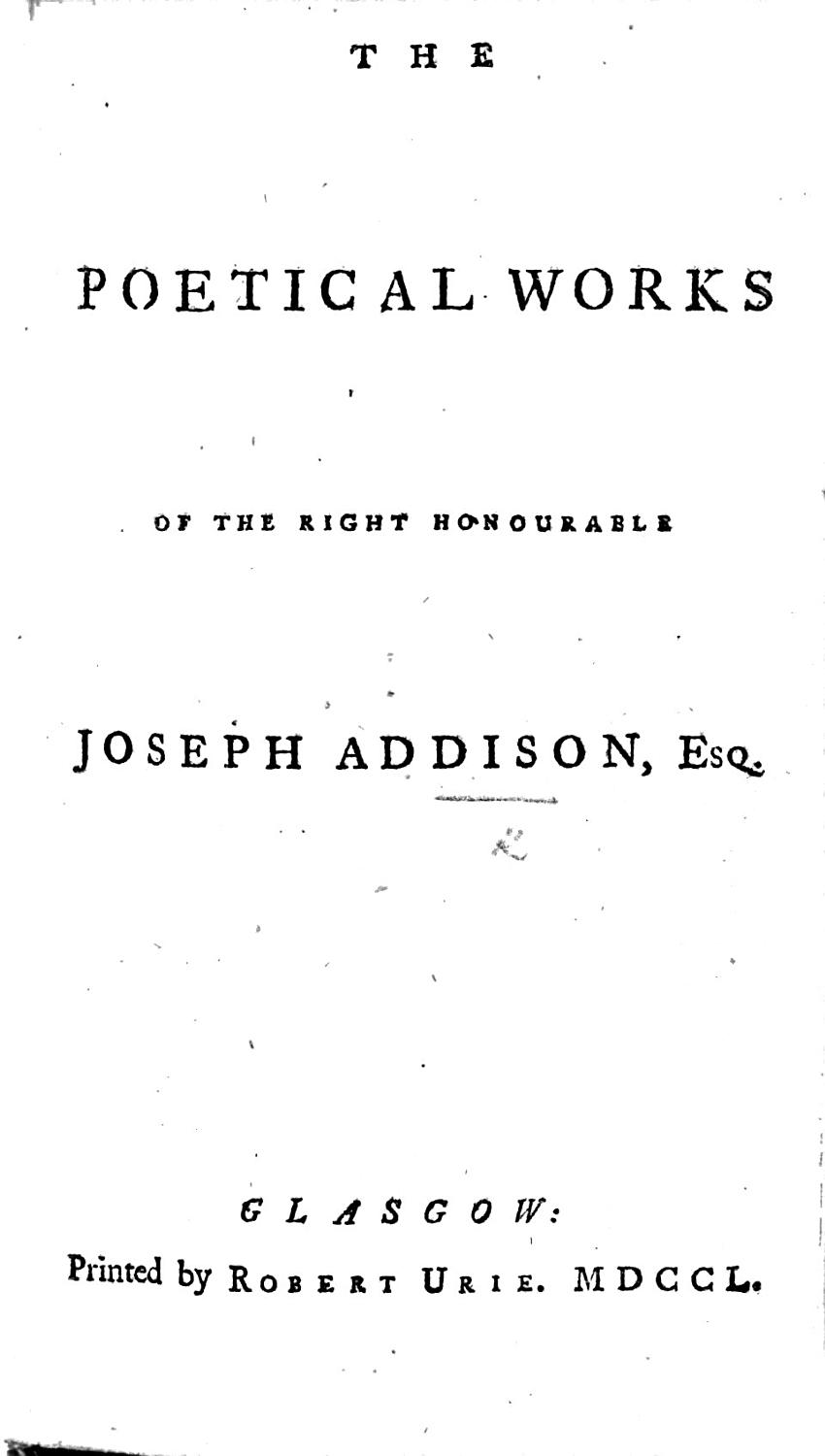
The Poetical Works of
The Poetical Works of Joseph Addison collects the verse written by Joseph Addison, the English essayist, poet, dramatist, and Whig politician who lived from 1672 to 1719. Addison is now overwhelmingly remembered for his prose work, particularly the essays he wrote with Richard Steele for the Tatler and the Spectator that essentially established the modern English literary essay as a major prose form. The poetry occupies a much smaller portion of his lasting reputation but was substantially important in his own time.
Addison’s major poetic work was The Campaign, a long verse celebration of the Duke of Marlborough’s victory at the Battle of Blenheim in 1704 during the War of the Spanish Succession. The poem was commissioned by the Whig government to celebrate the victory and was widely admired in its own time, contributing substantially to Addison’s emerging reputation as a major Whig literary figure and helping launch the political career that eventually took him to the position of Secretary of State.
The Campaign is the most famous of Addison’s poems and contains the famous lines about Marlborough riding through the battle with the calm composure of an angel directing the storm. The image was widely quoted in the period and became one of the standard metaphors for Marlborough’s military leadership. The poem belongs to the substantial body of early eighteenth century English political verse that combined classical poetic form with contemporary political celebration.
The other poetic works in the collection include various shorter poems on classical, religious, and occasional subjects that Addison produced across his career. His verse adaptations of psalms, including The Spacious Firmament on High that was set to music by Joseph Haydn, have remained in standard English hymnody. His earlier poems including A Letter from Italy of 1701 and the various Latin verses he had written as a young scholar at Oxford appear in most collected editions of his poetic work.
Addison’s verse is competent rather than inspired by the standards of either his contemporaries Pope and Swift or the broader English poetic tradition. The verse is most interesting now as background for the prose work that is his lasting achievement and as a representative example of early eighteenth century Whig political and occasional poetry. The Poetical Works edition pairs naturally with the Spectator and Tatler essays and with the broader Augustan literary tradition of the period.