


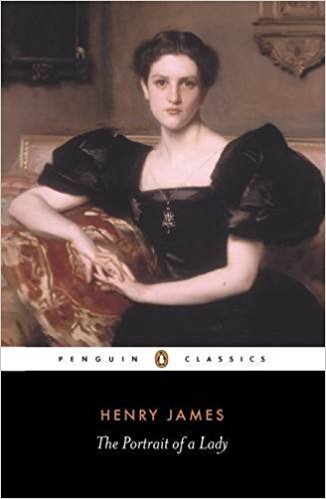
The Portrait of a Lady
Henry James

The Portrait of a Lady is a novel by Henry James, serialised in the Atlantic Monthly and Macmillan’s Magazine during 1880 and 1881 and published in book form in 1881. It is the major novel of his early maturity and is generally considered the best book of his first phase, before the experimental shorter novels of the 1890s and the great late masterworks of the 1900s.
Isabel Archer is a young American woman from Albany, brought to England by her aunt Mrs Touchett and introduced to the Touchett household at Gardencourt, a country house outside London. Her uncle Mr Touchett is dying. Her cousin Ralph, also gravely ill, becomes her devoted friend and admirer. Isabel attracts several proposals of marriage, including from the English Lord Warburton and from the American businessman Caspar Goodwood, and refuses both. When her uncle dies he leaves her a substantial fortune, on Ralph’s quiet suggestion, so that she may have the freedom to choose her own life. The freedom is exactly what destroys her. In Florence she meets Gilbert Osmond, an American expatriate of refined taste and limited fortune, introduced to her by Madame Merle, an apparently elegant friend of her aunt. Isabel marries Osmond. The second half of the novel works out the long consequences of that marriage.
The book is the novel where James first brought all his characteristic interests into a single fully realised work. There is the international subject, with Isabel as the American girl carried to Europe. There is the moral interest in the question of how a free young person actually uses freedom when it is given to her. There is the slow development of the central marriage and the gradual revelation of who Madame Merle and Osmond actually are. There is the famous chapter in which Isabel sits up alone through the night and works out what her marriage has become.
The novel runs about six hundred pages and is essential reading for any serious reader of nineteenth century English fiction. For readers new to James this is the recommended starting place after the shorter Daisy Miller. It pairs naturally with The Wings of the Dove and The Ambassadors, the great late novels that take the same central interests further.