The Renascence of the English Drama
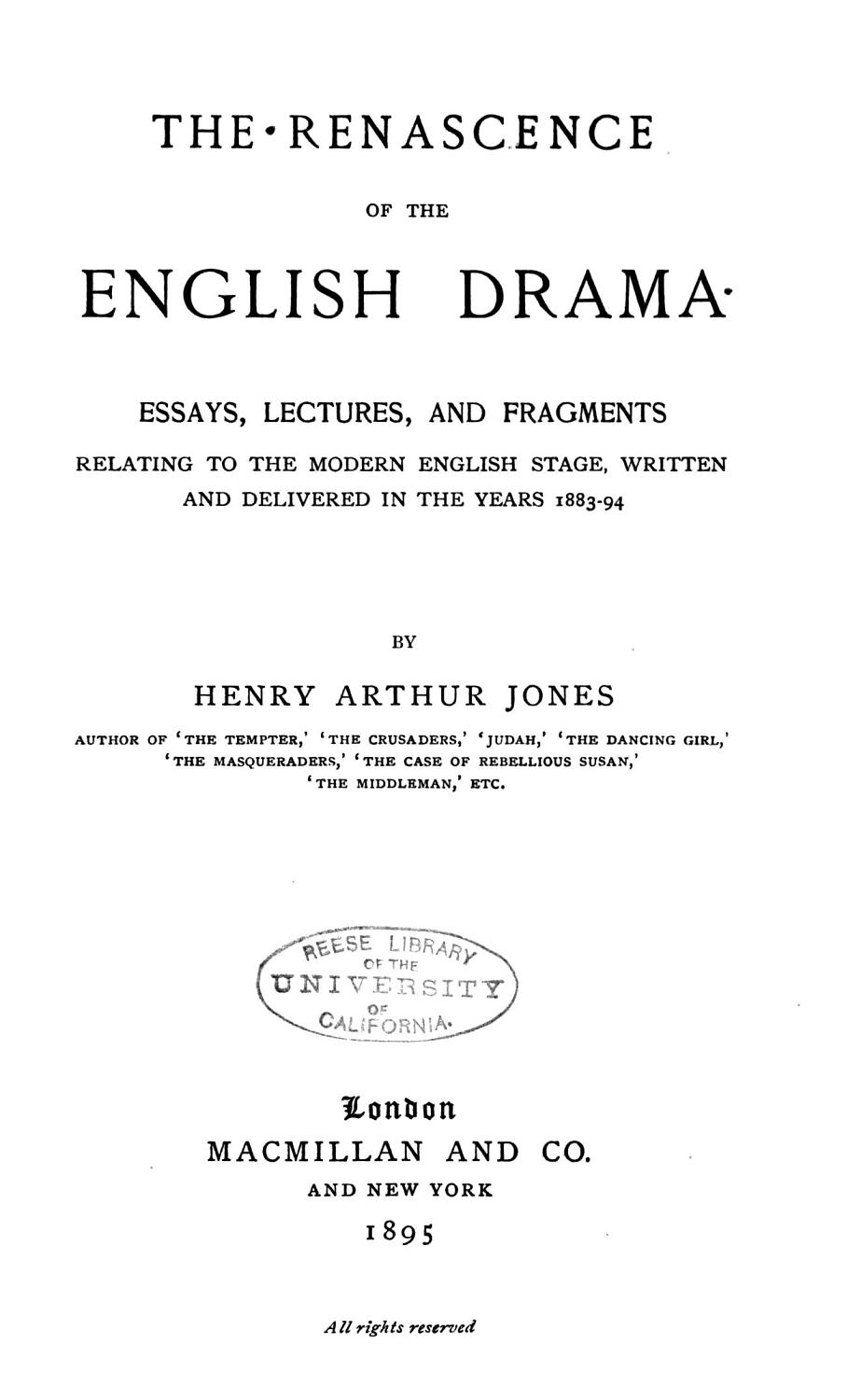
The Renascence of the English Drama is a collection of essays, lectures, and reviews by Henry Arthur Jones, first published in 1895. The book gathers together Jones’s various writings on the state of the English theatrical profession during the years when he and various of his contemporaries were attempting to elevate the artistic and intellectual standards of the English commercial theatre against the backdrop of the influence of Ibsen and the new continental drama.
Jones occupied an interesting position in the late Victorian theatrical world. He was a commercially successful working playwright with more than sixty plays produced across his career, but he was also a serious advocate for the reform of the English theatrical profession and the elevation of dramatic writing to the level of literary respectability that other serious literary forms enjoyed. The essays in this collection reflect both sides of his position. He writes as a practitioner who understands the commercial realities of the West End stage and as a theorist who believes English drama can and should be doing more than it currently does.
The collection includes essays on various aspects of the theatrical profession. There are pieces on the relationship between literature and the theatre, on the social position of actors and dramatists, on the censorship of plays by the Lord Chamberlain’s office, on the influence of Ibsen and the continental theatre on English dramatic writing, on the question of whether the English theatre is or is not capable of producing serious literature, and on various more specific topics involving particular plays, particular actors, and particular theatrical institutions. The tone throughout is engaged and reformist, with Jones consistently arguing for the seriousness of his profession against various forms of dismissal and condescension.
The book is one of the more important documents of late Victorian English theatrical debate and is essential reading for understanding the intellectual context within which the New Drama movement of the 1890s and the early Edwardian theatrical reforms eventually took shape. Jones, Pinero, and various of their contemporaries were attempting to do for the English stage what Ibsen had done for the Scandinavian stage, and the various successes and failures of that effort are documented in the essays gathered here.
The book runs about three hundred pages and is best read in essay sized pieces. For readers interested in late Victorian theatrical history, it is essential material. It pairs naturally with Shaw’s contemporary dramatic criticism.
About the Author
Read and download 4 free books by Henry Arthur Jones on BDeBooks. Browse the complete collection of Henry Arthur Jones’s works available as free PDF and EPUB downloads. Discover novels, fiction, and other writings by Henry Arthur Jones in our online eBook library.
See all books by Henry Arthur Jones →