The Seven Little Sisters Who Live on the Round Ball That Floats in the Air
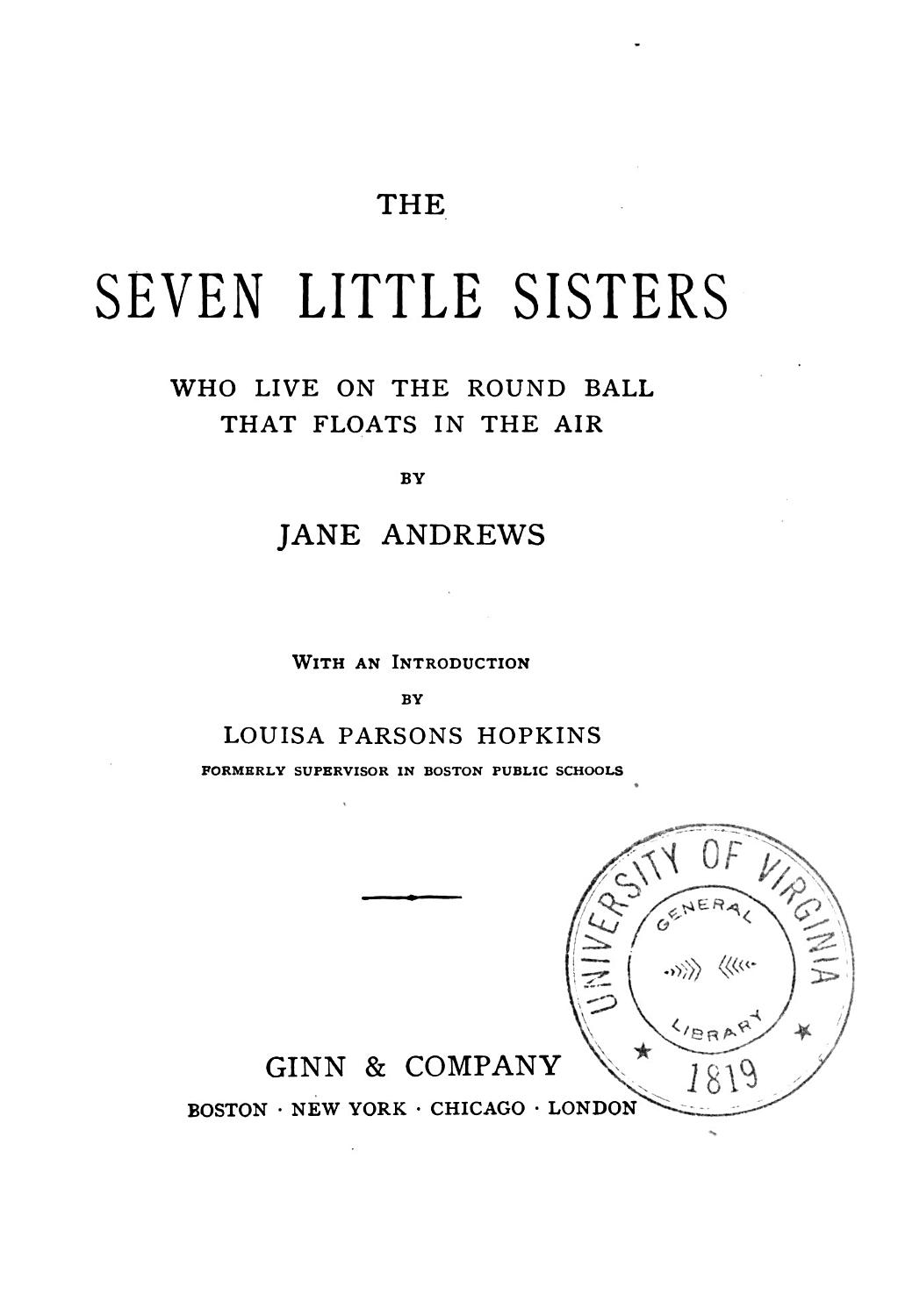
The Seven Little Sisters Who Live on the Round Ball That Floats in the Air is a children’s book by Jane Andrews, first published in 1861. Andrews, who lived from 1833 to 1887, was an American teacher and writer who produced a series of educational books for children that combined geographical, cultural, and natural history information with the simple narrative forms that suited the youngest readers. This book was her first major success and remained in print for many decades after its first appearance.
The book is built around a charming geographical conceit. The seven little sisters of the title are imaginary children, one from each of the major regions of the world as Andrews understood it. There is Agoonack the Esquimau sister from the far north, Gemila the Arab sister from the desert, Jeanette the French sister from the temperate zone, Louise the German sister, Manenko the African sister, Pen-se the Chinese sister, and Lucia the Italian sister who represents the Mediterranean south. The book introduces each sister in her own setting and describes the geography, climate, food, dress, customs, and daily life of her people in a form accessible to American children of the elementary school years.
The geographical and cultural treatment is shaped by the assumptions of mid nineteenth century American education and reflects the ethnographic generalisations characteristic of the period. Some of the descriptions of the various non European peoples are well intentioned but inevitably partial and at times patronizing in ways that would not be acceptable in a modern children’s book. The book was nevertheless a substantial improvement on the more openly racist children’s literature of the period and represented an early attempt to teach American children to think of the world as a single inhabited globe with many different peoples leading equally meaningful human lives.
The book is short, perhaps a hundred and fifty pages in the typical printing, and works best read aloud to young children. Andrews’s clear narrative style and her warm sympathy for her imagined sisters give the book its lasting character. For readers interested in nineteenth century American children’s literature and in early efforts at multicultural education for the very young, this is an important early example. It pairs naturally with Andrews’s other books including The Stories Mother Nature Told Her Children and Each and All.
About the Author
Download free books by Jane Andrews on BDeBooks. Read Jane Andrews’s works online or download as PDF/EPUB · part of our growing free eBook collection.
See all books by Jane Andrews →