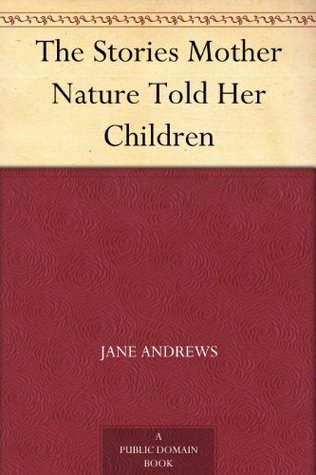
The Stories Mother Nature Told Her Children
The Stories Mother Nature Told Her Children is a children’s book by Jane Andrews, first published in 1888, the year after her death. Andrews, who lived from 1833 to 1887, was an American teacher and writer who produced several successful educational books for primary school children during the second half of the nineteenth century. The Stories Mother Nature Told Her Children is one of her later works and one of the most enduring of her efforts at natural history teaching for the youngest readers.
The book uses the framing device suggested by the title. Mother Nature herself is presented as a kindly storyteller who gathers her many children, the various creatures and natural phenomena of the world, around her and tells them the long histories of how the earth came to be as it is. The book is organized as a series of these stories, each focused on a particular natural subject. There are stories about the formation of the earth, about the origins of the oceans, about the slow growth of mountains, about the various kinds of weather, about the lives of plants and animals, and about the particular pleasures of the natural year as it passes through the seasons.
The scientific content is presented at a level appropriate for primary school children, with the kind of simple narrative explanations that the youngest readers could follow. Andrews drew on the popular natural science writing of her period, particularly the geological and biological works that had become accessible to general readers in the decades after Darwin, and she presents what was then known about the natural world in a form that would have been new and exciting for children encountering these ideas for the first time. The treatment is reverent toward nature throughout, in the tradition of nineteenth century natural theology that found religious meaning in the order and beauty of the created world.
The book is short, perhaps two hundred pages in the typical printing, and is meant to be read aloud to young children or to be used as an early reader. Some of the scientific content is now out of date, particularly the geological time scales and the assumptions about evolutionary processes that have been substantially revised by later science. But the basic narrative warmth of the book has kept it in print sporadically for more than a century. It pairs naturally with Andrews’s earlier The Seven Little Sisters and with the broader nineteenth century natural history literature for children.
About the Author
Download free books by Jane Andrews on BDeBooks. Read Jane Andrews’s works online or download as PDF/EPUB · part of our growing free eBook collection.
See all books by Jane Andrews →
Listen to The Stories Mother Nature Told Her Children Audiobook Free
Listen to The Stories Mother Nature Told Her Children by Jane Andrews free online. The full audiobook (2 hr 25 min, 14 chapters, read by volunteer narrators) streams free on this page.
The Stories Mother Nature Told Her Children (1888) is a public domain work.
| # | Chapter | Length | |
|---|---|---|---|
| 1 | The Story of the Amber Beads | 7:22 | |
| 2 | The New Life | 5:48 | |
| 3 | The Talk of the Trees That Stand in the Village Street | 6:51 | |
| 4 | How the Indian Corn Grows | 6:48 | |
| 5 | Water-Lilies | 5:54 | |
| 6 | The Carrying Trade | 12:15 | |
| 7 | Sea-Life | 29:32 | |
| 8 | The Frost Giants | 12:46 | |
| 9 | How Quercus Alba Went to Explore the Underworld | 13:18 | |
| 10 | Treasure-Boxes | 7:04 | |
| 11 | A Peep Into One of God's Storehouses | 17:16 | |
| 12 | The Hidden Light | 4:27 | |
| 13 | Sixty-Two Little Tadpoles | 8:43 | |
| 14 | Golden-Rod and Asters | 6:42 |
Prefer reading? Read The Stories Mother Nature Told Her Children online free or download the PDF and EPUB above.