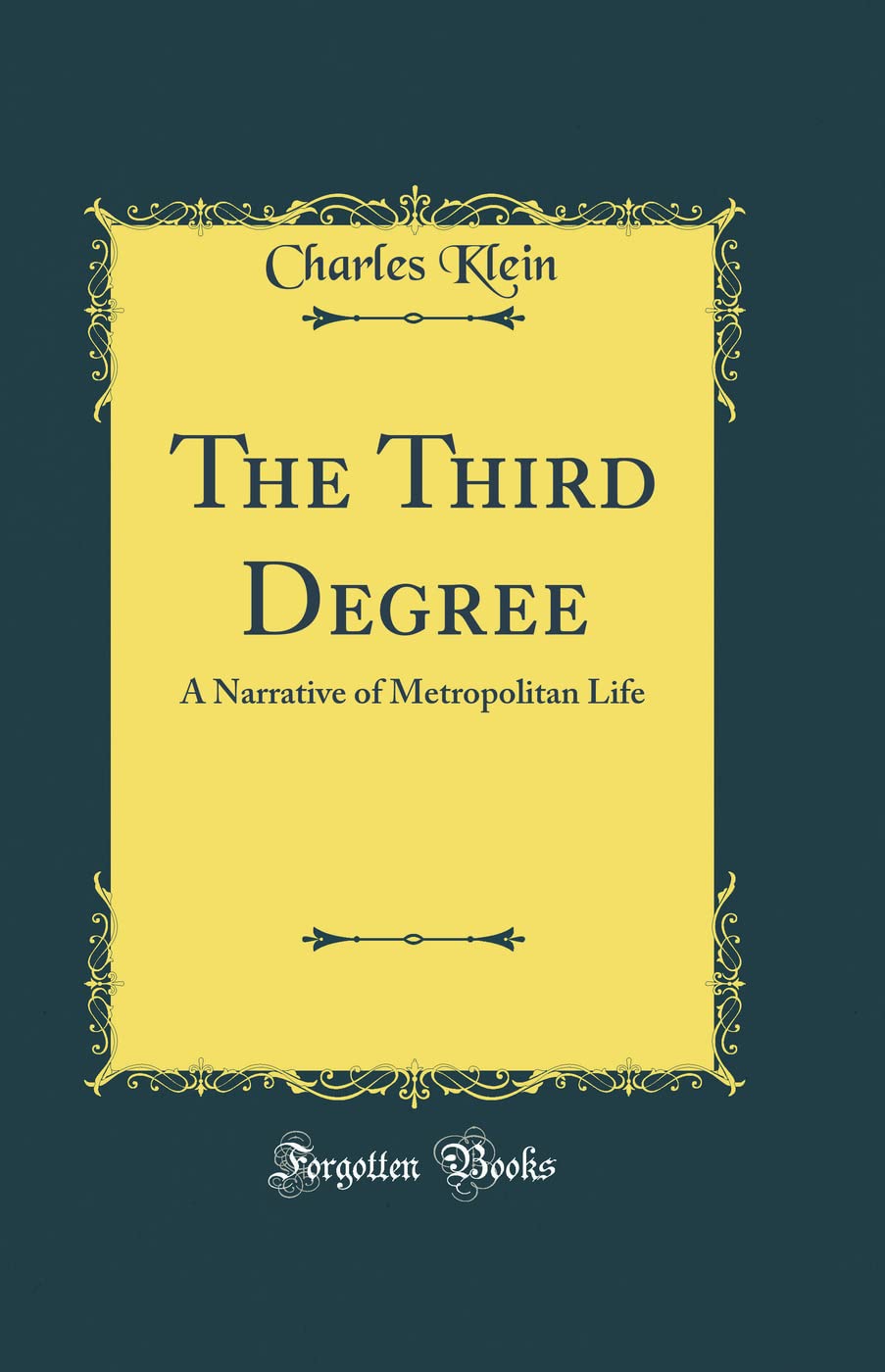
The Third Degree
The Third Degree is a play by Charles Klein, first produced on Broadway in 1909 and later novelized by Klein and Arthur Hornblow. Klein, who lived from 1867 to 1915, was an English born American playwright who became one of the most commercially successful dramatists of the early twentieth century. The Third Degree was one of his major hits during the period after The Lion and the Mouse had established him as a leading writer of socially conscious popular theater.
The title refers to the police interrogation practice known as the third degree, the use of prolonged and abusive questioning to extract confessions from suspects. The practice was widely known and widely condemned in early twentieth century America, and Klein’s play was one of the better known popular treatments of the subject. The play dramatizes the case of a young man falsely accused of murder who is subjected to the third degree by police interrogators and who confesses to a crime he did not commit. The play follows the efforts of his fiancée and her family to establish his innocence and to expose the police methods that had produced the false confession.
Klein combined melodramatic plot with serious social commentary in the manner that had served him well in The Lion and the Mouse. The progressive era audience that had responded to his earlier treatment of corporate corruption responded equally to his treatment of police abuse. The play tapped into the broader progressive era criticism of the criminal justice system and the various reform movements that were beginning to push for limits on police interrogation practices, for stronger defense rights, and for the kind of procedural protections that would eventually become standard in American criminal law during the twentieth century.
The novelization preserves the basic plot and dramatic structure while expanding the descriptive and psychological material that the play form had compressed. The book is essentially a piece of early twentieth century social problem fiction in the popular vein, with the kind of clear moral framework and dramatic resolution that the audience of the period expected. It is not subtle but it is effective on its own terms.
The book is of moderate length and reads quickly. For readers interested in early twentieth century American popular theater or in the progressive era criticism of the criminal justice system, this is a useful primary document. It pairs naturally with The Lion and the Mouse and with the broader progressive era reformist literature.
About the Author
Download free books by Charles Klein on BDeBooks. Read Charles Klein’s works online or download as PDF/EPUB — part of our growing free eBook collection.
See all books by Charles Klein →