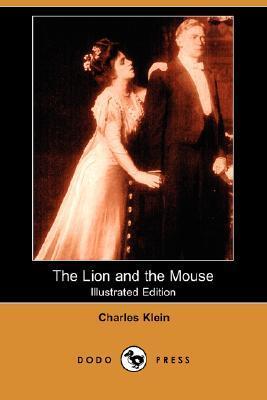
The Lion and the Mouse
The Lion and the Mouse is a play by Charles Klein, first produced on Broadway in 1905 and later novelized by Klein and the journalist Arthur Hornblow in 1906. Klein, who lived from 1867 to 1915, was an English born American playwright who became one of the most commercially successful dramatists of the early twentieth century before his death in the sinking of the Lusitania in May 1915. The Lion and the Mouse was his greatest hit and one of the most successful American plays of the early twentieth century.
The play is set in the financial and political world of the late nineteenth and early twentieth century United States, in the era of the great corporate trusts and the muckraking journalism that exposed their abuses. The lion of the title is John Burkett Ryder, a vastly wealthy and ruthless financier modelled openly on the figure of John D Rockefeller. The mouse is Shirley Rossmore, a young woman whose father, a federal judge, has been falsely accused of corruption and whose career and reputation are being destroyed by the financial powers that Ryder represents. Shirley sets out to clear her father’s name and the play follows her elaborate scheme to gain access to Ryder’s household and to obtain evidence of the conspiracy against her father.
The play combines melodramatic plot with serious political commentary in the manner that defined much of the popular American theater of the early twentieth century. The progressive era saw considerable public interest in exposing the abuses of the great corporate combinations, and Klein’s play tapped directly into that interest by presenting the conflict between concentrated financial power and individual justice in dramatic personal terms. The play was both popular entertainment and a vehicle for the kind of reformist political message that progressive era audiences responded to.
The novelization preserves the basic plot and characters while expanding the descriptive and reflective material that the dramatic form had necessarily compressed. The book runs about three hundred pages and reads as a brisk piece of early twentieth century commercial fiction with a clear social message. For readers interested in early twentieth century American popular theater or in the progressive era political and cultural climate, this is a useful primary document. It pairs naturally with the muckraking journalism of Ida Tarbell on Standard Oil.
About the Author
Download free books by Charles Klein on BDeBooks. Read Charles Klein’s works online or download as PDF/EPUB — part of our growing free eBook collection.
See all books by Charles Klein →