
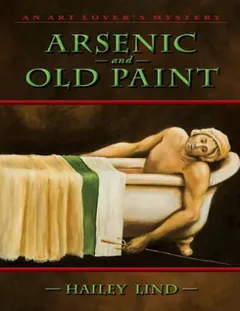
Arsenic and Old Paint
''Then it's well past high time.'' He…
Este capítulo es largo, así que está dividido en 3 partes.
''Then it's well past high time.'' He tsk-tsk ed, and handed me a glass of ruby red Rioja. We clinked glasses.
''To your love life,'' he said with a wink.
''To yours,'' I replied. Anton laughed heartily.
Lately Grandfather and his cronies had been waging a none-too-subtle campaign to marry me off. I wasn't certain of Georges's motives, since he also maintained I would come to my senses one day, chuck the boring law-
abiding life, and move to Paris where he and I would forge beautiful art together in his atelier in the Place des Vosges. But I suspected Georges was hoping that if I did crank out a passel of kids at least some of them would inherit the LeFleur art-forger gene. And should Michael—whom Georges adored—be the father of said children, they'd also lack a moral center.
They'd be perfect, in other words.
''How did you get in?'' I asked.
''Ah, Annie! You are so droll!'' Anton did legal art restoration these days, but in his prime—and in his heart—he was an unrepentant forger like Georges. Breaking into my dead-bolted third-floor apartment was child's play to my uncle's ilk.
''It's been a long time,'' I said.
''That it has, that it has. Georges will be so pleased to learn of our visit!''
''Have you heard from him recently?''
''I've been reading his blog. Don't worry, he sounds his old self.''
''Oh, I'm not worried.'' It would take a speeding Mack truck to fell my septuagenarian grandfather. I just hoped it was genetic.
I was surprised Anton had found enough pots and pans to work his culinary magic. I noted a cardboard box that he must have toted in. He had brought his own special paella pan, and a number of other items, including a chipped mug emblazoned LE PREMIER ARTISTE DU MONDE , or
''world's best artist.'' I had made it for him in Paris when I was sixteen, when Anton, Georges, and I had spent our days ''aging'' paper and canvases, and our evenings strolling along the Seine as the men vied to tell the most outrageous tale of international intrigue and daring. Did Anton always carry the mug with him? Or was this a none-too-subtle reminder of our shared past, and the importance of loyalty?
The kitchen was a disaster area, and I wondered why good cooks seemed to think the dishes cleaned themselves. Still, the whole place smelled great. Saffron and olive oil and shrimp and sausage. What's not to like?
''What are you working on these days?'' I asked as I set out two places.
''A little of this, a little of that. Restoration mostly. It is very boring work—a child could do it.'' I noticed splotches of paint on his hands, and a streak of vermilion on his bald head.
''I doubt that. By the way,'' I began, real casual-like, while I fussed with the silverware, ''did you happen to forge the Gauguin the New Zealander's looking for?''
Anton spilled the olive oil he had been pouring into a shallow saucer, swore under his breath, and sopped up the mess with a paper towel.
''Cut up that baguette, will you, Annie?''
I did as he asked, but kept one eye on him. Anton had never before dropped by to cook me dinner; in fact, he had never come to my apartment without an invitation. He was right; we were practically family and did not stand on ceremony. Still, his out-of-the-blue appearance was cause for concern. Anton had something to tell me. But he needed to butter me up first.
We sat at the table and served ourselves. I let the richness of the saffron rice and olives bathe my tongue. Besides being delicious, paella is a feast for the eyes. I remembered Anton telling me that the deep orangey-yellow saffron, a subtle spice gathered from the stamens of crocus flowers, was a component of traditional paints. When mixed with egg yolk, it was often used by medieval painters to imitate gold gilding.
After taking the edge off my hunger, I sipped my wine, sat back, and contemplated my faux uncle.
''A man was murdered at the Fleming Mansion today, and the scene was arranged like David's Death of Marat. Ring any bells?''
Anton paled. ''I never cared for the Neo-classicists.''
''It's better to talk to me now than to be questioned by the police later.''
He snorted. ''It would break your grandpapa's heart to learn you are with the FBI!''
''I'm not with the FBI,'' I insisted, though I couldn't suppress a visual of myself as a muy macha, gun-wielding Special Agent. I sort of liked it. Plus, I imagined FBI agents had health insurance. Maybe even dental. ''This is about murder, not art. At least, that's what I thought—until someone suggested you might be involved.''
''I am not involved in murder, Annie.''
''I never thought you were. How are you involved?''
''I have done occasional restoration work for the club. Also, I painted a charming reproduction for a Fleming-Union member, many years ago.''
''How long ago?''
''Five, maybe seven years. I don't remember; time passes so quickly at my age that—''
''And this is the copy that showed up at auction recently? The one the Kiwi insurance guy is looking into?''
''Ah, you met him! Such a charming fellow. Smart, too. Interesting people, the Maori.'' He waggled his bushy eyebrows. ''He's single, you know.''
''Anton, just tell me: did you paint the forgery that came up at auction?''
He just stared at me, lips pressed together in a stubborn line.
''Might as well 'fess up. I'll know the moment I see the painting in person.''
''There's nothing illegal about copying a painting.'' He muttered in Polish, took a sip of wine, and sighed. ''It wasn't supposed to go into circulation. Believe me when I say this. My client was forced to sell the original but insisted he would keep my copy at home. He did not want to lose face in front of his friends by admitting he had to sell.''
I'd heard that one before. ''So your client was a 'he,' then. Was it Victor Yeltsin?''
''I can't say, Annie. You know that.''
Anton and Georges were Old School forgers, which meant they lived by a strict code of personal and professional ethics that often baffled outsiders. The men were, after all, criminals. Near the top of the list, just below ''What Happens in thy Studio Stays in thy Studio,'' was ''Thou Shalt Not Squeal on thy Employer.''
''But you're positive there was a genuine Gauguin?''
''Of course! She lived with me for more than a month while I worked.
A rare beauty. I could have stared at her forever....'' Anton's expression was wistful, as though recalling a bittersweet romance. Passion such as this puts the ''love'' in ''art lover.''
''Who did he sell the original to?''
''All I know is that it was someone discreet. I did think...''
''What?''
''I got the impression at the time that selling the painting was part of another deal, perhaps a trade rather than a sale, and that he needed the insurance money.''
''And the secret message?''
''The client asked me to write it. To distinguish the copy from the original, I presume. I also acquired for him an EDXRF.''
''An EDXRF?''
''Annie, I'm surprised at you.'' He gave me a disappointed look, as though the acronym were as common as toothpaste. ''An energy-dispersive X-ray fluorescence spectrometer. So he could see the message on the spot, not confuse the two paintings.''
''Did you tell all this to Jarrah Preston?''
Anton looked shocked. ''He's practically a police officer!''
''Then why did you refer him to me?''
''Listen, Annie, I'm leaving town tomorrow. Wonderful news, my daughter is having a baby.''
''Congratulations. But—''
''I am to be a grandpapa! Oh, to think that my dear sweet grandchild might one day turn out as well as you, my dear. That would be the greatest of blessings indeed. How I have envied Georges his relationship with you, his granddaughter.''
Even though I knew full well that Anton was manipulating my emotions, and none too subtly at that, I got a little choked up. ''You deserve all the best, Anton.''
''I think I do.''
''Now will you answer my question? Why did you refer Preston to me?''
He waved a hand airily. ''I assumed you would recognize my work, keep my secret, and find the real Gauguin. I thought you might as well get paid for it. Your old Uncle Anton is always looking out for you, eh?''
''The only surprise is that I was surprised.'' I reached for more paella.
Anton looked at me sternly. ''It is critical that you find the missing Gauguin, Annie. I cannot bear to think it might disappear forever. ''
''Yeah, that's me all right,'' I said glumly; as good as it was, paella did not have the magical frustration-fighting abilities of chocolate. ''Annie Kincaid the First, Finder of Lost Art.''
OceanofPDF.com
6
Dear Georges: Is it true that some of your forgeries sell for millions of dollars?
Dear Reader: Yes. But if I tell you which ones they no longer will.
—Georges LeFleur, ''Craquelure''
After Anton left, I knelt on my living room floor beside my stack of old newspapers. Digging down a couple of weeks' worth, I found what I was looking for: the front page article on the Odibajian brothers.
According to the reporter, the two had built an empire together, riding to unthinkable wealth on the wave of real estate fever that clutched the San Francisco Bay Area over the last two decades. With the kind of money-making intuition that always eludes folks like me, they had diversified just in time to keep the bulk of their assets safe in the recent economic decline.
They now had significant investments in the pharmaceutical industry, oil concerns, and several lucrative high-tech startups, besides owning a good section of San Francisco's downtown. They were important benefactors to the San Francisco Opera, the symphony, the Legion of Honor and de Young museums. They'd bought the naming rights for the baseball stadium next year.
But the brothers had developed certain ''irreconcilable differences''—
differences in management style, it said here—and were untangling their assets. I got the distinct impression that the elder, Balthazar Odibajian, ran the show. He was the one who gave the majority of the quotes, and in the color photo of the two brothers ''in happier times'' he was slightly ahead of Elijah, looking larger, more confident, unsmiling. Elijah's face was hard to make out, looking off in the distance.
Another, smaller black-and-white photo showed Balthazar Odibajian standing with a crowd of well-dressed men and women whom I assumed to be the city's upper-crust party-goers. Balthazar had his arms draped casually around two glossy, well-endowed women, one on either side. Despite the arm candy, he looked unrelentingly stern.
So Balthazar Odibajian and Victor Yeltsin were ''brethren'' at the Fleming-Union. Maybe Victor knew Elijah through his brother, and had sold Elijah the Gauguin five years ago, giving him the copy instead of the real one. Then Elijah, under financial pressures because of the rift with his brother, decided to sell. And only then did he realize the painting was a fake. So could the man in the tub be Victor Yeltsin, killed by Elijah in a fury? And what happened to the genuine painting?
I glanced at the clock: 11:30. Too late to call Jarrah to see whether he'd managed to track down Elijah. I'd check in with him in the morning.
I tore out the Brothers Grimm article and put it into the case folder Jarrah Preston had given me, then took the folder into bed, fully intending to read up on one Victor Yeltsin. I flipped through the papers for all of five minutes. Police reports will put a person to sleep faster than a pill.
* * *
A friend of mine moved from New York City to the Bay Area last year and the first time he experienced what we locals call Casual Carpool, he called a New Yorker friend to exclaim that strangers were crawling into other strangers' cars, and it wasn't even something normal like a carjacking.Casual Carpool is a unique Bay Area answer to inadequate public transportation. San Francisco-bound drivers want to avoid the Bay Bridge toll and the most congested traffic lanes by using the ''diamond'' carpool lanes, which require three passengers on the bridge—except for two-seaters like my truck. Passengers, meanwhile, wish to avoid the cost of gas and parking, or BART or the bus. Riders wait at designated Casual Carpool spots, and drivers pick them up to cross the bridge. Simple as that.
This morning there was a long line of cars outnumbering riders. The aroma of my Peet's French roast permeated my truck's cab as I waited, creeping along in line as cars picked up two passengers at a time.
I had already called ahead to Spenser Keating at Mayfield's auction house. I would go straight there to assess the ersatz Gauguin, even though I knew it must be Anton's forgery. I doubted it would give me any more information than Anton had himself, but I had to look at it in person, and while I was there I would see if I could learn anything more from Keating about Elijah Odibajian. I had even dressed as a respectable professional for the meeting: straight skirt, silk tank, soft cardigan sweater.
Anton said he was going to drop out of sight for a while. That was good; one fewer thing to worry about. On the other hand, one more thing to
try to keep from Inspector Annette Crawford, who, while she wasn't out to get me, wasn't the sort to turn her back on an obvious act of larceny either.
With regard to the SFPD, my basic game plan was to avoid contact for the next few days until I figured a few things out.
Too bad I wasn't on better terms with Annette—or with anyone in the police department. I would love to know how things were progressing with the murder investigation.
I pulled ahead one more spot, starting to chafe at the delay. Why are there always more cars than riders, or the other way around? The law of averages would suggest that it even out, at least some of the time, shouldn't it?
Actually I had no idea what the law of averages said. Math was never my strong suit.
I placed a call to Elena Briones. I hated to talk while driving, but there wasn't any driving going on at the moment.
''Elena? It's Annie. I was just wondering whether you had an update on Destiny's situation with the police.''
''Actually, it looks as though she's going to be released today.''
''Already? Good job.''
''It's not anything I can take credit for. They made some assessments having to do with the body and the crime scene, and let her go.''
''What kind of assessments?''
''All I know is, the sword seems to have gone in postmortem. The most she'll be charged with is 'unlawful handling of a deceased individual.' ''
''Why would she stab a corpse?''
''She didn't stab anything,'' Elena, the lawyer, said in no uncertain terms. ''She was trying to pull it out.''
''Oh. Right. Thanks a lot for helping her out. I owe you.''
''No problem. All my clients should be so easy. But if she can't pay the bill, I'll send it on to you.''
She wasn't kidding. Unlike Pedro, Elena was very pragmatic when it came to her professional services.
I craned my neck to look down the street, hoping for more pedestrians to show up, briefcases in hand and ready to be productive members of society by shuffling money around from one account to the next. I've never figured out how the money ever does anything useful, but that probably
explains why I never seem to have any at hand. As Michael would say, I don't grasp the fundamentals of capitalism.
Speaking of whom, I tried Michael's cell phone again. No answer. No surprise.
If he disappeared for another week, I was calling the FBI on him. For real this time.
I called Jarrah Preston to see if he had made any headway with finding Elijah Odibajian, but he didn't pick up either. I left a message and asked him to get back to me.
Finally, I got to the head of the line. My turn to pick up the next passenger. I fiddled with my new Bluetooth device, which always made me feel like a cyborg, not even looking up as a suit-clad executive climbed into the cab of my truck, snapped open the San Francisco Chronicle's business section, and disappeared behind the newspaper. This was par for the course at Casual Carpool, where too much social interaction was generally frowned upon.
By the time we reached the toll plaza I noticed the man in the passenger seat smelled good. Really good. I'm not a cologne girl, but despite this–or perhaps because of it—I notice when men smell inordinately good. Must be a vegetarian.
There was a brief delay at the metering lights regulating the entrance to the bridge, so I tried calling Michael one more time. My passenger's phone also rang. I rolled my eyes at our brave new high-tech world, where we're more likely to chat with someone miles away than with the person sitting next to us. The businessman answered his phone just as Michael finally answered his.
''Hello?'' the executive said as I heard Michael say, '' Hello?''
I looked to the right. The executive looked to the left.
I cursed.
''You're not exactly a morning person, are you?'' Michael smiled.
''How did you manage...never mind. Listen, partner, we have to talk.''
We made it through the carpool metering lights to the span, then screeched to a halt once again.
''So talk.''
''Why are you dressed like that?''
''That's what we 'need' to talk about? My wardrobe? Whatever you say.
This morning I'm wearing an amusing little ensemble, a summery wool
neither too heavy nor too light, but appropriate for all venues, from bedroom to boardroom to ballroom—''
I snorted. ''You look like you're attending a funeral.''
''I'm heeding your words of wisdom and am taking seriously my responsibilities as a small-business owner. We entrepreneurs are the backbone of this country, the epitome of the American dream. It is by the sweat of our lowly brows that this great nation was built. Do you know, we self-employed small-business owners pay ten times as much in federal taxes than all the corporations in America combined?''
''No, we don't.'' We rolled ahead at five miles per hour, still only halfway across the first span. It was going to be one of those mornings that drove otherwise rational commuters to fantasize about rocket launchers and jetpacks.
''You got me. I made that up. You're looking pretty spiffy yourself today, partner.''
''Michael, cut the bull. You owe me an explanation. Where were you last week?''
''On a business trip.''
''What kind of business trip? You mean business as in your old business, as in stealing something?''
He frowned at me. ''Annie, I'm hurt.''
''Not half as hurt as when I finish with you—or more precisely, the feds finish with you—if you're back to your old ways.''
He leaned back against the door.
''You want the truth?''
''It would be so refreshing.''
''I had some family business to attend to.''
''Family? What kind of family?''
''What do you mean, what kind of family? I didn't think there were that many options.''
''Flesh-and-blood family?''
''Yes.''
''The people you share your DNA with?''
''Is 'family' a difficult concept for you?''
''Huh.''
''What's that supposed to mean?''
''It's just—nothing. So, where does your family live?''
''All over.''
''What did they need from you?''
''It's personal.''
First he mentions a mother, and now a personal life. Next thing you know the man would turn out to be a real person instead of a demi-god, and things would really spin out of control. I had an intense craving for chocolate.
After a brief pick-up in speed, the traffic slowed to a standstill again.
Out the window Alcatraz Island and the Golden Gate Bridge shimmered in the morning light. My eyes fell upon the dozen bright red mechanical cranes that were supposed to be rebuilding the eastern span of the Bay Bridge, though they never seemed to be in operation. The Bay Bridge is actually two bridges: the western span connects San Francisco to Yerba Buena Island, and the eastern span reaches from there to Oakland. San Francisco's half is attractive and in good condition. Oakland's half is ugly and seismically unsafe. A chunk of it fell during the last significant shaker.
Many Oaktown boosters find this symbolic, and more than a few whisper of conspiracies. Usually I'm happy to jump aboard the victimization bandwagon, but I find it hard to embrace conspiracy theories.
In my experience, people are too self-centered to organize a decent block party, much less pull off a successful conspiracy.
''Maybe you should stop disappearing,'' I said, sipping my coffee. ''It makes me question your reliability.''
He laughed and reached over with his left hand to smooth my hair, letting his hand rest on the back of my neck. ''I am many things, Annie.
Reliable is not one of them.''
''I know, I know. If I want reliability I should marry Frank.''
''I sure as hell wouldn't go that far. In fact, about your golden boy Frank—''
''I already know your feelings toward the man, Michael. My point is, this is your chance. Your shelf life as a thief is limited, you know. Surely you must be on your third strike by now. This is California. Despite our loosey-goosey reputation, we put people away for life for stealing candy bars on their third strike in California.''
Traffic picked up and we zoomed through the tunnel at Yerba Buena Island.
''Shocking,'' Michael said. ''Then again, sometimes you feel like a nut....''
''I'm serious.''
''Careful, Annie. It almost sounds like you care.''
''I...''
''Take the Embarcadero exit,'' said Michael as we reached the foot of the bridge and entered San Francisco.
''Here? Why?''
''I have a lead on Hermes. We have to talk with some folks.''
''I don't feel like it. I don't like those clubby types, and they don't like me. I want to do something fun, like work on the sketches for my clients'
living room. Besides, I have to go by Mayfield's to check on the Kiwi's painting.''
''This will be quick. And it's practically on the way. And need I remind you, you're the one who accepted this job.''
I pointed the truck toward one of the last affordable neighborhoods in San Francisco: Bayview–Hunter's Point. Crime rates are high, drug use rampant. On the up side, there is plenty of parking. I followed Michael's directions and pulled up in front of a run-down, two-story apartment building painted a bilious Pepto Bismol–pink that reminded me of the repurposed Motel 6 where I had lived in my senior year at college. The downstairs apartments opened onto the parking lot while the upstairs ones opened onto a covered walkway. In front of the former motel office was a small, kidney-shaped pool that had been emptied of water and filled with trash and broken furniture. A dusty neon sign with a palm tree declared the place to be ''Aloha Court,'' though based on the number of crack vials littering the premises, ''Sayonara City'' seemed more apt.
''Who—or what—are we looking for?'' I asked.
''I ran the license plate number the homeless guy gave us,'' Michael said, handing me a slip of paper with a name and address.
''The truck's owner is 'Perry Outlaw'?'' I said, reading. ''You have got to be kidding. A man named 'Outlaw' becomes a criminal? If he had any sense of irony at all he'd have become a judge.''
Michael chuckled as we climbed out of the truck.
''You guys cops, or Social?'' a scrawny young woman called out to us, and I surmised our business-themed attire screamed ''outsider.'' She was
dressed in jeans and a bright yellow T-shirt, her shaggy hair an unnatural arterial-blood red with dark roots.
''Something we can help you with?'' Michael asked.
''Bitch stole my money!'' she fumed, flinging her arm toward the squat building. ''Apartment Two.''
''What happened?''
''I gave her twenty bucks and she gave me a hunk of plaster!'' On her outstretched palm sat a small white chunk of plaster. We looked at it, at her, and then at each other.
''What do you want us to do about it?'' I asked.
''Get my money back!''
''You think we're cops, and you want us to get your drug money back?''
I said, not sure I'd followed the conversation.
''Hey, she stole my twenty bucks! This is America! Do something!''
''I'm afraid we're on another case, ma'am,'' Michael said. ''But if you'd like, I'll be happy to call in some backup and you can explain to the nice officers that you want your drug dealer arrested for selling fake crack cocaine.''
The woman stared at us, mouth open, before turning away with a look of pure disgust.
''I think we've shattered her faith in the system,'' I said softly as we walked away.
''That's what she gets for seeking justice from a forger and a thief,''
Michael replied.
'' Former forger.''
'' Former thief.''
''Fine.''
''Good.''
We shared a smile.
''So how do we handle this?'' I asked.
''Let me lead. I'll be the bad cop. Jump in when you think you should.''
''Okay, but be careful—impersonating a police officer actually is a crime.''
We reached Apartment Six, on the ground floor, and Michael knocked briskly. A skinny, pale young man in his early twenties answered, dressed in nothing more than a pair of tighty-whities that were more gray than white.
After my initial impression I tried very hard not to look.
''Perry Outlaw?''
''Who wants to know?''
''I'm Johnson. This is Kincaid. We'd like to ask you a few questions.''
''You from Social?''
Michael inclined his head.
Outlaw stepped back and we walked into an apartment that looked like a cheap motel room: to the left was an unmade double bed flanked by a pair of generic faux-wood nightstands, and to the right a dresser was pushed up against the wall. Atop the dresser a television set was chained to a bolt in the wall. The floor was carpeted in the common brown-and-tan mottled shag favored by tightwad landlords wanting to disguise suspicious stains.
The room smelled of stale cigarette smoke, fried chicken, and spoiled milk.
A thin blond woman, resembling a strung-out Kate Moss with bad skin, perched on the room's only chair, a towheaded toddler in her lap. The child pointed a bright green laser-type gun at us and pretended to pull the trigger.
''We're doin' okay,'' Perry said. ''Erin's just fine, aren't you, sweetie?''
I smiled at the child, who turned back to the cartoons that nipped and squawked on the TV.
''That's not a real gun or nothin','' Outlaw said ingratiatingly. ''Her uncle gave it to her on account of she wouldn't stop crying. But it don't shoot nothin'. Listen, we're clean,'' he insisted, dropping his voice but speaking in a determined tone. ''Ever since Melissa got outta jail the last time, we been on the straight and narrow, swear-to-God. I know this place don' look like much but—''
''Where were you last Monday night?''
''Monday?''
Michael nodded.
''I...uh...let's see. I guess I was here. Yep, I was here. I come home straight after work.''
''When's the last time you were on Nob Hill?'' Michael asked.
''Downtown?''
Michael nodded.
''Nah, man, not for years.'' He shook his head.
''Your truck was seen there.''
''Ah, maaaaan.'' Outlaw clutched at the top of his head with both hands and blew out a breath in a dramatic move. ''I told those dudes to stay clean.
What'd they do?''
''There was a sculpture stolen.''
''Naaaah, dude, they just borrowed my truck.''
''Who?''
''Dude, I don't even know, man,'' Perry moaned.
''Listen, bud,'' I said. ''Your scumbag friends stole an extremely valuable sculpture that belongs to someone with a whole lot of juice and not much patience, understand? If we don't get it back for him the legal way, he'll hire someone who will get it back the hard way. A real sick S.O.B., let me tell you. ''
Michael looked amused, and I remembered I was supposed to be the good cop.
Outlaw looked genuinely stricken. ''I'm telling you, they just borrowed my truck! I had nothin' to do with it, I swear!''
''Names and addresses. Now.''
He continued to protest as he wrote down the information. ''I got me a job, a legitimate job. Don't pay much, but I'm legit. Here.''
He handed Michael a piece of paper with two names, Alan Dizikes and Skip Goldberg, and an address in Crockett, a small city on a northern finger of the bay about half an hour's drive.
''Hey, I can't get in trouble for lendin' them the truck, right?'' Outlaw pleaded. ''I didn't know what they was up to and I wasn't there, man. Hey, maybe I got somethin' you could use for another case. Go ahead, ask me anythin'.''
''We're just interested in the sculpture, Mr. Outlaw,'' Michael said. ''Any idea what they'd do with a sculpture like that?''
Outlaw rubbed his jaw, the stubble making a skritch ing sound. ''Sell it.
Ain't like none of them wants it for his garden.''
''Sell it where?''
''Dude, anywhere they can.''
''Anything else?'' I asked. ''Now's your chance to do the right thing.
Because if I find out you held out on us, I'm gonna take that as a personal insult. Johnson, tell Mr. Outlaw here what happened to the last lying low-life who insulted me.''
''Well, now, that's hard to say, seeing how the body was never found.''
Outlaw's jaw dropped, but no sound came out.
Michael handed him a business card. ''You think of anything else, just give me a call.''
''Sure. Sure I will. You can count on me.''
Michael and I walked in silence to the truck. The sights and sounds of the Outlaw apartment had given me a dull headache and a nauseated feeling in the pit of my stomach. I felt the urge to go paint. Yes, I whined about the pitiful state of my bank account, but as an artist I could consider myself bohemian rather than just plain poor. Aloha Court was depressing.
''I don't think I'm cut out for this investigating gig,'' I said, climbing into the driver's seat and leaning across to unlock the door for Michael.
''First snooty club types, now this. How can people live like that? And with a kid? Maybe my grandfather's right. Maybe I should go back to forgery.''
''They're not as bad as some. At least they're trying, and that counts for a lot. So: off to Crockett? We could swing by Mayfield's first.''
''I don't know...maybe we should split up on this one.'' I pulled onto busy Third Street. ''We could get more done.''
''It's more fun together,'' Michael said. ''Besides, you just want to go hide in your studio and paint. Admit it.''
''That is still my main job, you know.''
''You've seen how lucrative some of these gigs are, Annie. We wrap this one up, plus that Gauguin gig, and you'll be able to put money down on that new truck you keep talking about.''
My cell phone signaled an incoming call with an electronic version of Flight of the Bumblebee, which Mary put on it last month after I demanded she remove the annoying rap tune she had previously uploaded. Rooting around for my Bluetooth was enough to make me frantic; the frenetic music was not helping.
''Hello?'' I answered, barely evading the switch to voicemail.
''Annie? It's Jarrah Preston.''
''Hi, Jarrah. Thanks for calling back. I wanted to ask you—''
''Listen, Annie. I don't know if you've heard but your uncle Anton,''
Preston interrupted. ''Anton Woznikowicz—''
''Has he been involved in something? Is he in trouble?'' Lord, I had known something was going on. Damn. I just hoped the bail wasn't set too high, because I really needed to buy that new truck.
''I'm sorry to have to tell you this, Annie. I stopped by his place this morning and found him on the floor. He's been poisoned.''
OceanofPDF.com
7
The history of paint is the history of poison, judiciously applied.
—Georges LeFleur, ''Craquelure''
''He hasn't been able to tell us what happened.'' Jarrah greeted me when I burst into the ICU waiting room at San Francisco General. Michael had gone to park the truck after I jumped out in front of the emergency room.
''When I found him he was conscious and mumbling, but just barely. The ER doctors said we have to wait and see if he regains consciousness.''
I squeezed my eyes shut. I should have done more. I should have forced Anton, at the point of a palette knife if necessary, to tell me what was really going on. And then I should have hand-delivered the nefarious fellow to his daughter's doorstep.
''What's wrong with him?''
''Here's the doctor now.''
The physician was dark-featured and petite. Notwithstanding the stethoscope hanging around her neck, the clipboard under her arm, and the spotless white lab coat, she looked all of fifteen years old.
''I'm Anton's niece,'' I said. ''I'm his only local family. What's the prognosis?''
''We believe your uncle's been poisoned,'' she said with a slight Pakistani lilt. ''It looks like arsenic.''
''Arsenic poisoning?''
''We've begun a process known as chelation, which is a way to try to rid the system of the poison.''
''How does that work?''
''We're administering a drug called dimercaprol every four hours. It's more toxic than succimer, but we don't have much choice given his acute condition. We'll do that for the first two days, followed by two injections on the third day then one a day for the next five days.''
''And what does 'chelating' do, exactly?''
''The chelating agents sequester the arsenic away from blood proteins, which is the most immediately damaging aspect of this kind of poisoning.''
''Are there side effects?''
''Sure. The most important side effect is hypertension, and possible kidney damage later. But at this point we don't have much choice. I hate to be blunt, but your uncle's condition is considered grave at this time. Given his age...well, it's not an ideal situation. It's lucky his friend found him in time. Be assured we are doing everything we can. ''
I sensed a presence behind me, and turned to see a large, square-headed man who looked like a caricature of a Polish Mafioso. In fact, he was a Polish Mafioso. Hipolit—Hippo to his friends; I could only guess what his enemies called him—was an Old School gangster, which meant he rained mayhem down upon the heads of his enemies but drew the line at their families, civilians, and cops. I wasn't sure how he and Anton knew each other—whether the connection was social, business, or cultural—but they were long-term associates. Most of the time Hippo's very existence made me nervous, but today I was glad to see him.
''I have my best man on it, Annie,'' he said, hugging me. He smelled of tobacco and Juicy Fruit gum. ''You need anything, Anton needs anything, you let me know. Here's my private line.'' He handed me a business card engraved with his name and phone number.
''Do you know how to get in touch with Anton's daughter?'' I asked.
''I've already called her,'' Hippo said. ''But she won't be able to make the trip in her condition. She's in Milan, due to have her baby any day now.''
Michael hurried in from the parking garage and put an arm around my waist. I leaned into him, grateful for his presence, and told him what I knew. He and Hippo acknowledged each other with a barely perceptible nod.
''Can I see him?'' I asked no one in particular.
''He's this way,'' Hippo replied.
A short way down the hall I spied Anton through a window. I moved to stand next to my unconscious faux-uncle, who looked small and fragile in the hospital bed. A plastic tube was taped to his mouth, he was hooked up to an IV stand, and wires and electrodes connected him to a bank of monitors that made rhythmic beeping sounds. For the first time he looked every inch of his seventy-something years.
Michael took up a position on the other side of the bed and gazed at Anton, shock and sorrow in his eyes. In my own grief I'd forgotten that Anton was a big part of Michael's world, too.
I felt rage boiling up, threatening to spill over. There was no point in hanging around the ICU. There was a would-be murderer to find. I turned to Michael, who nodded in unspoken agreement.
We walked out of the hospital into the strong late-morning sunshine.
The next thing I knew I was sitting on the curb, struggling to breathe as my head swam. Michael sat beside me and stroked my hair.
''I was with him last night,'' I said.
''It was an accident, Annie. A mistake. It happens.''
''Accidental arsenic poisoning? Tell me how that's possible. Anton knows paint chemistry better than anyone—better even than my grandfather, and he knows more than most chemists. Anton taught me himself, when I was a teenager.''
''He was also an absentminded fellow, Annie, you know that. As likely to put a tin of linseed oil on the stove to boil as the teakettle. And he's always covered in paint.''
''Arsenic doesn't work that way. It's not easily absorbed through the skin—that kind of poisoning would happen gradually, after years of exposure. The only way arsenic kills quickly is if it's ingested. We had dinner together last night, and I feel fine.''
''Perhaps he ate something else later.''
I stood up abruptly.
''Where are you going?''
''To his studio.''
''Annie, wait...''
I was already marching to the parking structure.
''At least let me drive,'' Michael said, trotting up behind me.
''Make it fast.'' I tossed him the keys.
We turned onto Anton's street in the Noe Valley neighborhood, and saw four black-and-white police cruisers, a hazardous materials truck, and an unmarked police car parked in the already cramped space in front of his house. A uniformed cop halted us at the gate to Anton's yard, and at my insistence, called over the investigating officer.
Annette Crawford.
''Annie, I'm so sorry—''
''Why would Homicide be here if this was an accident?'' I challenged without preliminary.
Annette shot a concerned look at Michael. It made me angrier.
''Homicide gets called in on special cases to assess the crime scene,''
she said, her deep voice gentle. ''It's standard procedure.''
''I want to see his studio.''
''You can't. The place was full of arsine gas. Hazmat is in there now, cleaning up so we can assess the scene.''
''Arsine gas?'' I asked.
Someone dressed in a moon-suit shouted to Annette, and she nodded.
''Listen, this isn't even my catch. I was checking out a possible link with the Fleming-Union. There have been some...developments that I need to speak with you—the two of you—about. I'll call with an update and we can arrange a time to meet, all right?''
''But—''
''Later, Annie. I promise.''
I became aware of Michael's firm grip on my upper arm, and allowed myself to be turned toward the street. Halfway down the block, beyond the clump of emergency vehicles, I spied Anton's cargo van parked at the curb.
Its tan paint was dented and scratched, its windowless sides advertised SULLY'S CARPET CLEANERS. It was the sort of vehicle that appeared unlikely to contain a functioning radio much less valuable artwork.
Glancing around to be sure the cop at Anton's gate wasn't watching, I headed straight for it.
'' Now where are you going?'' Michael said, chasing after me.
''Open it,'' I demanded as we reached the van.
''Why?''
''It's Anton's. I want to check it out.''
''Forgive me for stating the obvious, but if this wasn't an accident we should tell the cops about the van. It may contain evidence.''
''You heard Annette, Michael. They think it's an accident. No one's interested in what really happened. They're only too happy to blame the crazy old artist. Besides, even if the cops do rule it an assault, the closure rate on homicide in San Francisco is, what—thirty percent? Not good enough. Nowhere near good enough.''
''It's not a homicide, Annie. Anton's still alive, remember?''
''For now. But it was meant to be a homicide. And if anyone's going to get to the bottom of this, it'll have to be us.'' I was in a fever of needing to do something, anything. If I didn't keep going I would have to think about the fact that Anton— Uncle Anton—the talented, gossipy old artist, might
never again bug me about my love life in his funny Polish accent. ''Now, will you open the damned van or do I get a new business partner?''
Michael hesitated for a moment longer before trotting back down the street to my truck. He scrounged in back of the seat for a minute, returning to the van with a couple long strips of thin metal.
''Act as lookout,'' he said. I kept an eye on the bored cop guarding Anton's gate as he chatted on his cell phone, oblivious to the breaking-and-entering a hundred yards away. Michael slid a metal strip between the driver's door and the weather stripping and yanked up, popping the lock mechanism. It had taken at least three seconds.
''After you.'' Michael gestured.
''On second thought, let's drive around the corner so we can search it in peace.''
''No keys, love.''
''So hotwire it.''
''You want me to hotwire it?''
''You expect me to believe you don't know how to hotwire a car?''
''I know how to hotwire a damned car,'' Michael bit off, casting a glance back toward the marked police presence half a block down. He climbed into the driver's seat and started kicking at a panel under the dashboard. Leaning down, he fiddled with wires, working by touch while keeping his eyes fixed on me. ''In case you're wondering, I'm imagining what my poor parole officer will say when I'm busted for Grand Theft Auto.''
''I know exactly what he'll say,'' I replied. '' 'Practice your breathing.' ''
Breathing was a big part of Doug-the-parole-officer's philosophy of How to Fix the World and Find One's Place in It. He had explained it all to me over a vegan meal of flaxseed, tofu, and shredded carrots in a raspberry-melon vinaigrette at the Gratitude Café in Berkeley. The meal was memorable mostly because I grew weary of chewing long before my hunger was sated, which I imagine would be an excellent dieting technique.
According to Doug, the secret to inner peace was to breathe with intent, inhaling anger and exhaling compassion. Or maybe it was the other way around. I got it mixed up.