
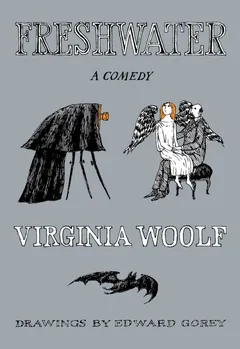
Freshwater_ A Comedy
Editor's Preface
The 1935 performance of Freshwater, a play Virginia Woolf had written twelve years earlier and then completely revised for this occasion, was one of a number of theatrical evenings that had characterized "Bloomsbury" parties since the early 1920s. These entertainments ranged from a production of Milton's Comus to varietyshow skits that could be, in Virginia's own words, "sublimely obscene." Among the earlier comedies, David Garnett recalls in his autobiography, was a play entitled Don't Be Frightened, or Pippington Park, inspired by the newspaper report of a wealthy gentleman who had molested a young woman in the park. Vanessa Bell played the victim, and the last act featured a pas de deux by Lydia Lopokova and Maynard Keynes. One play written by Quentin Bell presented his home at Charleston as an archeological ruin of the distant future, visited by tourists. Bell also remembers a comic drama in rhymed couplets called The Last Days of Old Pompeii. These performances were give11 at a number of different residences.
Freshwater appears to be one of a series of later plays staged in the mid-1930s in Vanessa Bell's London studio at 8 Fitzroy Street. Among them was a shadow play about John the Baptist, which featured a protruding severed head made by Duncan Grant out of cardboard and oozing red gelatin.
v
Vanessa's studio was L-shaped, with the spectators at these occasions seated in the long part of the L and a curtained stage extending from the short part. On the evening of 1 8 January 1935, there was evidently a full house of about eighty guests, who had come at the special invitation of "Mrs. Clive Bell and Mrs. Leonard Woolf"
to attend "Freshwater, A Comedy." The event also celebrated Angelica Bell's recent birthday.
The audience was in a party mood from the very outset and the play, which began at g:30, was pe rformed in an atmosphere of noise and levity. Clive Bell's booming voice and laughter in particular \\'Cre heard throughout the performance. Since the stage lighting was dim it was not always possible to sec, let alone to hear, what was going on. But Virginia's diary entry of the following day records her own appreciation of this "unbuttoned laughing evening." The production, however marred, as well as the writing of Freshwater, clearly gave her pleasure.
The performance room was connected by a wooden passagcvvay, roofed in corrugated iron, to Duncan Grant's adjoining studio. After the final curtain, the assembly of guests and players moved, as was the custom, down the mmbling hallway for a party in Duncan's quarters.
The party after Freshwater was predictably long and festive.
While these Bloomsbury plays were done in a jolly ambience, their preparation usually i nvolved a great deal of time and hard work for both writers and players. This was especially so in the case of Freshwater. Rehearsals for the play continued throughout the preceding summer, and even a casual study of the text shows how fully Virginia had researched the subject of her great-aunt Julia Margaret Cameron. The notes to Freshwater intend
to give only a few examples of the characteristic thoroughness with which she approached even such less serious projects.
The t wo manuscripts of the play, published here for the first time, were discovered by Olivier Bell in tg6g, a few weeks after Leonard Woolf's death. Leonard Woolf had known of their existence among the vast accumulation of papers in Monk's House, but he could not locate them when Quentin Bell first asked him about Virginia's unpublished play.
The problem of identifying these two texts is complicated by the fact that none of the surviving spectators and players interviewed could be certain which version was performed in 1935. Quentin Bell is among a number of people who received invitations but could not attend.
Having missed the actual performance staged in his mother's studio, he was forced in preparing the first drafts of his aunt's b iography to reconstruct the play from the recollection of rehearsals he had attended at Charleston. Quentin Bell's notes offer the best proof for dating at least one of the two versions, since he wrote them before his wife found the manuscripts and they record two incidents which occur only in the text beginning "Sit still, Charles." The two incidents arc Tennyson's poem on a young woman drowned and, more crucially, the scene on the beach between Ellen Terry and John Craig.
A handwritten transcription by Vanessa of her role as Mrs. Cameron, which includes a cast list, offers further proof. With one important exception (see pages 75-76) she has written down the part as we find it in the "Sit stilL
Charles" version.
Angelica Garnett recently discovered another cast list, this one in Virginia's hand, which offers a somewhat dif-
ferent and evidently more accurate Dramatis Personae (see page 3). While differing cast lists might suggest another performance of the revised play, I find no evidence that more than one ever took place.
Vanessa Bell's' notes are housed, along with the two versions of Freshwater, at the University of Sussex Library, Brighton.
Although the "unrevised" first version of Freshwater, included here in the Appendix, is somewhat harder to date, an examination of typescript and of internal references supports Quentin Bell's asser tion that it was written in 1923.
As early as 1919, Virginia states her intention to write a comedy about Julia Cameron. In her diary entry for 8 July 1923, she describes herself working vigorously on
"Freshwater, A Comedy," a welcome diversion in her struggle with "The Hours" (Mrs. Dalloway). She expects to complete the play on the next day. Six weeks later in a letter to Vanessa, Virginia expresses concern that the play is not yet finished and invites her sister and Duncan Grant to hear it read "as soon as possible." The urgency suggests a deadline and is clarified by her letter to Desmond MacCar thy, probably written in October of that same year, asking if he would consider stage-managing the play for a Christmas production. He agreed to direct Freshwater; Virginia, however, deeply involved in the writing of her novel, disappointed a number of people by deciding to abandon the production. "I could write something much better," she informs Vanessa in the late fall of 1923, "if I gave up a little more time to it: and I foresee that the whole affair will be much more of an undertaking than I thought." She was to find time to improve her play a decade later.
R eaders should be aware that the two manuscripts of viii
the play were typed rapidly and for oral presentation.
They are often without punctuation and filled with spelling and typographical errors. Obviously misspelled words have been corrected and punctuation added where the sense of the passage requires it, more extensively in inaccurately quoted verses. Where Virginia's handwritten additions and emendations are only partly legible, I have omitted them entirely. Otherwise, I have tried to reproduce the texts as they appear in manuscript.
My special thanks to Olivier and Quentin Bell, to Angelica Garnett and to Nigel Nicolson, all of whom supplied valuable information for prepar ing this edition.
My thanks also to Anita Ventura Mozley, Curator of Photography at the Stanfor d U niversity Museum of Art, for first pointing out to me how much of Freshwater is built upon fact, not fiction, and to John Graham, Duncan Grant, John Lehmann, Tom Lewis, Trekkie and Ian Parsons, Ann Jellicoe, Pat Rosenbaum, Susan Squier, Lola Szladits, and Joanne Trautmann for offering their t ime and help.
Finally, I thankfully acknowledge The University of Sussex L ibrary and the Henry W. and Albert A. Berg Collection of The New York Public Library, Astor, Lenox and Tilden Foundations, for permission to quote from u npublished Virginia Woolf letters.
LUCIO P. RUOTOLO
Monk's House
September 1975
Virginia Woolf's casting for Freshwater